


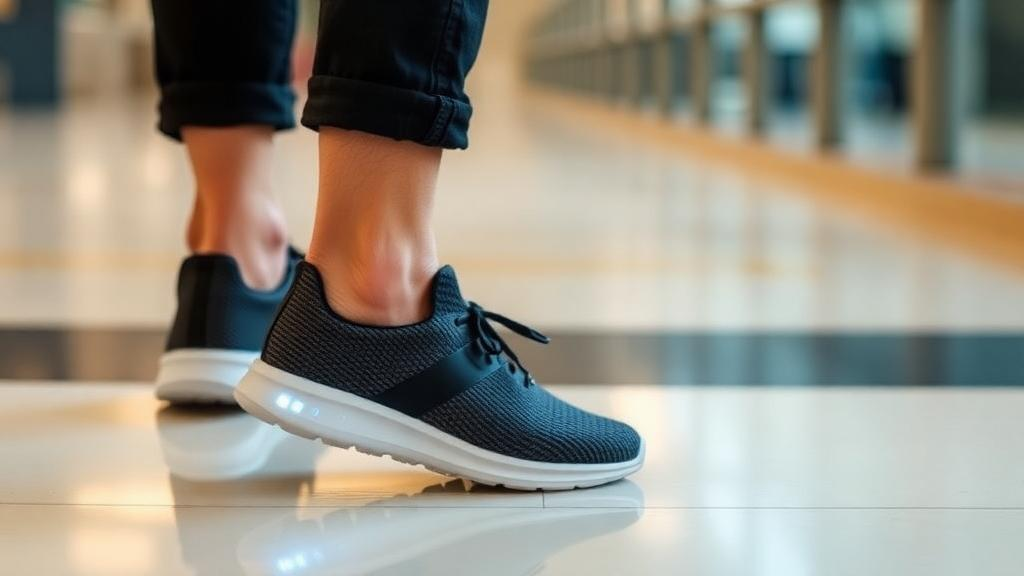
A pair of ordinary-looking white athletic shoes sitting in a laboratory at Rutgers University may represent an answer to one of the most persistent problems in wearable health technology: the battery. Engineers at Rutgers University-New Brunswick have developed a smart shoe that analyzes how a person walks without ever needing to be plugged in, drawing all of the power it requires from the simple act of moving. The prototype, described in a study published in Science Advances, counts steps, estimates calories burned, and classifies physical activity with 95.4% accuracy, all while generating its own electricity from the pressure and friction of every footfall. The research was led by Simiao Niu, a biomedical engineer and assistant professor in the Department of Biomedical Engineering in the Rutgers School of Engineering, whose team set out to build what he describes as a genuinely worry-free wearable.
The motivation behind the project came from a frustration that Niu knows intimately. Before joining Rutgers, he worked at Apple, where he helped develop an electrocardiogram sensor for the Apple Watch. That experience taught him how easily health monitoring is interrupted by the mundane logistics of charging. A device that is removed from the wrist and set on a charger may never make it back onto the body. Monitoring stops, data gaps appear, and the continuous record that makes wearable health technology valuable is broken. As Niu put it, once a wearable goes onto the charger, users typically forget about it, and those devices cannot monitor anyone’s health while sitting in a drawer. The problem is compounded by a trend in the industry: as wearables become more intelligent and artificial intelligence is used to extract meaningful findings from raw sensor data, their appetite for energy grows. Niu calls this tension the energy-intelligence bottleneck, and his team designed the smart shoe specifically to break through it.
The solution begins in the sole of the shoe, where an embedded device converts mechanical energy from walking into electricity. The underlying physics is the triboelectric effect, the same phenomenon responsible for the static electricity produced when different materials rub together. Each step generates small, irregular bursts of electrical charge as the foot strikes the ground and the materials within the sole interact. That electricity arrives in a form that conventional electronics cannot use directly, so the researchers designed a dedicated power-management circuit to convert the erratic output into a steady, usable supply. Their circuit design increased the amount of usable energy by as much as 120 times compared with a conventional method, a dramatic improvement that makes the difference between a system that can barely power itself and one that can run a complete sensing and computing pipeline.
A shoe, Niu explained, is a natural target for this kind of self-powered design because walking produces both the information the researchers want to analyze and the energy needed to analyze it. When a person sits down, no biomechanical energy is available, but at that moment there is also no gait to monitor. The symmetry is elegant: the very activity that generates useful health data also generates the power required to collect it. Gait, the technical term for a person’s pattern of walking, encompasses balance, speed, stride length, and rhythm, and scientists consider it one of the most significant biomarkers for a wide range of diseases. Changes in how a person walks can offer early clues about disease progression, elevated fall risk, or the pace of rehabilitation after injury, which is why clinicians have long sought ways to measure gait continuously rather than in brief clinical snapshots.
Today, doctors typically evaluate gait by watching a patient walk for a short time in a clinic or laboratory, an approach that captures only a narrow window of movement under artificial conditions. A wearable that could record gait over days or weeks as people go about their daily lives would provide a far richer picture. With further development and clinical testing, Niu said, patients could simply wear the shoes and have their gait patterns collected automatically, without thinking about it. Such a device might eventually help monitor people with Parkinson’s disease, spinal cord injuries, traumatic brain injuries, and other movement disorders, assessing fall risk, detecting unusual walking patterns, or tracking recovery over the long course of rehabilitation. Niu even suggests the underlying design could be adapted to monitor heart activity, biochemical signals, or other aspects of health beyond movement.
The technical heart of the shoe is a combination of sensing, computing, and energy efficiency that operates entirely on the device itself. An accelerometer measures the foot’s movement along three axes, labeled x, y, and z. A tiny processor then runs an artificial intelligence algorithm that analyzes patterns in those measurements and classifies each 15-second segment of activity as one of four categories: slow walking, fast walking, running, or climbing stairs. Results are displayed on a small screen attached to the shoe. This approach, known as edge AI, means the analysis happens inside the wearable rather than on a phone, computer, or cloud server. Because the shoe does not continuously transmit raw data over wireless connections, which are among the most power-hungry components of modern wearables, its energy demands drop dramatically. The combined sensor and AI system consumes just 86 microwatts, a small fraction of the power used by many wearable AI platforms.
Getting the AI to fit inside such a constrained system required its own act of engineering. The team’s original machine-learning model examined 21 different characteristics of movement and achieved 98.1% accuracy, but it demanded more memory than the shoe’s tiny processor could hold. Rather than simply accepting degraded performance, the researchers studied which features of the data actually mattered. They found that the variation in movement along the three accelerometer axes provided most of the information the algorithm needed. The streamlined model that resulted achieved 95.4% accuracy while running about 15 times faster and drawing roughly one-sixth as much current as the original. In laboratory tests, even slow walking generated enough electricity to keep the complete system operating, closing the loop between energy harvesting and intelligent analysis.
Fuying Dong, a Rutgers biomedical engineering doctoral student and the first author of the study, said the project’s greatest lesson was learning to treat the shoe as a single connected system rather than a collection of independent parts. The energy harvester, the power-management circuit, the sensor, the processor, and the algorithm all had to be co-designed, because a change in any one of them rippled through the others. Breaking a huge project into smaller pieces, finishing them one by one, and figuring out the biggest story behind the work was, in Dong’s words, the best thing he learned from the project. That systems-level thinking is visible in the final product, where every component has been optimized not in isolation but for the shared goal of running meaningful AI on harvested biomechanical energy.
For all its promise, the prototype remains an early-stage research device, and its creators are careful about what it can and cannot do. The current version is not a medical device. It cannot diagnose disease, predict a fall, or determine whether a treatment is working. What it demonstrates is that basic walking patterns can be analyzed accurately without a rechargeable battery, addressing a fundamental weakness in existing health wearables. The prototype was developed using data from four healthy volunteers between the ages of 23 and 26, and the AI algorithm has been trained and tested only on the four activities included in the study. It has not yet been evaluated in older adults, people with movement disorders, or patients undergoing rehabilitation, all of the populations who might ultimately benefit most from continuous gait monitoring.
Niu, Dong, and colleague Chi Han are inventors on a Rutgers provisional patent application related to the technology, a sign that the team intends to push the work beyond the laboratory. The path forward will require clinical testing, regulatory evaluation, and validation across diverse populations, but the conceptual breakthrough is already on the table: a wearable that solves the energy-intelligence bottleneck by making the body itself the power source. If future versions of these shoes fulfill that vision, the simple act of walking to the store or climbing a flight of stairs could one day generate both the data and the electricity needed to watch over health quietly and continuously, with no charger, no drawer, and no forgotten device standing between patients and the information their doctors need.
Subject of Research: A self-powered, edge-AI smart shoe for gait analysis
Article Title: Engineers develop a smart shoe that could help track changes in how people walk
Article References: Engineers develop a smart shoe that could help track changes in how people walk. (n.d.). Original publication
Image Credits: AI Generated
DOI: Not provided
Keywords: smart shoe, gait analysis, wearable technology, triboelectric effect, edge AI, energy harvesting, biomedical engineering, Parkinson's disease, movement disorders, Rutgers University, Science Advances, health monitoring
Cite Scienmag News
Faith Mcneil. (October 12, 2026). Battery-Free Smart Shoe Uses Footstep Energy and AI to Track How You Walk. Scienmag. https://scienmag.com/battery-free-smart-shoe-uses-footstep-energy-and-ai-to-track-how-you-walk/
Faith Mcneil. "Battery-Free Smart Shoe Uses Footstep Energy and AI to Track How You Walk." Scienmag, 12 October 2026, https://scienmag.com/battery-free-smart-shoe-uses-footstep-energy-and-ai-to-track-how-you-walk/. Accessed 12 October 2026.
Faith Mcneil. "Battery-Free Smart Shoe Uses Footstep Energy and AI to Track How You Walk." Scienmag. October 12, 2026. https://scienmag.com/battery-free-smart-shoe-uses-footstep-energy-and-ai-to-track-how-you-walk/


