


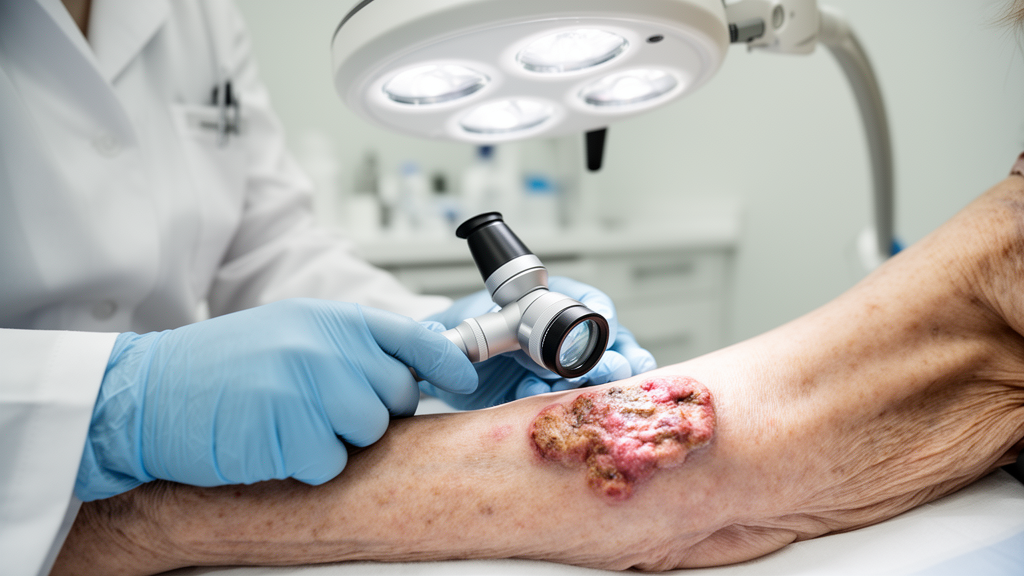
Basosquamous carcinoma (BSC) is one of dermatology’s most stubborn puzzles: a non-melanoma skin cancer that looks, under the microscope, like a collision between two of the most common skin tumors known to medicine. It carries features of basal cell carcinoma (BCC), the slow-growing tumor that rarely spreads, and of cutaneous squamous cell carcinoma (cSCC), a cancer with a genuine capacity to invade and metastasize. A new review published in the Archives of Dermatological Research by a team from the University of Chile and affiliated hospitals in Santiago weighs the evidence and reaches a conclusion that is both reassuring and unsettling: BSC is molecularly closer to BCC, yet it behaves badly enough that clinicians should treat it like high-risk BCC while keeping the vigilance reserved for cSCC.
The term basosquamous carcinoma has been around for nearly a century. Montgomery described basal squamous cell epithelioma back in 1928, and the debate over whether BSC is a true hybrid entity, a collision tumor of two adjacent cancers, or simply a BCC that has undergone squamous differentiation has never fully been resolved. What is not in dispute is the clinical stakes. Compared with conventional BCC, BSC shows higher rates of recurrence and metastasis, which means that misclassifying it as an ordinary BCC can have real consequences for patients.
Part of the difficulty is that BSC cannot be reliably distinguished from BCC on clinical examination alone. The tumors look similar on the skin’s surface, often presenting as lesions on sun-exposed areas such as the head and neck of older patients. This is where modern imaging tools are beginning to earn their place. Dermoscopy, the examination of skin lesions with a handheld magnifying device, and reflectance confocal microscopy, a technique that provides near-histological resolution of living skin without a scalpel, may both assist in diagnosis. Studies of BSC under these modalities reveal a mixed picture: features suggestive of the basaloid component alongside characteristics pointing to squamous differentiation. Line-field confocal optical coherence tomography, a newer hybrid technology, has been used in case series with histopathological correlation to map this dual identity in vivo.
Despite these advances, the gold standard for diagnosis remains histopathology, the microscopic examination of tissue, complemented by immunohistochemical techniques that use antibodies to flag specific proteins and help delineate the basaloid and squamous components. Biopsy strategy matters here as well; work on head and neck BSC has emphasized that the features seen on biopsy are critical to reaching the diagnosis of what some authors still call metatypical basal cell carcinoma. Even with these tools, interobserver agreement can be imperfect, and the boundary between a BCC with squamous differentiation and a bona fide BSC remains a matter of ongoing debate among pathologists.
The molecular story has become clearer in recent years, and it leans firmly toward the BCC side of the family. Genetic studies of BSC have identified mutations underlying what researchers call phenotypic plasticity, the tumor’s ability to shift between basaloid and squamous states. These findings support the idea that BSC is fundamentally a BCC variant whose cells can adopt squamous characteristics, rather than a separate cancer arising from two lineages. Circulating microRNA biomarkers studied across melanoma and non-melanoma skin cancers may eventually add another layer of diagnostic and prognostic information, though their role in BSC specifically is still exploratory.
Epidemiological data have also matured. A multicenter study published in Scientific Reports provided clinical and epidemiological analysis of BSC across multiple institutions, and a comprehensive single-center study in Skin Research and Technology characterized the disease’s epidemiological, clinical, dermoscopic, and confocal features. Together with earlier case series characterizing BSC as a distinct type of keratinizing tumor, these studies paint a picture of a cancer that is uncommon but not rare, and one that disproportionately affects chronically sun-exposed skin.
When it comes to treatment, the review is candid: no consensus exists on optimal management, and prospective studies are needed to better characterize the biology, treatment, and prognosis of this tumor. What the evidence does support is surgical intervention. Wide local excision and Mohs micrographic surgery, a technique in which tissue is removed in thin layers and examined microscopically until the margins are clear, are the most widely used therapeutic approaches. Mohs surgery has a substantial track record in BSC, but the literature is not uniformly triumphant; recurrence after Mohs surgery has been reported, underscoring that even meticulous margin control does not eliminate the tumor’s aggressive potential. A single-center clinicopathological evaluation has proposed an evidence-based protocol for managing BSC, reflecting the growing recognition that ad hoc approaches are inadequate for a tumor with this risk profile.
Beyond the scalpel, the options rest on thinner ice. Sentinel lymph node biopsy, a staging procedure used to detect early spread to regional lymph nodes, has been studied in primary cutaneous BSC, and chemotherapy and radiotherapy are supported only by limited evidence. Radiotherapy, however, may play a palliative role when surgery is not feasible, offering symptom control and local disease management for patients who cannot undergo resection. The National Comprehensive Cancer Network’s guidelines for basal cell skin cancer provide a framework, but BSC sits awkwardly within categories designed for purer entities.
The most exciting developments lie in targeted and immune-based therapies, borrowed from the two parent tumors. Sonic Hedgehog pathway inhibitors, drugs such as vismodegib and sonidegib that block the signaling pathway central to BCC biology, have produced encouraging results in case reports. Complete responses of locally advanced BSC to vismodegib have been documented, and neoadjuvant treatment with sonidegib, given before surgery to shrink tumors, has been described as an innovative approach. Hedgehog pathway inhibitor therapy for locally advanced and metastatic BCC has a strong evidence base from pooled analyses of interventional studies, and BSC appears to respond, at least in part, because of its molecular kinship with BCC.
On the immunotherapy front, anti-PD-1 immune checkpoint inhibitors, which unleash T cells against tumors by blocking a molecular brake, have also shown promise. One striking case report described an impressive response to just four cycles of cemiplimab in a sonidegib-resistant giant BSC of the midface, a tumor that had exhausted one targeted option and yet melted away under immunotherapy. A recent case series and literature review navigated the combined use of Sonic Hedgehog pathway inhibitors, immune checkpoint inhibitors, chemotherapy, and radiotherapy in locally advanced and metastatic BSC, supporting these agents as potential alternatives for unresectable, locally advanced, or metastatic disease. The overall message of the review is a pragmatic one: current evidence positions BSC as molecularly closer to BCC, but its clinical behavior warrants management as high-risk BCC with cSCC-like vigilance. For a tumor that has defied easy classification for nearly a hundred years, that dual strategy may be the most honest answer yet.
Subject of Research: The biology, diagnosis, and management of basosquamous carcinoma, a hybrid non-melanoma skin cancer
Article Title: Basosquamous carcinoma: closer to a basal cell carcinoma or a squamous cell carcinoma?
Article References: Maass, M., Vargas-Mora, P., González-Cuevas, R., Lobos-Guede, N., & Gárate, M. (2026). Basosquamous carcinoma: closer to a basal cell carcinoma or a squamous cell carcinoma?. Archives of Dermatological Research, 318(1), Article 390. https://doi.org/10.1007/s00403-026-04857-4
Image Credits: AI Generated
DOI: 10.1007/s00403-026-04857-4
Keywords: basosquamous carcinoma, basal cell carcinoma, squamous cell carcinoma, skin cancer, dermoscopy, Mohs surgery, Sonic Hedgehog inhibitors, immune checkpoint inhibitors, immunohistochemistry, reflectance confocal microscopy, radiotherapy, sentinel lymph node biopsy
Cite Scienmag News
Nathaniel Bowman. (October 16, 2026). Basosquamous Carcinoma: A Skin Cancer That Refuses to Sit in One Box. Scienmag. https://scienmag.com/basosquamous-carcinoma-a-skin-cancer-that-refuses-to-sit-in-one-box/
Nathaniel Bowman. "Basosquamous Carcinoma: A Skin Cancer That Refuses to Sit in One Box." Scienmag, 16 October 2026, https://scienmag.com/basosquamous-carcinoma-a-skin-cancer-that-refuses-to-sit-in-one-box/. Accessed 16 October 2026.
Nathaniel Bowman. "Basosquamous Carcinoma: A Skin Cancer That Refuses to Sit in One Box." Scienmag. October 16, 2026. https://scienmag.com/basosquamous-carcinoma-a-skin-cancer-that-refuses-to-sit-in-one-box/


