


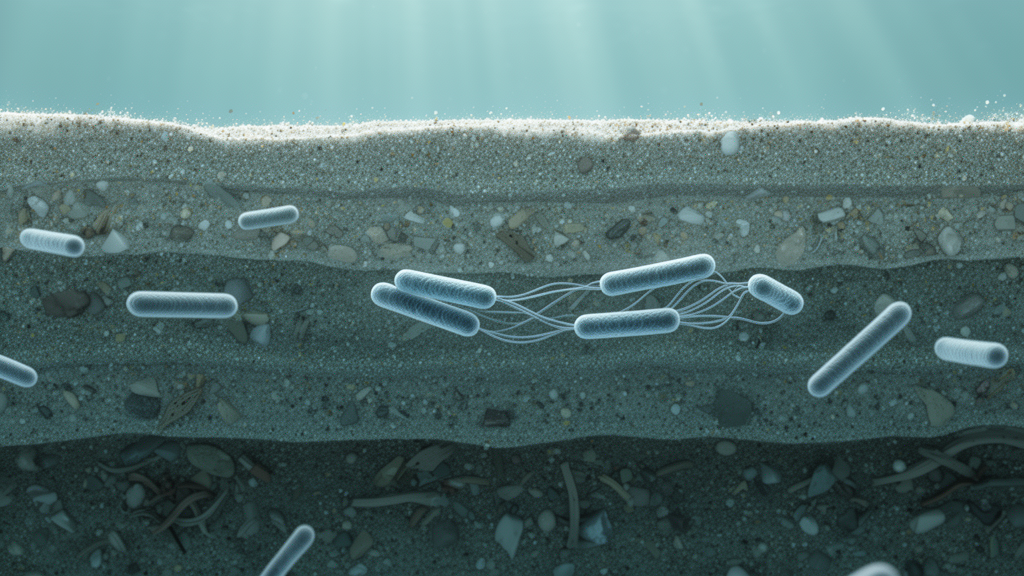
Deep in the muddy sediments of the Baltic Sea, a seemingly unremarkable bacterium is quietly rewriting one of biology’s most fundamental rules. For decades, evolutionary biologists have debated whether bacterial species truly exist as cohesive units, and if so, how they diverge in the absence of the sexual reproduction that drives speciation in animals and plants. Now, a team of researchers studying the Shewanella baltica species complex has uncovered evidence that bacteria can split into distinct species right under each other’s noses, without any geographic barrier separating them, and that this divergence is driven largely by a process best described as sexual: the promiscuous exchange and recombination of DNA between related lineages.
The study, published in PLOS Genetics, was led by Víctor Fernández-Juárez and colleagues, who examined an extraordinary collection of bacterial genomes recovered from a single sampling site in the Stockholm archipelago of Sweden. At Vaxön, the researchers collected sediment cores and extracted strains from multiple depths spanning just the top six centimeters of sediment, a vertical distance smaller than the width of a human hand. When these genomes were compared with earlier isolates from the same site and with allopatric strains collected from surrounding sediments and the water column, the picture that emerged was one of astonishing diversity hidden within what had long been considered a single bacterial species.
In total, the team analyzed 112 genome sequences using a reverse-ecology population genomics approach, a strategy that first identifies genetically cohesive groups and then searches for the ecological traits that distinguish them. Rather than finding a homogeneous population of Shewanella baltica, the researchers discovered that the sediment-associated strains resolve into three cohesive evolutionary groups, labeled G1, G2, and G3, each carrying distinct signatures of metabolic specialization. The scale of this diversification, uncovered within a few centimeters of sediment, far exceeds anything previously reported for S. baltica in other environments, suggesting that life in sediments creates conditions that actively promote the emergence of novel genotypes.
The three groups tell three different evolutionary stories. Group 1 consists predominantly of a single species, the canonical Shewanella baltica, but its members display high gene turnover, meaning their genomes gain and lose genes at a rapid pace, likely reflecting intense selection in the fluctuating chemical environment of the sediment. Groups 2 and 3, by contrast, are far more fractious. Each comprises an array of divergent putative genospecies, along with previously reported species that have been consistently recovered from sediments, hinting that these lineages have been diversifying in place for a considerable time.
What makes the divergence in Groups 2 and 3 particularly striking is its mechanism. By analyzing patterns of homologous recombination, the process by which bacteria incorporate DNA from related organisms into their own genomes, the researchers found that the splitting of lineages within these two groups is primarily recombination-driven. In other words, the bacteria are not simply accumulating random mutations in isolation; they are actively exchanging genetic material with one another, yet somehow maintaining their identities as separate, cohesive lineages. This paradox, in which gene flow both connects and divides populations, is precisely what biologists mean when they speak of sexual speciation in microbes.
Recombination, in the bacterial world, functions much like sex does in eukaryotes. When two related bacterial cells exchange DNA, homologous regions of their genomes can align and swap, homogenizing their sequences. But recombination can also introduce adaptive alleles from one lineage into another, and if certain combinations of genes confer an advantage in a particular ecological niche, selection can favor the retention of those combinations while rejecting incoming DNA that would disrupt them. Over time, this dynamic can create barriers to gene exchange between ecologically distinct populations, allowing them to diverge even while coexisting in the same patch of sediment. The Shewanella data suggest exactly this kind of selection-driven decoupling is at work.
The ecological signatures accompanying this divergence are telling. The researchers found that the splitting of lineages within Groups 2 and 3 is associated with specialization in sulfite reduction, the ability to breathe sulfite instead of oxygen in the oxygen-poor depths of the sediment, as well as with the utilization of particular carbon sources. In the layered chemistry of Baltic Sea sediments, where oxygen, nitrate, iron, and sulfur compounds each dominate at different depths and microenvironments, such metabolic specializations could provide powerful selective incentives for lineages to go their own genomic ways. Each genospecies, in effect, carves out its own chemical niche within the same handful of mud.
These findings carry significant implications for how scientists understand the boundaries of bacterial speciation. Sympatric speciation, the emergence of new species without geographic isolation, has long been controversial even in animals and plants, and in prokaryotes it had generally been documented only at the level of subspecific ecotypes, populations that differ ecologically but have not yet crossed the threshold into full species. The Shewanella baltica complex pushes that boundary outward, demonstrating that bacterial species can diverge and persist as distinct lineages in the absence of spatial segregation, and at microgeographic scales measured in centimeters rather than kilometers.
The results also speak to a broader question in microbial ecology: what holds a bacterial species together in the first place? Classical models propose that frequent recombination acts as a cohesive force, periodically purging differences that arise between members of the same species. The Baltic sediments suggest a complementary and perhaps more powerful organizing principle: collective interactions and ecological differentiation can structure sediment-associated bacterial populations strongly enough to drive divergence at the species level. In this view, the sediment is not merely a backdrop for evolution but an active participant, its chemical gradients and microbial consortia imposing the selective pressures that sculpt new species from old ones.
For researchers studying microbial evolution, the Shewanella baltica complex now stands as a natural laboratory for probing how new bacterial species arise in real time. The unprecedented genomic diversity documented at a single site in the Stockholm archipelago hints that sediments around the world may harbor far more cryptic bacterial diversity than current surveys suggest, much of it generated by the same recombination-fueled, ecologically driven processes now revealed in the Baltic. As genome-resolved studies extend to other sediment systems, the once-clean line between bacterial ecotype and bacterial species may continue to blur, replaced by a richer picture of evolution in which sex, ecology, and geography intertwine in unexpected ways, even within a single core of mud.
Subject of Research: Recombination-driven speciation and ecological diversification in the Shewanella baltica species complex from Baltic Sea sediments
Article Title: Life in sediments fosters ‘sexual’ speciation in the Shewanella baltica complex
Article References: Fernández-Juárez, V., Salvà-Serra, F., Seguí, G., & Martín-Rodríguez, A. J. (2026). Life in sediments fosters ‘sexual’ speciation in the Shewanella baltica complex. PLOS Genetics, 22(9), e1012306. https://doi.org/10.1371/journal.pgen.1012306
Image Credits: AI Generated
DOI: 10.1371/journal.pgen.1012306
Keywords: Shewanella baltica, speciation, bacteria, Baltic Sea, sediments, homologous recombination, population genomics, microbial evolution, sulfite respiration, sympatric speciation, genospecies, ecological differentiation
Cite Scienmag News
Juliet Wilcox. (October 8, 2026). Baltic Sea Sediments Drive Surprising Sexual Speciation in Bacteria. Scienmag. https://scienmag.com/baltic-sea-sediments-drive-surprising-sexual-speciation-in-bacteria/
Juliet Wilcox. "Baltic Sea Sediments Drive Surprising Sexual Speciation in Bacteria." Scienmag, 8 October 2026, https://scienmag.com/baltic-sea-sediments-drive-surprising-sexual-speciation-in-bacteria/. Accessed 8 October 2026.
Juliet Wilcox. "Baltic Sea Sediments Drive Surprising Sexual Speciation in Bacteria." Scienmag. October 8, 2026. https://scienmag.com/baltic-sea-sediments-drive-surprising-sexual-speciation-in-bacteria/


