


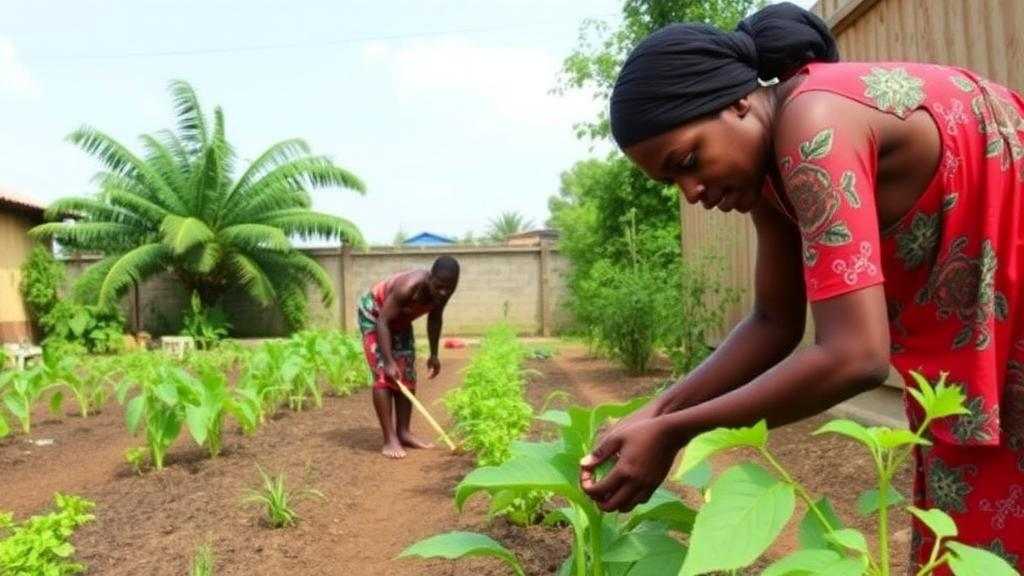
When the COVID-19 pandemic severed supply chains, closed markets, and stripped millions of Nigerians of their incomes, an unlikely buffer emerged in backyards, on balconies, and in small urban plots. Home gardening, the cultivation of fruits, vegetables, and herbs around the household, appears to have played a measurable role in protecting dietary quality during one of the most severe food security crises in recent memory. A new study published in BMC Agriculture by researchers at Obafemi Awolowo University and the University of the Free State provides some of the most detailed quantitative evidence yet that these small-scale gardens delivered both nutritional and economic returns when conventional food systems faltered.
The research team, led by Victoria Tanimonure, surveyed 656 households across all six of Nigeria’s geopolitical zones during the country’s second wave of infections, when Lagos, Kaduna, and the Federal Capital Territory served as epicentres. Data collection ran for twelve weeks, from mid-August to mid-October 2020, and was carried out almost entirely by telephone, a necessity imposed by lockdowns and movement restrictions. Respondents were recruited through a snowball sampling approach, in which initial contacts forwarded the survey link through their social networks, allowing the team to reach a geographically dispersed population despite pandemic constraints. The final sample exceeded the minimum of 384 respondents calculated using Cochran’s formula at a 95 percent confidence level and a 5 percent margin of error, giving the analysis additional statistical power.
To measure nutritional security, the researchers relied on the Household Dietary Diversity Score, a validated indicator that counts how many of twelve food groups a household consumed over a 24-hour recall period. The groups span cereals, roots and tubers, fruits, vegetables, meat, eggs, fish, legumes, nuts and seeds, milk and dairy products, oils and fats, and sweets, spices, and beverages. Scores range from zero to twelve, with higher values signaling broader access to nutrient-rich foods and, by extension, better protection against micronutrient deficiencies. Households in the study achieved an average score of 7.90, meaning the typical respondent consumed roughly eight food groups per day even amid lockdown conditions, a level the authors characterize as relatively high dietary diversity.
The headline finding is stark: households that practiced home gardening scored considerably higher on dietary diversity than those that did not. When the researchers sorted households into low, medium, and high diversity categories, 67 percent of those in the high-diversity group, consuming six or more food groups, were home gardeners. By contrast, 77 percent of households in the low-diversity category, eating fewer than three food groups, had no garden at all. The pattern held across the middle tier as well, where 70 percent of households were non-gardeners. This distribution strongly suggests that garden produce, rich in vitamins A and C, iron, and protein, directly diversified diets at a moment when market access was unreliable and prices were climbing.
Quantifying this relationship rigorously required the researchers to confront a classic econometric problem. Households that choose to garden may differ systematically from those that do not, in age, education, resources, or motivation, so a naive comparison of gardeners and non-gardeners could produce biased estimates. To address this selection bias, the team employed a Heckpoisson regression, an extension of Heckman’s two-step correction adapted for count data. The model runs two equations simultaneously: a selection equation estimating which households choose to garden, and a Poisson outcome equation estimating dietary diversity among gardeners. Because the two equations shared predictors that could introduce collinearity problems, the researchers applied an exclusion restriction, omitting certain variables from the selection stage to obtain consistent estimates.
The regression results confirmed the descriptive patterns. Income earned from home gardening was positively and significantly associated with dietary diversity, with each additional unit of garden-derived income raising the dietary diversity score by 0.20 points. On average, gardening households earned an estimated 209,122.70 naira annually from their plots, whether in cash from selling surplus produce or in kind through household consumption. That supplementary income, the authors note, can be spent on food groups the garden does not supply, creating a virtuous cycle in which gardening both diversifies the diet directly and finances further diversification through purchases. It also cushions households against the food price inflation and market disruptions that defined the pandemic economy.
The study also mapped who gardens and why. Participation was predominantly female, with only 47 percent of respondents male, reflecting global patterns in which women manage subsistence production and household nutrition. Gardeners tended to be older and more educated, with respondents averaging 30.15 years of age and about 13.56 years of formal schooling. In the selection model, the age of the household head, the age of the respondent, and the number of children under one year old all significantly increased the likelihood of gardening. Households with infants, the authors suggest, are particularly motivated to secure fresh, nutritious foods that support breastfeeding mothers and child development, making the garden a targeted nutritional intervention rather than a general hobby.
Dietary diversity itself was shaped by a cluster of socio-demographic factors. Marital status was positively associated with food security, consistent with evidence that married caregivers are better positioned nutritionally. Household size, counterintuitively, improved dietary diversity, likely because larger families pool income, share labor for garden maintenance, and make collective food decisions, though the authors acknowledge this runs against much of the literature linking bigger households to insecurity. The presence of an infant under one year old raised diversity scores, apparently because mothers deliberately broaden their own diets to improve breast milk quality. Meanwhile, the age of the household head and the presence of members aged 18 to 60 and above 60 were negatively associated with dietary diversity, with older respondents facing elevated risks of food and nutrition insecurity.
The pandemic’s fingerprint was equally visible. Households that reported being negatively affected by COVID-19 had significantly lower dietary diversity scores than those that were not, and 85 percent of households in the low-diversity category had been hit by the pandemic, compared with only 14 percent of the unaffected. Among high-diversity households, 62 percent had escaped the worst effects. Older respondents, older household heads, and larger households were disproportionately represented among the unaffected, suggesting that accumulated experience, savings, diversified income sources, and stronger support networks conferred resilience. The regression analysis confirmed that COVID-19 exposure carried a negative and statistically significant coefficient, underscoring how lockdowns, income losses, and restricted market access translated directly into poorer diets.
The authors conclude that home gardening deserves a central place in Nigeria’s food security and livelihood programming, particularly as the country confronts ongoing stress in which roughly 32.1 million people face food crisis or worse. They recommend awareness campaigns by governments and NGOs, subsidies or public-private partnerships for quality seeds and inputs, expanded extension services teaching organic farming and integrated pest management, and urban agriculture policies that ease land access and promote community gardens. Significant barriers remain, including scarce urban land, fragmented rural plots, limited inputs, and erratic rainfall driven by climate change. But the evidence from the pandemic years suggests that a modest investment in backyard plots can pay a double dividend, feeding households better while putting additional income in their pockets, a lesson that will matter long after the crisis has passed.
Subject of Research: The impact of home gardening on household nutritional security and income during the COVID-19 pandemic in Nigeria
Article Title: Home gardening for advancing nutritional security and income generation in response to the COVID-19 pandemic in Nigeria
Article References: Tanimonure, V., Ojo, T., Kehinde, A., Tijani, A., & Ogundeji, A. (2025). Home gardening for advancing nutritional security and income generation in response to the COVID-19 pandemic in Nigeria. BMC Agriculture, 1(1), Article 9. https://doi.org/10.1186/s44399-025-00010-0
Image Credits: AI Generated
DOI: 10.1186/s44399-025-00010-0
Keywords: home gardening, nutritional security, dietary diversity, COVID-19, Nigeria, food security, household income, Heckpoisson regression, urban agriculture, micronutrients, livelihoods, BMC Agriculture
Cite Scienmag News
Alan Morgan. (October 3, 2026). Backyard Gardens Became a Lifeline for Nigerian Households During COVID-19, Study Finds. Scienmag. https://scienmag.com/backyard-gardens-became-a-lifeline-for-nigerian-households-during-covid-19-study-finds/
Alan Morgan. "Backyard Gardens Became a Lifeline for Nigerian Households During COVID-19, Study Finds." Scienmag, 3 October 2026, https://scienmag.com/backyard-gardens-became-a-lifeline-for-nigerian-households-during-covid-19-study-finds/. Accessed 17 October 2026.
Alan Morgan. "Backyard Gardens Became a Lifeline for Nigerian Households During COVID-19, Study Finds." Scienmag. October 3, 2026. https://scienmag.com/backyard-gardens-became-a-lifeline-for-nigerian-households-during-covid-19-study-finds/


