


Researchers from the University of Melbourne and Politecnico di Torino report that shipping, sonar, exploration, and offshore construction are interfering with the whale songs and other acoustic communication many whales rely on to broadcast information to each other during migration.

Credit: Dr Stuart Johnston, University of Melbourne
Researchers from the University of Melbourne and Politecnico di Torino report that shipping, sonar, exploration, and offshore construction are interfering with the whale songs and other acoustic communication many whales rely on to broadcast information to each other during migration.
University of Melbourne mathematician Dr Stuart Johnston, who co-authored the paper published in Movement Ecology, said the simulation study suggests the current soundscape for whales – compared to pre-industrial conditions – might be causing a three-to-four-day delay in migration arrivals, representing an extra 20 per cent in travel time. If noise levels continue to rise, the model suggests some whales may never reach their destination, due to either drifting off course or avoiding loud noises blocking their route.
“We found that human-made noise is having three main effects on migration: it’s reducing the ability to hear acoustic communication like songs among whales, it’s generating an avoidance response when sufficiently loud, and it’s lowering the detection of environmental cues that some whales use to inform navigation,” Dr Johnston said.
“Baleen [toothless] whales such as minke whales, humpback whales and blue whales are renowned for their extraordinary acoustic communication, which can cross hundreds of kilometres, because sound travels a long way in water. We know noise pollution affects whale behaviour, reducing their communication range, and increasing their stress levels, which has been linked to strandings. But it hasn’t been known to what extent – that’s what we wanted to explore,” he said.
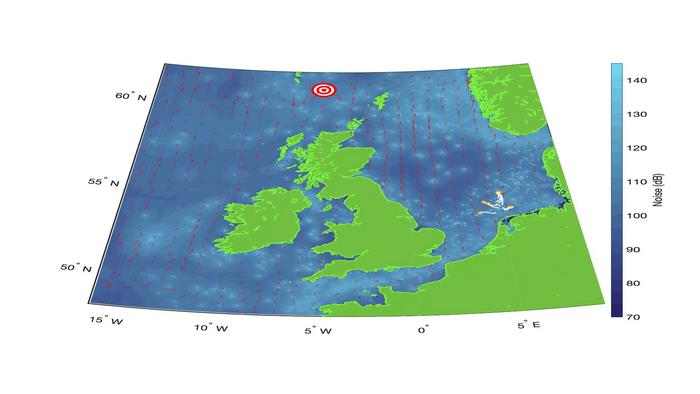
Using data of ships in the North Sea and their noise, researchers constructed sound maps and a sophisticated model that simulates how noise might affect whale migration. The model, which simulated the behaviour of 100 minke whales, also predicted the effect of future noise increases such as shipping, naval sonar operations, seismic exploration by gas industries, and offshore construction on whale migration.
“Whales rely on sounds from each other and from their environment to navigate through the vast oceans. Noise from sonar systems, shipping and construction is reducing the detection of environmental cues that may tell whales where to go. For example, icebergs clashing under the sea makes a very loud noise, which could inform whales what direction to move towards to find cooler polar waters. If they can no longer detect the sound, they are losing a key piece of information to help them navigate,” Dr Johnston said.
“We also looked at what makes whales avoid a migration route. If there’s loud drilling happening outside a meeting room, you wouldn’t want to use that room. Similarly, whales will avoid an uncomfortable environment when there is significant noise, and this could lead to increased journey time or even failure to arrive.”
Whales tend to migrate to cooler waters in summer and warmer waters in winter, following food sources and to breed and give birth where conditions are best for their calves. Dr Johnston said extra migration time due to noise interference would leave whales with less time and energy for breeding and searching for food, as well as creating the need to replenish the lost energy.
“These incredible animals journey up to 10,000km each year during migration – it’s a huge investment of time and energy. We must find a solution within the shipping and construction industries that don’t come at the cost of whale activity and breeding,” Dr Johnston said.
“The traffic in our oceans is predicted to go up by at least another 50 per cent by 2050. We need to make informed decisions about our continued activities in the ocean, and it’s important that these decisions are driven by science,” he said.
The research was co-funded by the Australian Research Council and the MIUR-Dipartimento di Eccellenza.
-ends-
AVAILABLE FOR INTERVIEW:
Dr Stuart Johnston
Co-Author, and Senior Lecturer in Applied Mathematics
University of Melbourne
CONTACT FOR INTERVIEWS:
Jo Piltz
Faculty of Science Communications
jo.piltz@unimelb.edu.au / 0424 004 553
Journal
Movement Ecology
Article Title
Avoidance, confusion or solitude? Modelling how noise pollution affects whale migration
Article Publication Date
19-Feb-2024
Cite Scienmag News
Reid Dalton. (April 9, 2024). Avoidance, confusion, solitude: whales react to rising noise pollution. Scienmag. https://scienmag.com/avoidance-confusion-solitude-whales-react-to-rising-noise-pollution/
Reid Dalton. "Avoidance, confusion, solitude: whales react to rising noise pollution." Scienmag, 9 April 2024, https://scienmag.com/avoidance-confusion-solitude-whales-react-to-rising-noise-pollution/. Accessed 4 September 2026.
Reid Dalton. "Avoidance, confusion, solitude: whales react to rising noise pollution." Scienmag. April 9, 2024. https://scienmag.com/avoidance-confusion-solitude-whales-react-to-rising-noise-pollution/

