


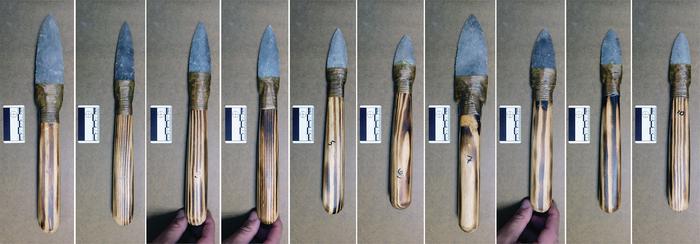
Kent State University’s experimental archaeologists, along with those from several other universities, joined forces with the popular hunting, outdoors, and conservation media platform, MeatEater, Inc., for a unique animal processing experiment, shedding new light on ancient stone knives and showcasing the importance of testing and looking for equifinality. ‘Equifinality’ is when two or more distinct processes can lead to the same outcome or result.

Credit: Metin I. Eren
Kent State University’s experimental archaeologists, along with those from several other universities, joined forces with the popular hunting, outdoors, and conservation media platform, MeatEater, Inc., for a unique animal processing experiment, shedding new light on ancient stone knives and showcasing the importance of testing and looking for equifinality. ‘Equifinality’ is when two or more distinct processes can lead to the same outcome or result.
The Kent State archaeologists included Professor Metin I. Eren, Ph.D.; Assistant Professor Michelle Bebber, Ph.D. and Alumni Michael Wilson (Kent State B.A., ‘18; M.A., ‘21) and Lawrence Mukusha (Kent State M.A., ‘23). The primary objective of the experiment was to test the efficiency of Clovis stone tools in processing a bison, offering insights into early human technologies. ‘Clovis’ refers to 13,000-year-old archaeological culture that represents some of the earliest hunting and gathering peoples in North America.
The experiment was meticulously documented and detailed in a recently published open-access article in the Journal of Archaeological Science: Reports.
While the researchers learned much about Clovis knife efficiency and other aspects of stone tool animal processing, one outcome that the researchers did not anticipate was that several of the replica knives broke during animal processing very similarly to breaks some assume would result from shooting the Clovis points.
“Even though one can use Clovis stone points for both hunting and processing, the breakage resulting from these distinct activities can be similar,” Eren said. “If an archaeological site is found that is comprised of a large animal and broken Clovis points, some archaeologists might assume that’s because the points were used to hunt the animal. What our experiment suggests is another interpretation: the animal was already dead and people scavenged it and processed it with knives.”
The researchers also documented several other instances of equifinality, involving bone cut marks, tool functional morphology, and resharpening.
“I used to think that the power of experimental archaeology was that it allowed us to help reverse engineer past technologies. And it can,” Eren said. “But, I think a more valuable aspect of experimental archaeology that’s becoming more and more consequential is that it documents equifinality, providing a vital check on archaeologists’ interpretations.”
Partnering with MeatEater, Inc.
Inspiration for the experiment stemmed from previous conversations that David J. Meltzer, Ph.D. (Southern Methodist University) and Eren had during their guest appearances on The MeatEater Podcast, where discussions about mammoth hunting led to the idea of a collaborative butchery experiment. Meltzer was a co-author on the study.
“The unique skills of the MeatEater crew in animal processing and media documentaries, combined with our expertise in archaeology and artifact recreation, sparked the idea of testing Clovis stone tools’ efficiency,” Eren said.
The entire experiment was recorded by a MeatEater film crew, and an edited version of the video was posted on YouTube as a documentary entitled Butchering a Bison with Clovis Points and Tools (https://www.youtube.com/watch?v=XmsrkFjPiKM).
“It was a career highlight for us to work with all the folks at MeatEater who have amazing experience and skills; we learned so much from them,” Eren said. “And they’re so curious – they’re natural scientists.”
Journal
Journal of Archaeological Science
Method of Research
Experimental study
Subject of Research
Not applicable
Article Title
Experimental bison butchery using replica hafted Clovis fluted points and large handheld flakes
Article Publication Date
8-Apr-2024
Cite Scienmag News
Courtney Benton. (April 9, 2024). Experimental collaboration between archaeologists and MeatEater highlights the prevalence of equifinality in archaeological interpretation. Scienmag. https://scienmag.com/experimental-collaboration-between-archaeologists-and-meateater-highlights-the-prevalence-of-equifinality-in-archaeological-interpretation/
Courtney Benton. "Experimental collaboration between archaeologists and MeatEater highlights the prevalence of equifinality in archaeological interpretation." Scienmag, 9 April 2024, https://scienmag.com/experimental-collaboration-between-archaeologists-and-meateater-highlights-the-prevalence-of-equifinality-in-archaeological-interpretation/. Accessed 4 September 2026.
Courtney Benton. "Experimental collaboration between archaeologists and MeatEater highlights the prevalence of equifinality in archaeological interpretation." Scienmag. April 9, 2024. https://scienmag.com/experimental-collaboration-between-archaeologists-and-meateater-highlights-the-prevalence-of-equifinality-in-archaeological-interpretation/

