


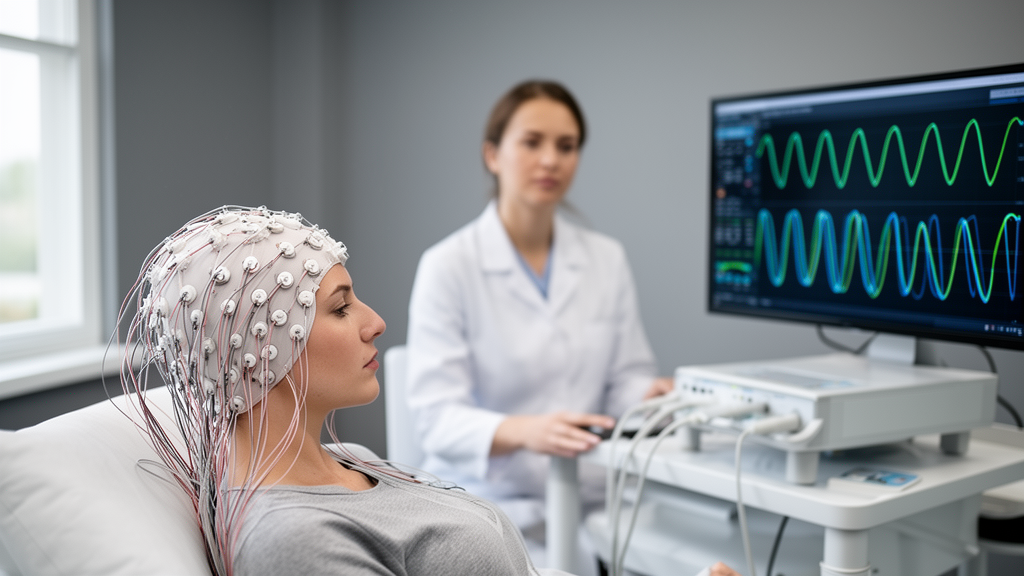
A new hybrid artificial intelligence framework can classify epileptic seizures from brain wave recordings with an overall accuracy of 98.83 percent, outperforming several recent state-of-the-art methods on a widely used benchmark. The system, developed by researchers at Chandigarh University in India, Sejong University in South Korea, the University of Jeddah in Saudi Arabia and Northern Border University in Saudi Arabia, chains together three complementary deep learning techniques and was described in Frontiers in Computational Neuroscience.
Electroencephalography, or EEG, remains the workhorse of epilepsy diagnosis. The technique records the brain’s tiny electrical fields, typically just 10 to 100 microvolts in amplitude, through electrodes on the scalp, and offers the millisecond-level temporal resolution that brain imaging tools such as MRI cannot match. Yet the same signals are notoriously difficult for machines to interpret. They are non-stationary, meaning their statistical properties shift over time, they are non-linear, and they carry a low signal-to-noise ratio contaminated by eye movements, muscle activity and electrode drift. Manual review by a trained neurologist is slow, subjective and vulnerable to fatigue-induced error.
Earlier automated approaches relied on handcrafted features such as power spectral density, wavelet coefficients or common spatial patterns, fed into shallow classifiers like support vector machines and linear discriminant analysis. These pipelines demand task-specific engineering and struggle to capture the full complexity of EEG dynamics. Deep learning changed the calculus: convolutional neural networks, or CNNs, learn local waveform patterns directly from raw signals, while recurrent architectures such as Long Short-Term Memory networks track how those patterns evolve across time. But each approach has blind spots. CNNs alone have no notion of temporal context, and recurrent networks process sequences inefficiently and look in only one direction.
The new framework, dubbed CNN-BiLSTM-MHSA, addresses those gaps by stacking three modules into a single end-to-end trainable network. A multilayer one-dimensional CNN front end, with filters of 32, 64 and 128, extracts localized morphological signatures such as spikes and sharp waves. A Bidirectional LSTM layer with 128 units then reads the feature sequence in both forward and backward directions, capturing how ictal activity unfolds and recedes over time. Finally, a Multi-Head Self-Attention mechanism with four heads adaptively weights the most discriminative moments in the recording, no matter how far apart they lie in time, and refines the recurrent representation through a residual connection and layer normalization.
The attention module serves a second purpose beyond raw accuracy: interpretability. Because attention weights can be visualized as temporal salience maps, clinicians can in principle see which segments of an EEG recording drove the model’s decision. The authors report that high attention values align with informative temporal regions, while low-weight regions correspond to comparatively irrelevant signal segments, a property that becomes increasingly important as such tools move toward clinical translation.
Before any of this learning took place, the raw data passed through a disciplined preprocessing pipeline. A fifth-order Butterworth bandpass filter with cutoffs at 0.5 and 40 Hz isolated the clinically relevant delta-through-gamma frequency range where epileptiform activity is typically expressed, and zero-phase forward-backward filtering eliminated the timing distortions that ordinary filters introduce. Each one-second epoch was then normalized to zero mean and unit variance so the network would learn morphological patterns rather than amplitude artifacts. To stretch a moderate dataset further, the team generated synthetic training variants by injecting Gaussian noise with a standard deviation of 0.01 and applying random amplitude scaling, emulating natural variability across patients.
The evaluation used the UCI/Kaggle Epileptic Seizure Recognition dataset, comprising 11,500 EEG segments of 178 samples each, sampled at 178 Hz and balanced across five classes: seizure activity, tumor-region activity, healthy brain region from tumor patients, and eyes-closed and eyes-open resting states in healthy subjects. With a stratified 80:20 train-test split, the framework achieved 98.83 percent accuracy, 98.95 percent precision, 98.84 percent recall, a 98.90 percent F1-score, 99.71 percent specificity, 99.80 percent ROC-AUC and 99.72 percent PR-AUC. One class achieved perfect recognition, and per-class accuracies exceeded 99 percent for most categories. On the efficiency side, the model contains just 494,483 parameters and classified samples at roughly 2.26 milliseconds each, a throughput of about 442 samples per second.
An ablation study confirmed that each component earns its place. A CNN alone reached 94.72 percent accuracy, adding the BiLSTM lifted that to 96.84 percent, and pairing the CNN with attention alone produced 97.41 percent. The full three-module system with data augmentation reached 98.83 percent, while the same architecture without augmentation managed 97.92 percent, showing that the augmentation strategy alone contributed nearly a full percentage point. The complete system also edged out a prior BiLSTM-based approach on the same dataset that had reported 98.70 percent accuracy.
Visualization analyses reinforced the picture of a model that has genuinely learned the structure of brain activity. Projections of the learned features into two dimensions using t-SNE revealed five well-separated clusters with minimal overlap, and intermediate convolutional feature maps showed strong responses around informative EEG regions while suppressing redundant signal components. The handful of misclassified recordings, the authors note, exhibited waveform characteristics inherently similar to neighboring categories, underscoring the difficulty of the residual cases rather than any systematic weakness in the architecture.
The researchers caution that clinical deployment will require external validation on diverse patient populations, along with attention to interpretability, data privacy, computational constraints and integration with existing hospital workflows. Their planned next steps include testing on larger clinical EEG corpora such as CHB-MIT and TUH EEG, developing lightweight versions for edge devices, and incorporating explainable AI techniques to support clinical decision-making. If those hurdles are cleared, an attention-guided network that reads a second of brain activity in about two milliseconds could bring automated, near-real-time seizure detection closer to the bedside.
Subject of Research: A hybrid deep learning framework using CNN, BiLSTM and multi-head self-attention for multiclass epileptic seizure recognition from EEG signals
Article Title: An attention-enhanced hybrid CNN-BiLSTM framework for multiclass epileptic seizure recognition using EEG signals
Article References: Kaur, B., Middha, S., Ali, A., Khan, N., Alhejaili, R., & Almutairi, A. H. (2026). An attention-enhanced hybrid CNN-BiLSTM framework for multiclass epileptic seizure recognition using EEG signals. Frontiers in Computational Neuroscience, 20, Article 1949040. https://doi.org/10.3389/fncom.2026.1949040
Image Credits: AI Generated
DOI: 10.3389/fncom.2026.1949040
Keywords: EEG, epilepsy, seizure detection, deep learning, CNN, BiLSTM, self-attention, neural networks, brain-computer interface, signal processing, computational neuroscience, machine learning
Cite Scienmag News
Cassandra Pierce. (October 16, 2026). Attention-Powered AI Reads Brain Waves to Spot Seizures With 98.8% Accuracy. Scienmag. https://scienmag.com/attention-powered-ai-reads-brain-waves-to-spot-seizures-with-98-8-accuracy/
Cassandra Pierce. "Attention-Powered AI Reads Brain Waves to Spot Seizures With 98.8% Accuracy." Scienmag, 16 October 2026, https://scienmag.com/attention-powered-ai-reads-brain-waves-to-spot-seizures-with-98-8-accuracy/. Accessed 16 October 2026.
Cassandra Pierce. "Attention-Powered AI Reads Brain Waves to Spot Seizures With 98.8% Accuracy." Scienmag. October 16, 2026. https://scienmag.com/attention-powered-ai-reads-brain-waves-to-spot-seizures-with-98-8-accuracy/


