

Monday, July 27, 2026
Science
No Result
View All Result
  • Login
  • HOME
  • SCIENCE NEWS
  • CONTACT US
  • HOME
  • SCIENCE NEWS
  • CONTACT US
No Result
View All Result
Scienmag
No Result
View All Result
Home Science News Space

Astronomers Detect First Wandering Black Hole on Outskirts of Galaxy

July 27, 2026
in Space
Reading Time: 3 mins read
0
Astronomers Detect First Wandering Black Hole on Outskirts of Galaxy

Astronomers Detect First Wandering Black Hole on Outskirts of Galaxy

65
SHARES
587
VIEWS
Share on FacebookShare on Twitter
ADVERTISEMENT

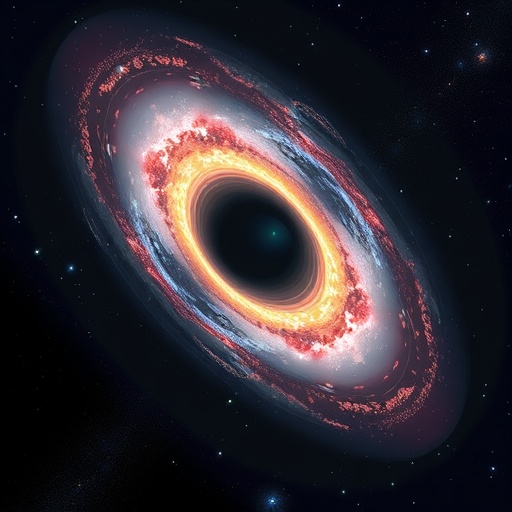
University of Maryland astronomers have reported what they call a “wandering” supermassive black hole—an object hiding in the outskirts of a galaxy rather than sitting at its center. The team’s detection hinges on a fleeting flare: a dormant black hole revealed itself when it tore apart a passing star. The discovery is described as the first clear sighting of such a quiescent black hole at this distance from galactic centers.

The result was published July 27, 2026, in The Astrophysical Journal Letters. “This is a novel result,” said co-author Suvi Gezari, emphasizing that the usual assumption—that the biggest black holes live in galaxy cores—doesn’t hold here. The finding could reshape how scientists track the merging history of galaxies over cosmic time.

Most black holes remain invisible because they are quiescent, meaning they emit little light and do not actively consume material. Theorists have long predicted that galaxies’ collisions should eject or displace black holes into extended orbits. Yet confirming those predictions has been difficult because “silent” black holes rarely announce themselves to telescopes.

In this study, the first clue came from the Zwicky Transient Facility (ZTF), a wide-field survey that repeatedly images the northern sky. With the survey generating hundreds of thousands of events nightly, manually identifying the telltale signature of a tidal disruption event (TDE) is impractical. Instead, the researchers used an AI system trained to recognize the characteristic light pattern produced when a black hole disrupts a star.

The AI approach screened the entire sky for similar flares, not just those occurring in galactic centers where TDEs are commonly found. The program began operating in August 2025, and the candidate was confirmed only three months later—prompting rapid follow-up observations from additional instruments.

The black hole lies 9.3 kiloparsecs (about 30,000 light-years) from the galaxy’s center—comparable in mass to the black hole at the heart of the Milky Way. Strikingly, no obvious host galaxy structure surrounds it, deepening the mystery of how it ended up far from any central stellar congregation.

To explain the origin, the authors propose two leading scenarios. One possibility is hierarchical cannibalism: a larger galaxy strips stars from a smaller companion until only the black hole core remains. Another involves black-hole interactions: a central binary may be perturbed by a third black hole during a merger, ejecting the smallest member into the outskirts. Continued monitoring of the TDE could help discriminate between these pathways.

Understanding quiescent black holes matters because most supermassive black holes—including ours—are inactive most of the time. Stein stressed that the odds of encountering a wandering black hole are extremely low. Meanwhile, the team is expanding the search, aiming to find many more such objects using next-generation facilities.

Using the Vera C. Rubin Observatory, the researchers expect to uncover dozens or even hundreds of wandering black holes each year. Complementary capabilities from the Lowell Discovery Telescope and its Rapid infrared IMAger-Spectrometer will also strengthen searches for tidal disruption events at even greater distances. The study’s authors describe this case as the strongest evidence for a wandering black hole currently known.

Subject of Research: Wandering supermassive black holes; tidal disruption events in galaxy outskirts
Article Title: TDE 2025abcr: A Tidal Disruption Event in the Outskirts of a Massive Galaxy
News Publication Date: 27-Jul-2026
Web References: http://dx.doi.org/10.3847/2041-8213/ae77f3
References: The Astrophysical Journal Letters (27-Jul-2026); DOI: 10.3847/2041-8213/ae77f3
Image Credits: Robert David Stein

Keywords

Wandering black holes; tidal disruption event; Zwicky Transient Facility; machine learning; supermassive black holes; galaxy mergers

Tags: astrophysical flare signalsblack hole detection methodsblack hole displacement during galaxy collisionsblack holes in galaxy outskirtsdormant black holesgalaxy evolution and black hole dynamicsgalaxy merger historyimplications for supermassive black hole distributionquiescent supermassive black holesstellar tidal disruption eventswandering black hole detectionZwicky Transient Facility observations
Share26Tweet16
Previous Post

UC Irvine Researchers Develop California Wildfire Damage Risk Map

Next Post

Iceberg barriers reduce foraging links, causing sharp chick declines in Coulman Island penguins

Related Posts

Astronomers Identify Extremely Bright Quasar Lenses in New Findings
Space

Astronomers Identify Extremely Bright Quasar Lenses in New Findings

July 27, 2026
All-Angle Acoustic Topological Insulators Enable Omnidirectional Antennas and Tunable Klein Tunneling
Space

All-Angle Acoustic Topological Insulators Enable Omnidirectional Antennas and Tunable Klein Tunneling

July 27, 2026
Physics Reveals Universal Structure of Exceptional Points in Nonlinear Systems
Space

Physics Reveals Universal Structure of Exceptional Points in Nonlinear Systems

July 27, 2026
Link Between Carotid Hemodynamics and Cerebral Blood Flow in Early Simulated Microgravity
Space

Link Between Carotid Hemodynamics and Cerebral Blood Flow in Early Simulated Microgravity

July 27, 2026
Cutting forever-chemical pollution in farmlands at a fraction of costs
Space

Cutting forever-chemical pollution in farmlands at a fraction of costs

July 27, 2026
Rocks from the Moon’s unexplored far side reshape lunar history
Space

Rocks from the Moon’s unexplored far side reshape lunar history

July 26, 2026
Next Post
Iceberg barriers reduce foraging links, causing sharp chick declines in Coulman Island penguins

Iceberg barriers reduce foraging links, causing sharp chick declines in Coulman Island penguins

  • Mothers who receive childcare support from maternal grandparents show more

    Mothers who receive childcare support from maternal grandparents show more parental warmth, finds NTU Singapore study

    27656 shares
    Share 11059 Tweet 6912
  • University of Seville Breaks 120-Year-Old Mystery, Revises a Key Einstein Concept

    1061 shares
    Share 424 Tweet 265
  • Bee body mass, pathogens and local climate influence heat tolerance

    682 shares
    Share 273 Tweet 171
  • Researchers record first-ever images and data of a shark experiencing a boat strike

    546 shares
    Share 218 Tweet 137
  • Groundbreaking Clinical Trial Reveals Lubiprostone Enhances Kidney Function

    531 shares
    Share 212 Tweet 133
Science

Embark on a thrilling journey of discovery with Scienmag.com—your ultimate source for cutting-edge breakthroughs. Immerse yourself in a world where curiosity knows no limits and tomorrow’s possibilities become today’s reality!

RECENT NEWS

  • Personalized Phage Therapy in ICU Patient Treating Polymicrobial Lung Infections
  • Echocardiography Hemodynamics in Preterm Infants Predict Neurodevelopment Through Age Three
  • Breast Milk Odor Exposure Influences Early Oral Feeding in Preterm Infants
  • APCDd1 Identified as Highly Specific Marker for Ventral Midbrain Dopaminergic Progenitors

Categories

  • Agriculture
  • Anthropology
  • Archaeology
  • Athmospheric
  • Biology
  • Biotechnology
  • Blog
  • Bussines
  • Cancer
  • Chemistry
  • Climate
  • Earth Science
  • Editorial Policy
  • Marine
  • Mathematics
  • Medicine
  • Pediatry
  • Policy
  • Psychology & Psychiatry
  • Science Education
  • Social Science
  • Space
  • Technology and Engineering

Subscribe to Blog via Email

Enter your email address to subscribe to this blog and receive notifications of new posts by email.

Join 5,146 other subscribers

© 2025 Scienmag - Science Magazine

Welcome Back!

Login to your account below

Forgotten Password?

Retrieve your password

Please enter your username or email address to reset your password.

Log In
No Result
View All Result
  • HOME
  • SCIENCE NEWS
  • CONTACT US

© 2025 Scienmag - Science Magazine

Discover more from Science

Subscribe now to keep reading and get access to the full archive.

Continue reading
