

Sunday, May 3, 2026
Science
No Result
View All Result
  • Login
  • HOME
  • SCIENCE NEWS
  • CONTACT US
  • HOME
  • SCIENCE NEWS
  • CONTACT US
No Result
View All Result
Scienmag
No Result
View All Result
Home Science News Technology and Engineering

Artificial blood vessels could improve heart bypass outcomes

July 25, 2024
in Technology and Engineering
Reading Time: 3 mins read
0
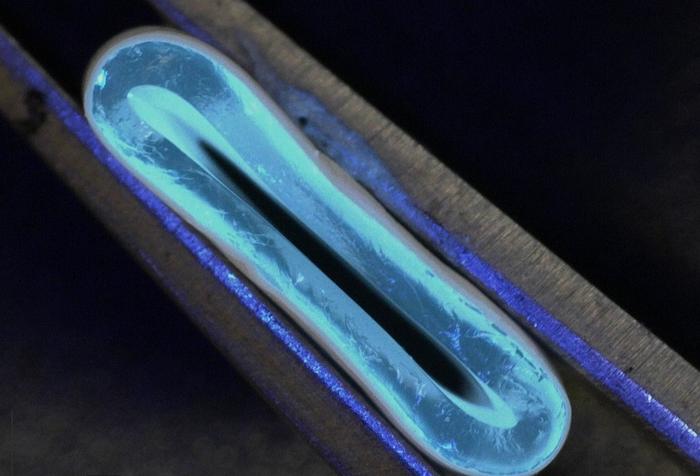
Image of a 3D printed blood vessel.
66
SHARES
599
VIEWS
Share on FacebookShare on Twitter
ADVERTISEMENT

Artificial blood vessels could improve heart bypass outcomes

Image of a 3D printed blood vessel.

Credit: Dr Norbert Radasci, School of Engineering, University of Edinburgh.

Artificial blood vessels could improve heart bypass outcomes

3D-printed blood vessels, which closely mimic the properties of human veins, could transform the treatment of cardiovascular diseases.

Strong, flexible, gel-like tubes – created using a novel 3D printing technology – could improve outcomes for heart bypass patients by replacing the human and synthetic veins currently used in surgery to re-route blood flow, experts say.

The development of synthetic vessels could help limit scarring, pain and infection risk associated with the removal of human veins in bypass operations of which some 20,000 are carried out in England each year. The products could also help alleviate the failure of small synthetic grafts, which can be hard to integrate into the body.

In a two-stage process, a team of researchers led by the University of Edinburgh’s School of Engineering used a rotating spindle integrated into a 3D printer to print tubular grafts made from a water-based gel.

They subsequently reinforced the printed graft in a process known as electrospinning, which uses high voltage to draw out very thin nanofibers, coating the artificial blood vessel in biodegradable polyester molecules.

Tests showed the resulting products to be as strong as natural blood vessels.

The 3D graft can be made in thicknesses from 1 to 40 mm in diameter, for a range of applications, and its flexibility means that it could easily be integrated into the human body, the team says.

The next stage of the study will involve researching the use of the blood vessels in animals, in collaboration with the University of Edinburgh’s Roslin Institute, followed by trials in humans.

The research, published in Advanced Materials Technologies, was carried out in collaboration with Heriot-Watt University.

Dr Faraz Fazal, of the University of Edinburgh’s School of Engineering and lead author, said: “Our hybrid technique opens up new and exciting possibilities for the fabrication of tubular constructs in tissue engineering.”

Dr Norbert Radacsi, of the University of Edinburgh’s School of Engineering and principal investigator, said: “The results from our research address a long-standing challenge in the field of vascular tissue engineering – to produce a conduit that has similar biomechanical properties to that of human veins.

“With continued support and collaboration, the vision of improved treatment options for patients with cardiovascular disease could become a reality.” 

For further information please contact: Rhona Crawford, Press and PR Office, tel 07876 391498, email Rhona.Crawford@ed.ac.uk


Journal

Advanced Materials Technologies

DOI

10.1002/admt.202400224

Method of Research

Experimental study

Subject of Research

Lab-produced tissue samples

Article Title

Fabrication of a Compliant Vascular Graft Using Extrusion Printing and Electrospinning Technique

Article Publication Date

25-Jul-2024

Share26Tweet17
Previous Post

Physical employment standards move beyond tactical settings to ensure workplace safety

Next Post

Electrical currents may make body’s cancer-killing cells even better killers

Related Posts

Early Detection of Keratoconus Enhanced by Light Polarization and AI — Technology and Engineering
Technology and Engineering

Early Detection of Keratoconus Enhanced by Light Polarization and AI

May 2, 2026
SNU Researchers Create Battery-Free, Skin-Conforming Wearable Technology — Technology and Engineering
Technology and Engineering

SNU Researchers Create Battery-Free, Skin-Conforming Wearable Technology

May 1, 2026
Strategies to Prevent Supply Chain Disruptions Amid the Rapid Growth of Drone and Robot Manufacturing — Technology and Engineering
Technology and Engineering

Strategies to Prevent Supply Chain Disruptions Amid the Rapid Growth of Drone and Robot Manufacturing

May 1, 2026
Dan M. Frangopol Wins Third ASCE Wellington Prize for Pioneering Infrastructure Resilience Research — Technology and Engineering
Technology and Engineering

Dan M. Frangopol Wins Third ASCE Wellington Prize for Pioneering Infrastructure Resilience Research

May 1, 2026
Allied Health Impact on Preterm Infant Nutrition — Technology and Engineering
Technology and Engineering

Allied Health Impact on Preterm Infant Nutrition

May 1, 2026
Cu-Ion Crosslinked Membranes Boost High-Temp Fuel Cells — Technology and Engineering
Technology and Engineering

Cu-Ion Crosslinked Membranes Boost High-Temp Fuel Cells

May 1, 2026
Next Post

Electrical currents may make body’s cancer-killing cells even better killers

  • Mothers who receive childcare support from maternal grandparents show more parental warmth, finds NTU Singapore study

    Mothers who receive childcare support from maternal grandparents show more parental warmth, finds NTU Singapore study

    27639 shares
    Share 11052 Tweet 6908
  • University of Seville Breaks 120-Year-Old Mystery, Revises a Key Einstein Concept

    1042 shares
    Share 417 Tweet 261
  • Bee body mass, pathogens and local climate influence heat tolerance

    677 shares
    Share 271 Tweet 169
  • Researchers record first-ever images and data of a shark experiencing a boat strike

    540 shares
    Share 216 Tweet 135
  • Groundbreaking Clinical Trial Reveals Lubiprostone Enhances Kidney Function

    527 shares
    Share 211 Tweet 132
Science

Embark on a thrilling journey of discovery with Scienmag.com—your ultimate source for cutting-edge breakthroughs. Immerse yourself in a world where curiosity knows no limits and tomorrow’s possibilities become today’s reality!

RECENT NEWS

  • Lifestyle and CtrA Drive Phage Resistance in Roseobacter
  • Family Health Needs of Disabled Elders Explored
  • Mcu Controls Bone Growth Through Mitochondrial Calcium
  • Physical Disorders, ADLs, Cognition, Depression in Nursing Homes

Categories

  • Agriculture
  • Anthropology
  • Archaeology
  • Athmospheric
  • Biology
  • Biotechnology
  • Blog
  • Bussines
  • Cancer
  • Chemistry
  • Climate
  • Earth Science
  • Editorial Policy
  • Marine
  • Mathematics
  • Medicine
  • Pediatry
  • Policy
  • Psychology & Psychiatry
  • Science Education
  • Social Science
  • Space
  • Technology and Engineering

Subscribe to Blog via Email

Enter your email address to subscribe to this blog and receive notifications of new posts by email.

Join 5,146 other subscribers

© 2025 Scienmag - Science Magazine

Welcome Back!

Login to your account below

Forgotten Password?

Retrieve your password

Please enter your username or email address to reset your password.

Log In
No Result
View All Result
  • HOME
  • SCIENCE NEWS
  • CONTACT US

© 2025 Scienmag - Science Magazine

Discover more from Science

Subscribe now to keep reading and get access to the full archive.

Continue reading
