


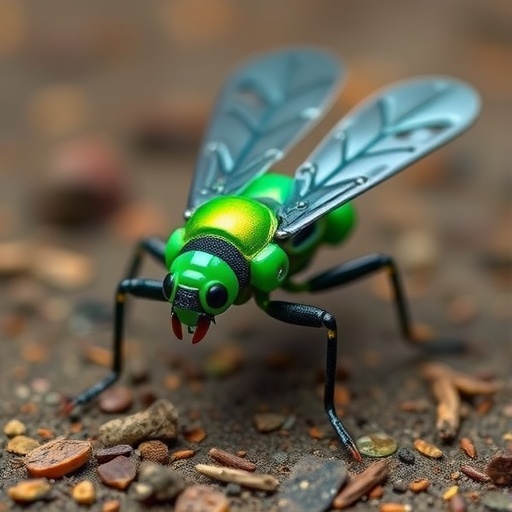
A tiny robot inspired by dragons, qilins, chimeras, fish, and sea lions has demonstrated an unusual combination of speed, strength, and agility. Developed by researchers at the Harbin Institute of Technology, the insect-scale miniature piezoelectric robot can move rapidly across the ground, turn within a space only slightly wider than its own body, and carry loads many times heavier than itself. The results suggest that small robots may no longer have to choose between being fast and being strong.
The robot’s design is based on the idea of combining useful traits from different animals. Fish can propel themselves across land by striking the ground with their tails, while otariids, including sea lions, use their powerful hindlimbs to drive their bodies forward and their forelimbs to provide support. The researchers translated these biological strategies into a three-legged machine with one active driving leg and two passive supporting legs. This hybrid architecture allows the robot to generate propulsion and maintain stability without relying on a complex collection of actuators.
The tethered prototype measures just 38 millimeters in length and weighs 8.6 grams. Its central driving leg contains four lead zirconate titanate, or PZT, piezoelectric elements arranged in two orthogonal groups. When sinusoidal electrical signals are applied with a phase difference of 90 degrees, the elements generate first-order bending vibrations in two perpendicular planes. The combined vibrations make the foot trace an elliptical path, allowing it to interact with the ground and convert high-frequency oscillation into forward or rotational movement.
Unlike many miniature robots that require separate mechanisms for propulsion and steering, this machine uses the same driving leg for both functions. By changing the actuation conditions and mechanical orientation of the leg, the researchers can produce either forward motion or turning. The two supporting legs are fitted with wheels, creating a foot-wheel support scheme that reduces friction at the front of the robot while allowing the vibrating driving foot to deliver thrust at the rear. This arrangement simplifies the robot’s structure while preserving a surprisingly broad range of movement.
During testing, the robot reached a maximum forward speed of 313.49 millimeters per second. That is equivalent to approximately 8.25 body lengths per second, a performance comparable to the relative speeds of many insects. It also achieved an angular velocity of 11.54 radians per second and a minimum turning radius of only 12.64 millimeters. Such maneuverability could allow the robot to operate in narrow passages, damaged infrastructure, pipe networks, and other environments in which conventional wheeled or legged machines would struggle to turn.
The researchers found that the robot’s performance depended strongly on its leg geometry, tilt angle, and weight distribution. Increasing the angle of the driving leg relative to the ground and shifting the center of mass forward improved straight-line speed. In contrast, reducing the tilt angle and moving the weight toward the rear enhanced turning performance. These adjustments alter the direction and efficiency of the contact forces produced by the oscillating foot, demonstrating how small changes in mechanical configuration can substantially affect the behavior of a millimeter-scale machine.
One of the most striking findings emerged when the team added external loads. Rather than slowing down, the tethered robot became faster as additional weight was applied. Under a 200-gram load—23.26 times the robot’s own mass—it continued to exceed 300 millimeters per second. The researchers attribute this counterintuitive result to improved contact between the driving foot and the ground. Greater normal force reduces slipping and enables more of the piezoelectric leg’s vibration to be converted into useful movement. A performance metric combining load ratio and speed produced a value of 312.8, substantially higher than those reported for comparable miniature robots.
The team also created a fully untethered version by adding a 100-mAh battery and a compact control unit. The upgraded robot weighs 20.9 grams, including its electronics, but still reached 265 millimeters per second while carrying a 180-gram load, or 8.63 times its own weight. Its reported cost of transport, a measure of the energy required to move a given weight over a given distance, was only 1.91. The robot could operate continuously for approximately 70 minutes on one charge, an unusually long endurance for a piezoelectric machine of this scale.
To test its practical mobility, the researchers constructed a narrow tunnel 75 millimeters wide containing turns of 15 degrees. Using joystick control, they guided the untethered robot through the course, where it navigated the confined route smoothly. The demonstration points toward possible applications in disaster debris, collapsed buildings, industrial inspection, and other locations where small machines could enter spaces inaccessible to people or larger robots. Because the robot is compact, fast, and capable of carrying a substantial payload, it could eventually transport sensors or communication equipment through hazardous environments.
The current machine is manually controlled, but the researchers are developing visual sensing and closed-loop control systems that could give it autonomous navigation capabilities. A future version might detect obstacles, estimate its position, and adjust its leg angle or actuation signals in real time. The work, published in Cyborg and Bionic Systems, shows how combining multiple biological strategies can produce a simple yet powerful robotic architecture. By merging the propulsion of a fish-like tail with the support strategy of a sea lion’s limbs, the researchers have created a tiny robot that challenges the assumption that miniature machines must sacrifice speed, endurance, or carrying capacity.
Web References: https://doi.org/10.34133/cbsystems.0525
References: Cyborg and Bionic Systems, published July 23, 2026
Keywords
Miniature robotics, piezoelectric robot, biomimetic robot, untethered robot, insect-scale robot, PZT actuator, microrobotics, robotic locomotion, autonomous navigation, search and rescue robotics
Cite Scienmag News
Denise Maddox. (August 4, 2026). Researchers unveil untethered insect-scale piezoelectric robot with multiple biomimetic capabilities. Scienmag. https://scienmag.com/researchers-unveil-untethered-insect-scale-piezoelectric-robot-with-multiple-biomimetic-capabilities/
Denise Maddox. "Researchers unveil untethered insect-scale piezoelectric robot with multiple biomimetic capabilities." Scienmag, 4 August 2026, https://scienmag.com/researchers-unveil-untethered-insect-scale-piezoelectric-robot-with-multiple-biomimetic-capabilities/. Accessed 4 September 2026.
Denise Maddox. "Researchers unveil untethered insect-scale piezoelectric robot with multiple biomimetic capabilities." Scienmag. August 4, 2026. https://scienmag.com/researchers-unveil-untethered-insect-scale-piezoelectric-robot-with-multiple-biomimetic-capabilities/


