


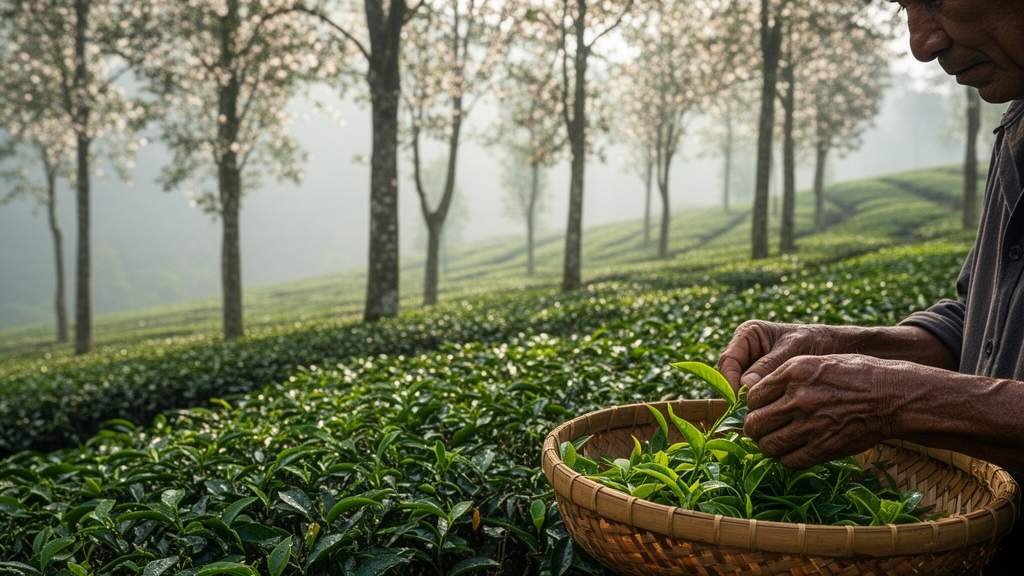
Green tea is one of the most widely consumed beverages on Earth, and its commercial value rests almost entirely on flavor. Amino acids, catechins, caffeine, and a constellation of volatile compounds collectively determine whether a cup tastes sweet and umami-rich or bitter and harsh. Yet decades of intensive monoculture in tea plantations have degraded soils, eroded biodiversity, and, according to mounting evidence, diminished tea quality itself. A new study published in Food Chemistry: X offers a striking demonstration that the identity of the trees planted alongside tea bushes can profoundly reshape the chemistry of the leaves—and with it, the sensory experience of the infusion.
Researchers led by Yanan Liu and Yinxiang Gao of Jiujiang University compared three cultivation systems in a twelve-year-old tea field at Hailu Tea Expo Park in Jiujiang City, Jiangxi Province, China. The systems comprised monoculture tea, tea intercropped with Osmanthus fragrans, the fragrant sweet osmanthus, and tea intercropped with Photinia serratifolia, an aromatic woody species with its own distinctive secondary metabolism. Fresh shoots consisting of one bud and one leaf were harvested from the Lushan Yunwu tea population on April 5, 2024, and processed into green tea under identical conditions. No fertilizer was applied throughout the trial, ensuring that any chemical differences in the finished tea could be attributed to the companion trees rather than to nutrient inputs.
The team integrated three complementary analytical approaches: sensory evaluation by five professional panelists holding national tea assessor certificates, quantitative profiling of non-volatile taste compounds by liquid chromatography, and characterization of volatile aroma compounds by headspace solid-phase microextraction coupled with gas chromatography–mass spectrometry. The sensory panel, working under blind conditions with randomized sample codes, scored appearance, liquor colour, fragrance, flavor, and infused leaf characteristics following the Chinese national standard GB/T 23776–2018. The results were unambiguous: the Osmanthus intercropping system achieved the highest comprehensive sensory score, characterized by a pronounced umami taste, persistent sweetness, mild bitterness, and delicate astringency. The Photinia system, by contrast, displayed a floral aroma but stronger bitterness and astringency relative to the Osmanthus treatment.
The chemical basis for these sensory differences emerged clearly from the amino acid analysis. Total amino acid concentrations reached 33.49 milligrams per gram in the Osmanthus system, compared with 29.80 in the Photinia system and 24.78 in monoculture. The three principal umami-contributing amino acids—glutamic acid, aspartic acid, and theanine—reached their highest concentrations in the Osmanthus treatment, with theanine alone accounting for 40.88 percent of total amino acids. Sweet-tasting amino acids, including serine, glycine, alanine, and proline, were also significantly higher under Osmanthus intercropping. In contrast, the Photinia system accumulated the highest levels of bitter-tasting amino acids at 8.57 milligrams per gram, providing a chemical explanation for its harsher taste profile.
The catechin analysis revealed an equally dramatic divergence. Both intercropping systems promoted total catechin accumulation relative to monoculture, but they reshaped catechin composition in opposite directions. The Photinia system exhibited the highest esterified catechin content at 61.23 milligrams per gram, with epigallocatechin gallate, the principal contributor to bitterness and astringency, reaching a taste activity value of 595.93—far above the threshold of perception. The Osmanthus system preferentially accumulated non-esterified catechins such as epigallocatechin and epicatechin, which impart a milder mouthfeel and reduce excessive astringency. Caffeine, gallic acid, and theobromine were also significantly higher in the Photinia treatment, compounding its bitter character. The researchers note that umami substances, including theanine, glutamic acid, and aspartic acid, can mitigate the bitterness of esterified catechins through hydrogen bonding, particularly under moderate catechin concentrations—a mechanism that appears to have favored the Osmanthus treatment.
Volatile compound analysis identified 85 aroma-active components across the three systems, classified into seven categories including 23 terpenes, 26 alkanes, 16 alcohols, 8 esters, 4 aldehydes, 4 ketones, and 4 other compounds. The Osmanthus system exhibited the highest total volatile content and the greatest diversity, with 80 compounds detected compared with 69 in monoculture. Multivariate statistical analysis using principal component analysis and partial least-squares discriminant analysis clearly separated the three treatment groups, with linalool exhibiting the highest variable importance in projection score at 2.55 and reaching its greatest concentration of 101.19 micrograms per kilogram in the Osmanthus treatment. The terpene alcohols linalool, geraniol, and nerolidol—well-recognized contributors to floral aroma—accumulated predominantly under Osmanthus intercropping, along with the appearance of heptanal, a lipid-derived aldehyde associated with fresh, fruity, and green aroma notes that was entirely absent from monoculture tea.
The Photinia system developed its own distinctive aromatic signature, dominated by jasmonate-related volatiles. Cis-jasmone, which imparts a jasmine-like aroma even at low concentrations, reached its maximum relative odor activity value of 1.62 in the Photinia treatment, while methyl jasmonate, a key terpenoid ester contributing elegant orchid-like floral notes, reached 0.67. Delta-cadinene, a woody and herbal terpene, also peaked in the Photinia system at 2.95. These findings indicate that the two companion species were associated with fundamentally different volatile metabolic profiles in the tea bushes, with Osmanthus favoring floral terpene alcohols and Photinia enriching jasmonate-related and woody terpene compounds.
The researchers are careful to acknowledge the limitations of their design. Because each cultivation system was represented by a single composite tea sample, statistical comparisons should be interpreted as descriptive rather than as independently replicated field treatment effects. Environmental variables such as canopy microclimate, light availability, temperature, humidity, and rhizosphere conditions were not directly measured, so their potential contributions to the observed metabolic differences remain hypotheses rather than demonstrated mechanisms. The study also did not preserve matched fresh-leaf samples for parallel analysis, meaning the researchers cannot determine whether the observed chemical differences were already present in the fresh shoots or emerged during processing. Future studies incorporating non-aromatic companion species with comparable canopy architecture, root-barrier treatments, and direct monitoring of volatile emissions would be valuable for disentangling these mechanisms.
Nevertheless, the findings carry significant implications for sustainable tea cultivation. As long-term monoculture continues to degrade tea plantation ecosystems worldwide, intercropping with aromatic woody species offers a strategy that can simultaneously enhance biodiversity and modulate tea quality. The study demonstrates that companion tree identity matters enormously: Osmanthus fragrans intercropping appears more suitable for producing premium green tea with enhanced freshness and floral aroma, whereas Photinia serratifolia intercropping may be more appropriate for developing teas with intense floral characteristics and a distinctive jasmine-like profile. The integrated analysis identified 19 taste-active compounds and eight aroma-active compounds closely associated with quality differences among the systems, providing a theoretical basis for companion species selection and precision management in tea agroforestry. In an era when consumers increasingly demand both environmental sustainability and exceptional flavor, the humble choice of which tree to plant beside a tea bush may prove to be one of the most consequential decisions a tea grower can make.
Subject of Research: Plant Science
Article Title: Species-dependent variation in flavor profile and sensory quality of green tea under aromatic woody intercropping systems
Article References: Liu, Y., He, Y., Yao, L., Shi, X., Liu, J., Zhang, L., Chen, G., Yu, C., Huang, J., & Gao, Y. (2026). Species-dependent variation in flavor profile and sensory quality of green tea under aromatic woody intercropping systems. Food Chemistry: X, Article 104647. https://doi.org/10.1016/j.fochx.2026.104647
Image Credits: AI Generated
DOI: 10.1016/j.fochx.2026.104647
Keywords: green tea, intercropping, agroforestry, food chemistry, flavor science, sustainable agriculture, metabolomics, tea quality, Species-dependent, variation, flavor, profile
Cite Scienmag News
Bethany Barker. (October 17, 2026). Aromatic Tree Neighbors Can Reshape the Taste and Aroma of Green Tea. Scienmag. https://scienmag.com/aromatic-tree-neighbors-can-reshape-the-taste-and-aroma-of-green-tea/
Bethany Barker. "Aromatic Tree Neighbors Can Reshape the Taste and Aroma of Green Tea." Scienmag, 17 October 2026, https://scienmag.com/aromatic-tree-neighbors-can-reshape-the-taste-and-aroma-of-green-tea/. Accessed 17 October 2026.
Bethany Barker. "Aromatic Tree Neighbors Can Reshape the Taste and Aroma of Green Tea." Scienmag. October 17, 2026. https://scienmag.com/aromatic-tree-neighbors-can-reshape-the-taste-and-aroma-of-green-tea/


