


In recent years, the Arctic has become a focal point of scientific inquiry and public concern due to its rapid and unprecedented changes. A groundbreaking study published in Communications Earth & Environment in 2026 sheds new light on the complex interconnections between Arctic sea ice decline and the atmospheric phenomena known as sudden stratospheric warmings (SSWs), which have profound implications for winter weather patterns across the Northern Hemisphere. This research led by Rao, Garfinkel, Cohen, and their colleagues delves deeply into the increasing frequency of successive SSW events and how this trend is closely linked with the ongoing reduction of Arctic sea ice. Their findings suggest that these changes in the polar region are not only a symptom of climate change but actively contribute to colder and more extreme winters over large continental regions in the Northern Hemisphere.
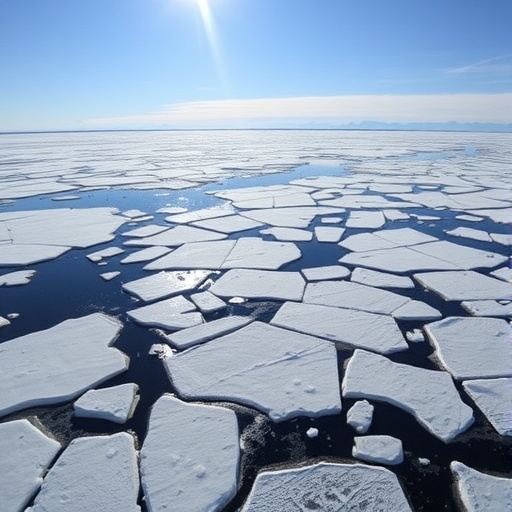
The Arctic sea ice cap, covering millions of square kilometers, has been shrinking at an alarming rate due to global warming. This decline, documented extensively by satellite observations, is having ripple effects far beyond the polar region. As the sea ice retreats earlier in the season and forms later in the year, surface temperatures in the Arctic increase dramatically. This warming affects the stability and dynamics of the stratosphere, the layer of Earth’s atmosphere located approximately 10 to 50 kilometers above the surface. Within the stratosphere, sudden stratospheric warmings occur when polar temperatures abruptly rise by tens of degrees over a matter of days, disrupting the polar vortex – a persistent cyclonic circulation that typically confines cold air to polar latitudes.
Rao and colleagues’ study reveals an alarming trend: as Arctic sea ice diminishes, successive sudden stratospheric warming events – often occurring twice or more within a single winter season – are becoming more frequent. Such compounded SSW activity differs significantly from the long-studied isolated SSW events and appears to have unique influences on weather patterns. By using advanced climate models and analyzing decades of observational data, the researchers demonstrate that these successive warmings weaken the polar vortex multiple times in a season, causing prolonged disruptions in the stratospheric circulation. This results in an increased likelihood of cold air outbreaks traveling southward into mid-latitude continents.
The implications of this discovery are multifaceted. While Arctic amplification — the phenomenon where the Arctic warms faster than the rest of the planet — has been understood to cause shifts in jet streams and weather patterns, the role of stratospheric processes adds a critical layer of complexity. Successive SSW events act as intensifiers, reinforcing these disruptions and leading to extended periods of anomalously cold weather across Europe, North America, and parts of Asia. This has real-world consequences for agriculture, energy demand, and human health, particularly as societies grapple with the paradox of a warming planet yet colder regional winters.
Central to the team’s analysis was the use of coupled ocean-atmosphere climate models that simulate interactions between diminishing sea ice and atmospheric circulation patterns. By perturbing sea ice conditions in these models, the researchers isolated the causal link between reduced ice cover and enhanced stratospheric warming events. Their simulations show a clear increase in the frequency of multiple SSWs within a single winter season under future warming scenarios—suggesting that such weather phenomena may become the “new normal” in decades to come if current trends continue unabated.
In addition to modeling efforts, the study incorporated comprehensive observational datasets ranging from satellite measurements of sea ice extent to stratospheric temperature profiles obtained through balloon soundings and reanalysis products. This multi-pronged approach confirmed that years marked by exceptionally low Arctic sea ice correspond to winters with higher incidences of successive SSWs. Furthermore, the researchers identified specific atmospheric wave patterns originating in the lower troposphere that amplify and propagate vertically into the stratosphere, triggering these warming events. This mechanistic insight helps explain how surface conditions in the Arctic can influence the dynamics of the stratosphere and, by extension, mid-latitude climate.
The phenomenon of successive sudden stratospheric warmings presents new challenges for seasonal weather prediction. Traditionally, forecasters consider the likelihood of a singular SSW event and its aftermath. However, the occurrence of multiple consecutive events complicates the predictability of winter weather, often leading to abrupt shifts between cold, warm, and volatile conditions. Recognizing this, Rao and colleagues emphasize the need to refine stratosphere-resolving climate models and integrate real-time stratospheric observational data into operational forecasts to better anticipate these shifts and mitigate their societal impacts.
Another crucial aspect of the study concerns the feedback mechanisms between Arctic sea ice loss and the stratosphere. The research illustrates a positive feedback loop wherein diminished sea ice triggers more frequent SSWs, which in turn influence tropospheric circulation patterns that can temporarily slow the recovery of sea ice through anomalous temperature and wind patterns. This complex interplay underscores the interconnectedness of Earth’s climate system components and highlights how localized changes in the polar region can have far-reaching and lasting effects.
Rao et al. also explore the broader climatic context by examining historical instances of sudden stratospheric warming events in relation to major Arctic ice minima. The correlations they found suggest that past episodes of low ice extent – particularly during notable cold winters in the 20th and early 21st centuries – likely involved successive SSWs, though this phenomenon has only recently been appreciated in the scientific literature. This retrospective analysis reinforces the importance of long-term observational datasets and the reanalysis archives that have helped climate scientists uncover new dimensions of atmospheric variability.
The research further prompts reconsideration of the links between human-induced climate change and extreme weather events. While it is well established that greenhouse gas emissions drive long-term warming trends, the findings of increasing successive SSW events emphasize that anthropogenic changes also alter atmospheric dynamics in ways that can transiently enhance cold extremes. This nuanced understanding is crucial for policymakers and stakeholders as it highlights that global warming does not only manifest as uniformly rising temperatures but can induce complex and sometimes counterintuitive regional climate effects.
Moreover, the study draws attention to implications for ecosystems and infrastructure in northern mid-latitudes. Increased frequency of severe cold spells due to stratospheric influences can stress agricultural production by shortening growing seasons and increasing frost damage. Similarly, energy systems have to cope with heightened demand for heating and potential disruptions from extreme weather. Urban populations may face increased health risks, particularly among vulnerable groups such as the elderly and those with preexisting respiratory conditions. These cascading consequences illustrate the societal relevance of the researchers’ findings.
Looking ahead, the authors call for enhanced international collaboration in monitoring and modeling stratospheric phenomena and Arctic changes. They advocate for deploying more sophisticated observational platforms in the Arctic, including stratospheric balloons, dedicated satellites, and ground-based sensors, to improve data quality and coverage. Such efforts would enable finer resolution of the timing and spatial characteristics of stratospheric warming events and their linkages to surface climate. This research paradigm shift could facilitate better early warnings and adaptation strategies in response to changing winter climates.
In conclusion, this seminal study not only confirms the critical role of Arctic sea ice decline in modulating stratospheric circulation but also reveals that multiple successive sudden stratospheric warmings are an emerging and potent driver of cold extremes in the Northern Hemisphere. As the planet continues to warm and the Arctic faces an uncertain future, understanding and predicting these interconnected phenomena will be absolute priorities. The work of Rao, Garfinkel, Cohen, and their team represents an essential step forward, equipping scientists and society with new insights into the dynamic ways our changing climate influences weather patterns in unexpected and sometimes paradoxical directions.
The intricate relationship between sea ice and sudden stratospheric warmings opens new avenues for climate science research, especially in the context of extreme weather variability and risk management. It challenges the simplistic narrative of a uniformly warming world by highlighting critical atmospheric mechanisms that can exacerbate winter cold spells. This perspective underscores the importance of integrative research approaches spanning cryosphere, atmosphere, and human systems to fully grasp the consequences of ongoing Arctic transformations.
Ultimately, the findings presented in this 2026 study confront us with a sobering reality: as Arctic sea ice continues to retreat, the Northern Hemisphere may experience not only warmer summers but also more frequent and severe winters driven by stratospheric dynamics. This emerging pattern calls for urgent scientific attention and policy measures aimed at mitigating climate change and enhancing resilience to its multifaceted impacts.
Rao, J., Garfinkel, C.I., Cohen, J. et al. Arctic sea ice decline, increasing successive sudden stratospheric warmings and cold northern hemisphere continents. Commun Earth Environ (2026). https://doi.org/10.1038/s43247-026-03604-x
Cite Scienmag News
Violet Maxwell. (May 11, 2026). Arctic Ice Decline Triggers Sudden Stratospheric Warmings. Scienmag. https://scienmag.com/arctic-ice-decline-triggers-sudden-stratospheric-warmings/
Violet Maxwell. "Arctic Ice Decline Triggers Sudden Stratospheric Warmings." Scienmag, 11 May 2026, https://scienmag.com/arctic-ice-decline-triggers-sudden-stratospheric-warmings/. Accessed 3 September 2026.
Violet Maxwell. "Arctic Ice Decline Triggers Sudden Stratospheric Warmings." Scienmag. May 11, 2026. https://scienmag.com/arctic-ice-decline-triggers-sudden-stratospheric-warmings/


