


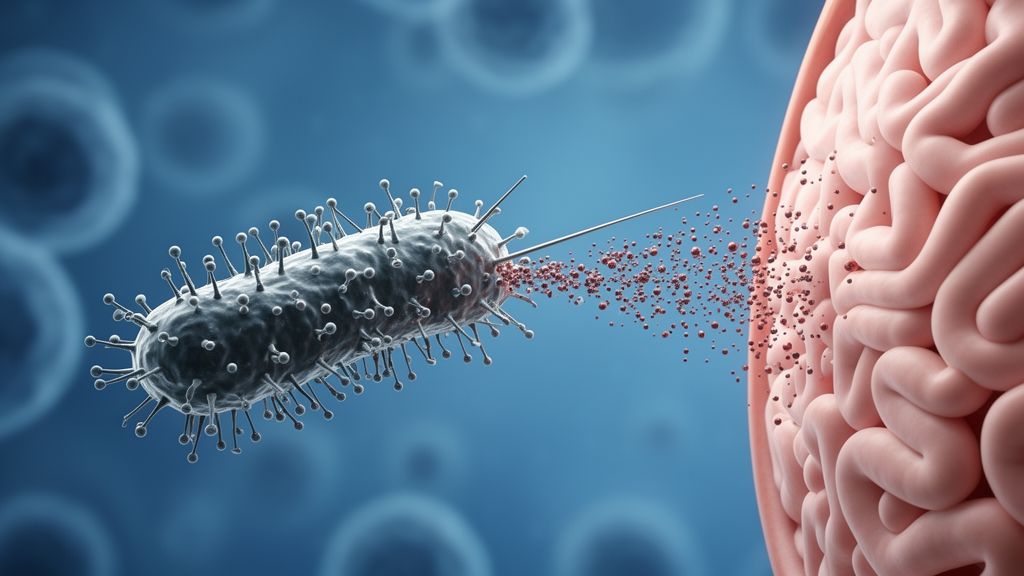
Mycobacterium abscessus, an environmental bacterium that has become a notorious threat to people with cystic fibrosis and other chronic lung diseases, carries only two of the five protein secretion systems found in its more famous relative, Mycobacterium tuberculosis. Yet one of those two systems, the ancestral ESX-4 apparatus, is essential for the pathogen to survive inside immune cells. A new study published in Frontiers in Tuberculosis has now mapped, in fine molecular detail, the genes that switch this system into action, uncovering a hidden arsenal of candidate toxins, enzymes and structural proteins that may explain how M. abscessus dismantles the compartments designed to destroy it.
Type VII secretion systems, known as ESX systems, are molecular machines that span the waxy, lipid-rich mycobacterial cell envelope and push proteins from the cytoplasm to the cell surface or beyond. Each system is built from a conserved set of core components and typically exports a signature pair of small WXG100 proteins that fold together into a four-helix bundle. In M. tuberculosis, the ESX-1 system secretes the virulence factors EsxA and EsxB, which are central to the bacterium’s ability to escape from phagosomes and damage host tissue. Slow-growing mycobacteria generally encode five ESX systems with distinct roles, ranging from iron and zinc acquisition through ESX-3 to host interaction through ESX-1 and ESX-5. M. abscessus, a rapid-growing species that lives in soil and water but can also cause serious pulmonary infections, encodes only ESX-3 and ESX-4, making the ancestral ESX-4 system unusually important for its dual life as a free-living saprophyte and an intracellular pathogen.
The research team, led by Todd Gray and Keith Derbyshire at the Wadsworth Center in Albany, New York, focused on a transcriptional regulator called SigM, an alternative sigma factor that directs RNA polymerase to specific promoters. In M. tuberculosis and the model organism M. smegmatis, SigM is known to co-induce ESX-4 genes and putative secreted substrates. In M. smegmatis, both SigM and ESX-4 are essential for conjugation, a contact-dependent process of DNA transfer between donor and recipient cells, and the SigM regulon there includes six of the seven esx4 core genes. The researchers hypothesized that in M. abscessus, SigM would similarly coordinate expression of the ESX-4 machinery together with the effector proteins it secretes, potentially including the factors responsible for phagosomal survival.
To test this, the team constructed a precise, scarless deletion of the sigM-rsmA locus in M. abscessus strain ATCC 19977, removing 1,580 base pairs that encode SigM together with RsmA, its dedicated anti-sigma factor. They complemented the mutant with a plasmid expressing sigM from a constitutive promoter. The researchers then performed RNA sequencing on mid-log-phase cultures of the wild-type strain, the deletion mutant and the complemented derivative, obtaining roughly ten million reads per replicate and quantifying gene expression with standard bioinformatic pipelines. Comparing transcript levels across the three strains allowed them to identify mRNAs that respond to SigM, while the deletion strain revealed which genes depend on the regulator under normal growth conditions.
The analysis defined a remarkably coherent regulon: 15 loci encoding 50 genes, each transcribed from a promoter containing a recognizable SigM-binding site. Using motif discovery on the sequences upstream of each induced operon, the team identified a single enriched consensus motif with a highly significant probability score, aligned at a GGAACCG sequence at the minus-35 position. Ten promoters matched the consensus precisely and the remaining five were near-matches, indicating that these genes are direct transcriptional targets of SigM rather than downstream consequences of indirect regulation. Notably, the motif logo also revealed an adenine-rich region just upstream of the minus-35 site, a feature the authors speculate may contribute to regulon gene expression in the GC-rich mycobacterial genome.
Within the esx4 locus itself, the picture differed strikingly from M. smegmatis. In M. abscessus, SigM directly induced only the esxUT operon, which encodes EsxU and EsxT, the WXG100 pair that serves as the primary secretion substrate for ESX-4. Transcript levels of esxUT dropped in the deletion strain and rose above wild-type levels upon SigM complementation, while transcription of the other esx4 core genes was not reduced in the deletion mutant and only marginally elevated in the complemented strain. This suggests that the production of the ESX-4 secretion apparatus in M. abscessus is controlled by other transcription factors, with SigM reserved for boosting the supply of secreted cargo. The authors interpret this as evidence that M. smegmatis requires ESX-4 function specifically under conditions that activate SigM, whereas M. abscessus deploys ESX-4 secretion more broadly, in situations separate from those that trigger SigM.
To understand what the SigM-regulated genes might do, the researchers turned to protein structure prediction using AlphaFold and AlphaFold 3, visualizing the models with molecular graphics software and supplementing them with database annotations and structural homology searches. The results revealed three recurring classes of candidate secretion substrates. The first comprises WXG100-family proteins, including EsxU and EsxT themselves as well as homologs of the M. tuberculosis proteins EsxE and EsxF, all predicted to form the characteristic four-helix bundles with juxtaposed WXG and YXXXD/E secretion signal motifs. The second class consists of PE and PPE proteins, named for their proline- and glutamic acid-rich amino termini, which typically function as heterodimeric pairs; several predicted PE/PPE complexes were found in the regulon, including one accompanied by a predicted EspG-like chaperone, mirroring the ternary complexes described in other mycobacteria. The third class includes monomeric substrates such as an EspB-like protein that carries both the four-helix bundle and the secretion signal in a single polypeptide.
Beyond structural hallmarks, many of the 50 genes encode enzymatic activities with obvious implications for host interaction. Two operons encode predicted NlpC/P60 domain peptidases, enzymes associated with cell wall hydrolysis and remodeling; in M. smegmatis, a SigM-regulated NlpC/P60 protein is induced in the recipient cell upon donor contact and is required for conjugation. Another operon carries a homolog of CpnT, a necrosis-inducing toxin secreted by ESX systems in M. tuberculosis that is required for survival in macrophages, co-transcribed with EsxE and EsxF homologs, suggesting that toxin secretion in M. abscessus may depend on the adjacent Esx proteins. Additional genes encode an alpha/beta hydrolase of the kind found in mycobacteriophage lysins, a beta-lactamase-like protein, kinase-like domains and a chemotaxis protein. A striking recurrent feature is the DUF3558 domain, a small module of 177 to 195 amino acids found throughout actinomycetes: six of the 50 regulon genes carry it, a marked enrichment given that M. abscessus encodes only 11 such proteins in total. Whether DUF3558 proteins act as secretion chaperones or as effectors themselves remains an open question for future study.
The evolutionary implications of the findings are considerable. ESX-4 is regarded as the progenitor of the mycobacterial ESX systems, which arose through successive gene duplication and specialization. The composition of the M. abscessus SigM regulon supports this model: most of its operons encode PE/PPE-class substrates that are predominantly secreted by ESX-5 in other mycobacteria, and other loci encode EspB and EspG homologs typically associated with ESX-1 and ESX-5. This is consistent with M. abscessus retaining an ancestral ESX-4 system that performs a broad range of functions later delegated to specialized descendant systems elsewhere in the mycobacterial lineage. A survey of 96 M. abscessus isolates showed that twelve of the fifteen operons are present in at least 90 of them, indicating that the regulon is broadly conserved across the species, although the NlpC/P60 and CpnT operons are found in only 39 and 72 isolates respectively, hinting at strain-specific variation in effector repertoires.
The practical significance of the work lies in the connection to pathogenesis. Previous studies in mouse models and in macrophage and amoeba infection systems showed that mutations in esx4 core genes completely attenuate M. abscessus and that the system blocks phagosome acidification while promoting phagosome lysis, granting the bacilli access to the cytosol. Until now, the specific secreted activities underlying this behavior were unknown. By defining the SigM regulon as a set of 15 directly induced loci whose products carry the structural signatures of ESX secretion substrates, the study provides a concrete shortlist of effector candidates for the phagosomal survival roles previously attributed to ESX-4. The authors note that basal transcription of the regulon provides steady expression suitable for rapid responses, while specific contacts or environmental conditions activate SigM to boost production of the secreted proteins. Disrupting this regulatory circuit, or the effectors it controls, could offer a route to new therapeutic strategies against an organism that is already among the most drug-resistant bacteria infecting human lungs.
Subject of Research: SigM-dependent transcriptional regulation of the ESX-4 type VII secretion system and its candidate effector proteins in Mycobacterium abscessus
Article Title: Sigma factor M induces an ESX-4-focused regulon in Mycobacterium abscessus
Article References: Canestrari, J. G., Gianola, S., Derbyshire, K. M., & Gray, T. A. (2026). Sigma factor M induces an ESX-4-focused regulon in Mycobacterium abscessus. Frontiers in Tuberculosis, 4, Article 1797268. https://doi.org/10.3389/ftubr.2026.1797268
Image Credits: AI Generated
DOI: 10.3389/ftubr.2026.1797268
Keywords: Mycobacterium abscessus, SigM, ESX-4, type VII secretion system, WXG100 proteins, PE/PPE proteins, RNA-seq, sigma factor, nontuberculous mycobacteria, phagosomal survival, DUF3558, AlphaFold
Cite Scienmag News
Kristina Jarvis. (October 17, 2026). Ancient Secretion System Reveals Its Hidden Arsenal in a Troublesome Lung Pathogen. Scienmag. https://scienmag.com/ancient-secretion-system-reveals-its-hidden-arsenal-in-a-troublesome-lung-pathogen/
Kristina Jarvis. "Ancient Secretion System Reveals Its Hidden Arsenal in a Troublesome Lung Pathogen." Scienmag, 17 October 2026, https://scienmag.com/ancient-secretion-system-reveals-its-hidden-arsenal-in-a-troublesome-lung-pathogen/. Accessed 17 October 2026.
Kristina Jarvis. "Ancient Secretion System Reveals Its Hidden Arsenal in a Troublesome Lung Pathogen." Scienmag. October 17, 2026. https://scienmag.com/ancient-secretion-system-reveals-its-hidden-arsenal-in-a-troublesome-lung-pathogen/


