


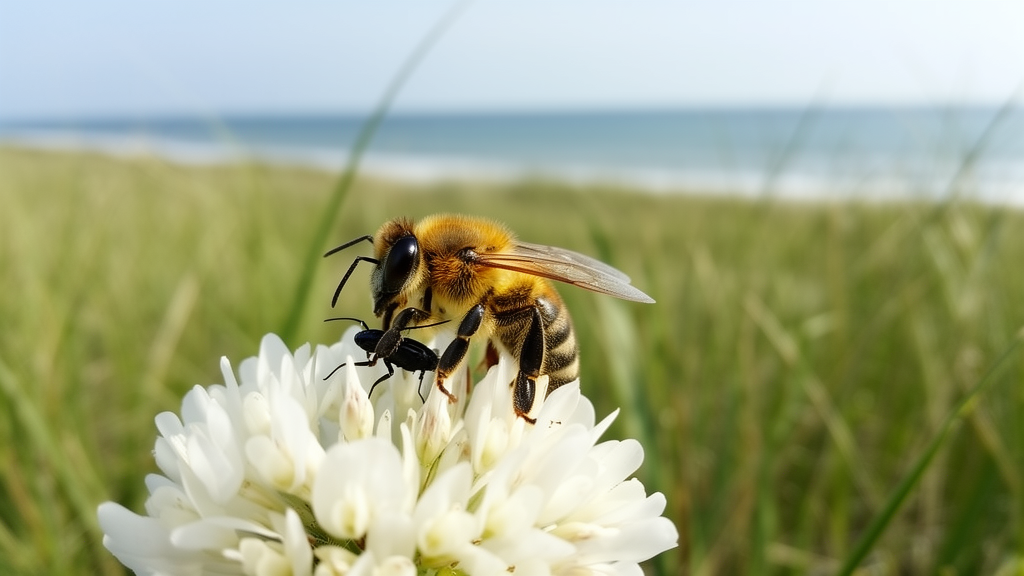
Deep in the coastal thickets of Hainan Island, a tiny drama has been unfolding inside the hollowed-out twigs of a beach shrub. Scientists collecting the nests of a small, emerald-tinged carpenter bee have stumbled upon something entirely unexpected: a brand-new species of parasitoid wasp, never before recorded anywhere in China, quietly feeding on the bee’s larvae. The discovery, published in the Biodiversity Data Journal, not only adds a new name to the catalogue of life but also raises urgent questions about how conservationists boost pollinator populations in fragile island ecosystems.
The new species, formally described as Aximopsis qiong, belongs to a cosmopolitan group of parasitoid wasps in the family Eurytomidae, a lineage currently comprising 43 described species found across the globe except in Australia and Antarctica. The genus Aximopsis, as broadly defined, is a taxonomic puzzle: its boundaries remain unstable, and recent molecular phylogenies suggest it is not a natural, single-origin group. Roughly half of its known species fall within the so-called nodularis species group, parasitoids of endophytic insects—creatures that live hidden inside branches, stems, or leaf mines. While a handful of eurytomid species in Europe and North America have been documented attacking small carpenter bees of the genus Ceratina, no member of Aximopsis had ever been recorded from China until now.
The host bee, Ceratina smaragdula, is no obscure insect. Widely distributed across southern Asia, this small carpenter bee is a significant pollinator sustaining both natural plant communities and agricultural productivity. On Hainan Island and its associated archipelagos, it plays a particularly vital role in coastal ecosystems, where it extensively nests in the dead twigs of the native littoral shrub Scaevola taccada. The research team, led by scientists from the South China Botanical Garden and the Institute of Zoology, both part of the Chinese Academy of Sciences, collected nest-bearing twigs from two sources: naturally occurring dead branches along roadsides showing telltale circular entrance holes and accumulated wood dust, and artificial trap nests made of sun-dried twigs placed in PVC holders near Scaevola thickets. Fieldwork spanned from September 2023 to December 2025, covering the peak nesting season of the host bees, at sites in Wenchang Town on Hainan Island itself and on Yongxing Island in the Sansha City archipelago.
Back in the laboratory, each twig was carefully dissected lengthwise under a stereomicroscope. Brood cells containing parasitoid larvae or pupae were kept individually in ventilated tubes and checked daily for adult emergence. The last parasitoids emerged in June 2026. What emerged was a species the team recognised as new to science: a gregarious ectoparasitoid, meaning multiple larvae feed externally on a single host, with several host larvae within a single nest tube parasitised. From 12 parasitised nests in Wenchang, the researchers reared 71 females and 20 males, a strikingly female-biased sex ratio of 3.6 to 1. Individual parasitised hosts typically bore between one and five parasitoids. Adults emerged in late May on Yongxing Island and in August in Wenchang, suggesting regional variation in emergence timing.
Morphologically, the new species is a study in chalcidoid architecture. The female holotype measures 5.1 millimetres, with a black body, yellow scape, pedicel, and first flagellomere on the antenna, and broadly reddish legs apart from black coxae. The head is 2.5 times as wide as long in dorsal view, with a smooth scrobal depression completely delimited by carinate ridges. The mesosoma bears a dense punctured sculpture with narrow interspaces, a horizontal ventral shelf on the mesopleuron, and a completely delimited epicnemium—features that define the genus. The propodeum slopes gently at roughly 50 to 60 degrees relative to the main body axis, and the gaster is lanceolate, about 1.5 times as long as the mesosoma. Males are considerably smaller, around 2.2 millimetres, with entirely dark brown to black antennae bearing distinctly pectinate flagellomeres armed with two rows of long, white, erect setae. The species is provisionally placed in the nodularis group based on a suite of characters including a conspicuous mesopleuron ventral shelf, carinate fore coxae, a distinctly petiolate female metasoma, and male funicular segments with two convex apices covered in long pubescence.
Distinguishing Aximopsis qiong from its closest relative, the European Aximopsis nodularis, required careful comparison. The new species differs in antenna colouration—its scape, pedicel, and first flagellomere are yellow, whereas those of A. nodularis are entirely black—and in the ratio of the marginal vein to the parastigmal vein, which is subequal in A. nodularis but more than twice as long in A. qiong. Hair on the mesepimeron is present in the new species but absent in its European counterpart. These diagnostic characters, along with detailed illustrations of both sexes, are provided in the publication to aid future identification.
To probe the evolutionary relationships of this enigmatic lineage, the team extracted genomic DNA from the right fore-leg of four specimens and amplified the mitochondrial cytochrome oxidase subunit 1 gene, a standard barcode region for insect phylogenetics. Combining these new sequences with publicly available data from related taxa, they reconstructed a phylogenetic tree using maximum-likelihood methods under the best-fitting evolutionary model, assessed with 1000 ultrafast bootstrap replicates. The result was telling: Aximopsis, as currently defined, did not emerge as a single natural group. Instead, it was repeatedly rendered paraphyletic by the genus Chryseida, echoing recent phylogenomic analyses that also recovered a tangled relationship between Aximopsis and the New World genera Axima and Chryseida. The new species was recovered as sister to Aximopsis balajasi and Aximopsis collina, though with only weak statistical support, underscoring just how unstable the current generic boundaries remain.
The discovery carries ecological weight beyond taxonomy. Ceratina smaragdula is a key wild pollinator in Hainan’s coastal ecosystems, and the finding that it faces significant parasitoid pressure from a strongly female-biased, gregarious enemy is a concern for pollinator management. Artificial trap nests constructed from native plant materials are increasingly promoted as an effective strategy for monitoring and augmenting solitary bee populations to enhance pollination services. The research confirms that Ceratina smaragdula readily accepts such nests, making it a promising candidate for managed population enhancement in island and coastal restoration projects. Yet the same trap nests, without precautions, may inadvertently function as concentrated breeding resources for the parasitoid, facilitating its local population increase and intensifying parasitism pressure on the very pollinator the programme aims to support. The authors recommend that trap-nesting programmes implement routine inspections and, where feasible, remove or destroy parasitised brood cells before parasitoid emergence.
There is also an intriguing biogeographic twist. Ceratina smaragdula has recently been documented as an invasive species in Hawai’i, which might invite speculation about deploying the new parasitoid for biological control. The authors caution against this: the lack of host specificity documented in related species, such as the broad-host-range Aximopsis nodularis, makes such an application highly uncertain. The primary value of documenting Aximopsis qiong in its native range, they argue, lies in the warning it provides for local conservation. In Hainan, where the bee serves as a key pollinator, trap-nesting programmes could inadvertently spread the parasitoid and undermine pollination services. Management efforts should prioritise excluding the parasitoid from augmented bee populations rather than promoting it as a biocontrol agent.
Ultimately, the discovery of Aximopsis qiong expands the known distribution and host range of this parasitoid lineage while spotlighting the pressing need for a comprehensive taxonomic revision of Aximopsis sensu lato. As molecular tools continue to reveal that morphologically defined genera in this group do not map cleanly onto evolutionary history, each new species described becomes both a data point and a reminder that the smallest insects—hidden inside hollow twigs on remote island shores—can reshape our understanding of biodiversity, evolution, and the delicate balance between pollinators and their enemies.
Subject of Research: New parasitoid wasp species Aximopsis qiong discovered in Hainan, China, parasitising the coastal pollinator bee Ceratina smaragdula
Article Title: First record of Aximopsis s.l. ( Hymenoptera , Eurytomidae ) from China, with description of a new species parasitising the larvae of the coastal pollinator Ceratina smaragdula ( Hymenoptera , Apidae )
Article References: Li, Z., Zhang, Y. M., Liu, Z., Luo, S., & Chen, H. (2026). First record of Aximopsis s.l. (Hymenoptera, Eurytomidae) from China, with description of a new species parasitising the larvae of the coastal pollinator Ceratina smaragdula (Hymenoptera, Apidae). Biodiversity Data Journal, 14, Article e206796. https://doi.org/10.3897/bdj.14.e206796
Image Credits: AI Generated
Keywords: Aximopsis qiong, Ceratina smaragdula, parasitoid wasp, Eurytomidae, pollinator conservation, Hainan, First, record, Aximopsis, Hymenoptera, China, description
Cite Scienmag News
Julie Wynn. (October 17, 2026). Tiny Parasitoid Wasp Discovered in China Attacks a Beloved Coastal Pollinator Bee. Scienmag. https://scienmag.com/tiny-parasitoid-wasp-discovered-in-china-attacks-a-beloved-coastal-pollinator-bee/
Julie Wynn. "Tiny Parasitoid Wasp Discovered in China Attacks a Beloved Coastal Pollinator Bee." Scienmag, 17 October 2026, https://scienmag.com/tiny-parasitoid-wasp-discovered-in-china-attacks-a-beloved-coastal-pollinator-bee/. Accessed 17 October 2026.
Julie Wynn. "Tiny Parasitoid Wasp Discovered in China Attacks a Beloved Coastal Pollinator Bee." Scienmag. October 17, 2026. https://scienmag.com/tiny-parasitoid-wasp-discovered-in-china-attacks-a-beloved-coastal-pollinator-bee/


