


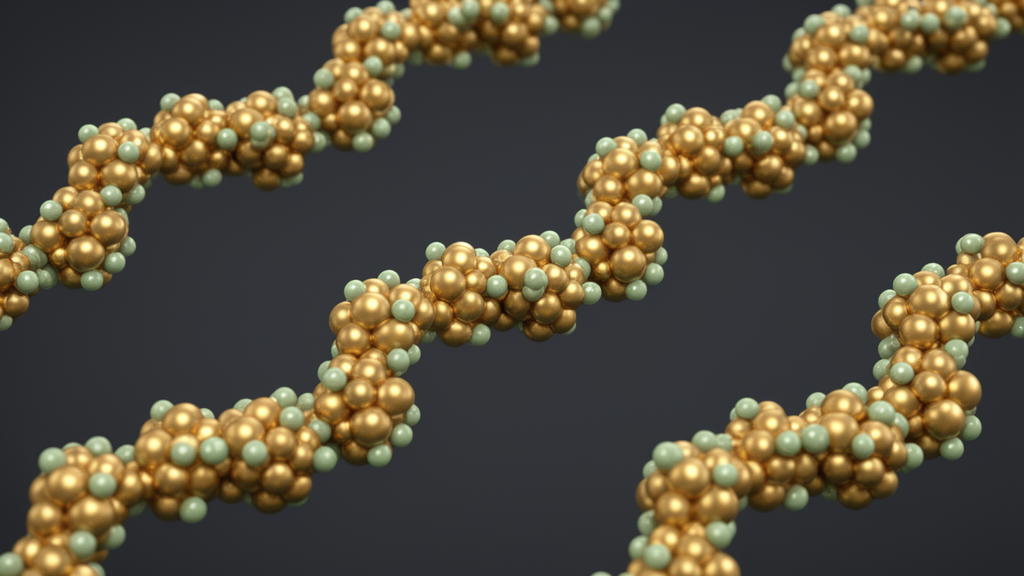
Gold has a secret weakness for itself. In 1988, chemists noticed that certain gold(I) compounds contain two gold atoms sitting closer together than any conventional force should allow, and the phenomenon was soon given a name of its own: aurophilicity, the affinity of gold for gold. Now a research team spanning Nankai University in Tianjin and the VINCA Institute in Belgrade has shown that this peculiar attraction is powerful enough to act as the master architect of an entire family of hyperchlorinated gold clusters, dictating their shapes, their growth, and even which members of the family survive the violence of a laser blast. The findings, published in Frontiers in Chemistry, map the structural landscape of Au(n)Cl(n+5)− cluster anions with two to seven gold atoms, a series whose stable geometries and interaction patterns had remained largely unexplored compared with their better-characterized low- and medium-chloride cousins.
The experimental side of the study relied on laser desorption/ionization time-of-flight mass spectrometry, a technique in which a pulsed ultraviolet nitrogen laser at 337 nanometers strikes a sample and ejects ions that can then be sorted by mass. The researchers deposited tiny droplets of an aqueous chloroauric acid solution, HAuCl4, onto a stainless-steel target plate with no organic matrix, and fired 300 laser shots per spectrum. Earlier work had already revealed that clusters of the general formula Au(n)Cl(n+m)−, with m equal to 1, 3, 5, or 7, appear in such spectra, but the chlorine-richest members, the Au(n)Cl(n+5)− series, had never been systematically characterized. The new measurements show that these hyperchlorinated anions are not random debris. At an optimal laser intensity of 2,300 arbitrary units, the Au3Cl8− anion emerges as the most abundant species in the entire spectrum, with Au2Cl7− and Au4Cl9− also producing strong signals, while Au5Cl10− and Au6Cl11− appear with considerably lower intensities.
The most striking result of the intensity analysis is that cranking up the laser power reverses the abundance hierarchy of the clusters. At a low laser intensity of 1,300 units, the relative peak intensities for the two-gold-atom series follow the order Au2Cl3− greater than Au2Cl5− greater than Au2Cl7−, meaning the chlorine-poor species dominate. At 2,300 units, that order flips completely, and the chlorine-richest anion becomes the most abundant. The same reversal appears for the three- and four-gold-atom series, where Au3Cl8− and Au4Cl9− rise from minor players to dominant species as the laser fluence increases. The interpretation offered by the team is thermodynamic: higher laser intensity rapidly raises the concentration of free chlorine atoms in the plume, so reactions that add two chlorine atoms at a time to a growing cluster become thermodynamically favored, steering the population toward the chlorine-rich end of the family.
To understand what these ions actually look like, the researchers turned to density functional theory. Global minimum searches were conducted with a basin-hopping-style algorithm supplemented by manually constructed isomers, and the resulting candidate structures were optimized in Gaussian 09 at the TPSSh level of theory. For gold, the calculations employed the ECP60MDF relativistic pseudopotential with its associated MDF60 basis set, a choice that captures the relativistic effects known to be indispensable in gold chemistry, while chlorine atoms were described with the aug-cc-pVTZ basis set. Frequency analyses confirmed every optimized structure as a true minimum on its potential energy surface, and zero-point energy corrections were included in all reported binding energies. The team notes that no counterpoise correction for basis-set superposition error was applied, though the large augmented triple-zeta basis substantially mitigates that error, and full corrected calculations are left for future higher-level work.
The computed global minima tell a remarkably consistent structural story. Except for the smallest member, Au2Cl7−, every cluster in the series adopts a nearly planar zigzag geometry, echoing the motifs previously established for the Au(n)Cl(n+1)− and Au(n)Cl(n+3)− series. In these frameworks, the two terminal gold atoms sit in a tetracoordinate Au(III) state, each bonded to four chlorine ligands, while the internal gold atoms carry a lower-coordinated Au(I) character. The zigzag backbone is invariably flanked by AuCl4− units at both ends, and additional chlorine atoms attach at positions vertical to the main chain. Isomers that relocate a single tetracoordinate Au(III) center from a terminal to an internal position pay an energetic penalty of roughly 6 to 11 kilocalories per mole, underscoring how strongly the terminal placement is preferred. Notably, low-lying isomers containing explicit Au-Au covalent bonds, which appear in the lower-chloride series, are absent among the most stable hyperchlorinated structures, likely because the pronounced excess of chlorine over gold atoms discourages such motifs.
The aurophilic analysis hinges on a simple distance criterion. The sum of the van der Waals radii for two gold atoms is 3.32 angstroms, while a typical covalent Au-Au bond measures about 2.72 angstroms, so aurophilic contacts are expected to fall between those two values. In the hyperchlorinated series, all terminal Au-Au distances, meaning the separations between a terminal Au(III) center and its neighbor, measure between 3.82 and 3.90 angstroms, well beyond the threshold and therefore showing no aurophilic attraction whatsoever. In stark contrast, every non-terminal distance, the spacing between two adjacent internal Au(I) centers, falls within a narrow window of 2.90 to 2.92 angstroms, confirming robust aurophilic bonding. Remarkably, these internal distances remain virtually invariant as the chain grows longer, and they are even marginally shorter than the corresponding distances reported for the lower-chloride series, suggesting that the extra chlorine atoms slightly enhance the aurophilic pull between the internal Au(I) centers along the backbone.
Two complementary electronic analyses confirm the origin of the interaction. Electron localization function maps show that the electron-pair density between terminal Au(III) and adjacent atoms is virtually nil, while a distinct localization domain emerges between internal Au(I) pairs, growing in area and intensity with cluster size until it reaches a plateau for clusters with four or more gold atoms. Natural bond orbital calculations reveal that the terminal Au(III) centers carry substantially higher positive charges, around +0.47 elementary charges, compared with roughly +0.34 for the internal Au(I) centers. The higher coordination number and oxidation state of Au(III) deplete its 5d electrons, reduce 6s occupancy, and increase 6p participation. Crucially, significant 5d/6s orbital delocalization occurs exclusively between adjacent internal Au(I) centers, identifying the electronic fingerprint of the aurophilic attraction, while negligible orbital mixing appears between terminal Au(III) and neighboring Au(I) centers. The aurophilic interaction first emerges at Au4Cl9− and rapidly stabilizes for larger clusters, a size-dependent saturation that mirrors the plateau seen in the localization maps.
The thermodynamic analysis completes the picture. The binding energy for the series is defined as the energy change for the incremental growth reaction in which an Au(n−1)Cl(n+4)− cluster captures an AuCl unit. All computed binding energies are negative, ranging from −188 to −176 kilojoules per mole, confirming that cluster growth is exothermic and that these anions are thermodynamically viable. With increasing nuclearity, the absolute binding energy decreases monotonically before converging asymptotically to approximately −176 kilojoules per mole, a convergence that parallels the trends in Au-Au bond lengths and electron localization. Comparison with the previously reported Au(n)Cl(n+1)− and Au(n)Cl(n+3)− series shows that this core thermodynamic behavior, the gradual convergence of binding energy and aurophilic strength, is largely invariant with respect to chloride content, although higher chloride substitution accelerates the size convergence.
The reaction-energy framework also explains the puzzling intensity patterns observed at low laser power. Certain ions, such as Au3Cl6− and Au4Cl7−, appear weaker than their neighbors under low fluence because their formation and depletion pathways release different amounts of energy. For Au3Cl6−, four reaction pathways were analyzed, releasing −187, −362, −183, and −357 kilojoules per mole respectively, and the balance among these competing routes determines the observed signal. Adding excess chlorine atoms to form Au3Cl10− introduces significant steric repulsion within the cluster, rendering that reaction far less thermodynamically favored, which is verified by the weak experimental signal of Au3Cl10−. As laser intensity rises, the chlorine atom concentration climbs, the two-chlorine-addition routes dominate, and the chlorine-rich anions prevail. Because the proposed reactions involve strong structural inheritance and do not require breaking chemical bonds, making them nearly barrierless, the assumption of thermodynamic rather than kinetic control is reasonable, the authors note.
The study closes with a provocative outlook. It is reasonable to expect that clusters with even higher chlorine-to-gold ratios, beyond the n+5 stoichiometry, could also exist, retaining similar yet extended zigzag backbones. Because the chlorine species concentration can potentially be modulated during synthesis, the structural flexibility and compositional diversity of these one-dimensional gold-halogen chains may open new avenues for catalytic activity in relevant reactions. The work demonstrates that aurophilicity, born from relativistic effects that make gold unlike any of its lighter congeners, is not merely a curiosity of coordination chemistry but a genuine structure-directing principle, one that sculpts matter at the nanoscale into precise one-dimensional architectures even under the{
Subject of Research: Aurophilicity as a structure-directing principle in hyperchlorinated AunCln+5- (2 ≤ n ≤ 7) clusters
Article Title: Aurophilicity as a structure-directing principle in hyperchlorinated AunCln+5- (2 ≤ n ≤ 7) clusters
Article References: Chen, Y., Xu, S., Wang, S., Li, S., Veljković, F., Veličković, S., & Kong, X. (2026). Aurophilicity as a structure-directing principle in hyperchlorinated AunCln+5- (2 ≤ n ≤ 7) clusters. Frontiers in Chemistry, 14, Article 1986508. https://doi.org/10.3389/fchem.2026.1986508
Image Credits: AI Generated
DOI: 10.3389/fchem.2026.1986508
Keywords: aurophilicity, gold clusters, gold chloride, mass spectrometry, density functional theory, Au(I), Au(III), relativistic effects, zigzag geometry, binding energy, NBO analysis, electron localization function
Cite Scienmag News
Bethany Barker. (October 17, 2026). Aurophilic attraction sculpts hyperchlorinated gold clusters into zigzag chains. Scienmag. https://scienmag.com/aurophilic-attraction-sculpts-hyperchlorinated-gold-clusters-into-zigzag-chains/
Bethany Barker. "Aurophilic attraction sculpts hyperchlorinated gold clusters into zigzag chains." Scienmag, 17 October 2026, https://scienmag.com/aurophilic-attraction-sculpts-hyperchlorinated-gold-clusters-into-zigzag-chains/. Accessed 17 October 2026.
Bethany Barker. "Aurophilic attraction sculpts hyperchlorinated gold clusters into zigzag chains." Scienmag. October 17, 2026. https://scienmag.com/aurophilic-attraction-sculpts-hyperchlorinated-gold-clusters-into-zigzag-chains/


