


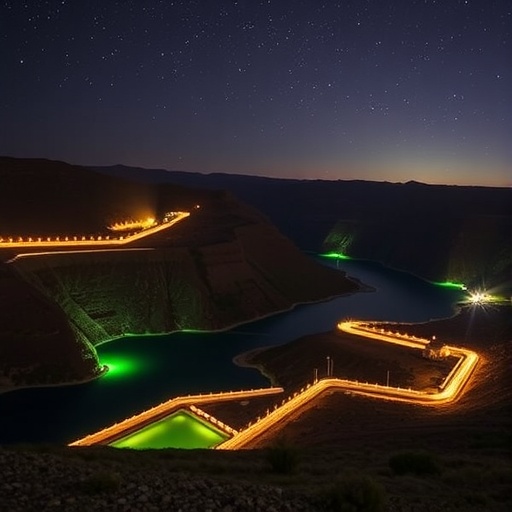
In the arid landscapes of Southern Kyrgyzstan, researchers have unearthed a remarkable archaeological find that sheds light on ancient subsistence strategies and environmental conditions. A water reservoir dating back to a period between the 3rd and 5th century AD has been identified as a potential key to understanding how societies thrived in the Fergana basin region during a time when agricultural practices and environmental dynamics were undergoing significant transformations. This remarkable discovery offers insight not only into historical water management but also into the socio-economic structures that revolved around sustenance and survival.
The reservoir itself is a testament to the engineering capabilities of the people who inhabited the region. Constructed to store and manage freshwater, it highlights the innovative approaches these ancient communities took to adapt to their environment. In contrast to modern-day infrastructural projects, which often prioritize immediate utility and financial gain, this ancient reservoir reflects a profound understanding of hydrology and resource management that sustained a community over centuries. The careful planning involved in its construction underscores the significance of water in the agrarian lifestyles of these past societies.
The research team, led by Kočár et al., undertook a comprehensive study of the reservoir site, utilizing various archaeological techniques to uncover not just the structure itself but also the cultural and environmental context surrounding it. Excavations revealed not only the physical remnants of the reservoir but also artifacts that signify the activities and lifestyles of the inhabitants. These findings are pivotal in reconstructing the subsistence strategies that enabled them to thrive in a challenging environment characterized by limited water resources.
Substantial evidence suggests that the region around the Fergana basin was not only a hub for agriculture but also served as a significant trade route. As the researchers delved deeper into the archaeological layers, they unearthed remains of crops and tools that hint at the agricultural practices employed by the inhabitants. The successful cultivation of crops linked to the reservoir would have played a crucial role in ensuring food security for the population, thus hinting at the sophisticated agricultural techniques that developed during this era.
With environmental conditions fluctuating, the reservoir likely offered a strategic advantage for these ancient peoples. By harnessing and effectively managing water resources, they could mitigate the impacts of drought or heavy rainfall, thus stabilizing their food supply. This stability would have fostered social cohesion and economic collaboration among surrounding communities, enabling them to engage in collective agricultural practices, share resources, and support one another during challenging periods.
In addition to its practical applications, the reservoir serves as a cultural artifact that encapsulates the relationship between the community and its environment. The construction and maintenance of such a facility may have also held social or ritual significance, serving as a gathering place for the local populace. The presence of communal projects like the reservoir could indicate a level of social organization and cooperation that is vital for sustaining larger populations.
The implications of their findings extend beyond the immediate understanding of ancient water management. This reservoir site offers a glimpse into the broader socio-political dynamics at play in the region. It poses questions about the governance structures that might have been in place, as well as the influence of external factors such as climate change or population shifts that could have dictated the necessity of such communal projects.
As Kočár and his team continue to analyze the data collected from the reservoir site, they aim to provide a nuanced understanding of the environmental adaptability of ancient societies in the Fergana basin. Their approach synthesizes archeology, anthropology, and environmental science, forming a holistic perspective that is crucial for comprehending how ancient civilizations arose and fell in relation to their changing climates and landscapes.
The project not only highlights historical accomplishments but also emphasizes the significance of preserving water sources in an era of climate uncertainty. It serves as a learning model for contemporary societies facing similar water management challenges, urging modern humans to re-evaluate their relationship with natural resources. Lessons from the past could inform future policies on sustainable water practices and agricultural developments.
In addition, the research could catalyze renewed interest in the Fergana basin as a historically rich area deserving of further exploration. As scholars and enthusiasts alike recognize the value of such regions, there is potential for the development of heritage tourism that honors these ancient achievements while educating the public about their importance.
As this study progresses, the science behind the ancient water reservoir will continue to unfold. The attention it garners may also inspire future research endeavors aimed at uncovering more about the lives of those who once thrived in this demanding landscape. In an era where historical narratives often get lost, the resurrection of such detailed accounts fosters a deeper appreciation for the resilience and ingenuity of past civilizations.
Ultimately, Kočár and his collaborators hope that their work will not only illuminate a crucial aspect of Kyrgyz history but also spark broader discussions about sustainability, environmental stewardship, and the lessons that past societies offer to contemporary communities. Through their meticulous research, they aim to contribute to a richer, more comprehensive historical narrative that respects the complexities of human adaptability to environmental change.
Through a combination of robust archaeological exploration and innovative thinking, the discovery of this reservoir exemplifies the importance of interdisciplinary collaboration in archaeology. The insights gained further emphasize the need to appreciate and learn from ancient technologies and subsistence strategies that have withstood the test of time, particularly in regions that continue to face environmental challenges today.
As we stand to gain both knowledge and wisdom from the stories told by such archaeological finds, the legacy of the water reservoir from the 3rd to 5th century AD may indeed echo throughout academic circles and the wider world. This research serves as an inspiring reminder of the enduring human spirit, adapting to and thriving in the complex interplay of environment, culture, and innovation.
Kočár, P., Sůvová, Z., Vatansever, A. et al. A water reservoir from the 3rd to 5th century AD as a possible key for understanding the subsistence strategies and environment at the margin of the Fergana basin in Southern Kyrgyzstan. Archaeol Anthropol Sci 18, 37 (2026). https://doi.org/10.1007/s12520-025-02389-y
Cite Scienmag News
Violet Maxwell. (February 2, 2026). Ancient Reservoirs Illuminate Fergana Basin’s Subsistence Strategies. Scienmag. https://scienmag.com/ancient-reservoirs-illuminate-fergana-basins-subsistence-strategies/
Violet Maxwell. "Ancient Reservoirs Illuminate Fergana Basin’s Subsistence Strategies." Scienmag, 2 February 2026, https://scienmag.com/ancient-reservoirs-illuminate-fergana-basins-subsistence-strategies/. Accessed 4 September 2026.
Violet Maxwell. "Ancient Reservoirs Illuminate Fergana Basin’s Subsistence Strategies." Scienmag. February 2, 2026. https://scienmag.com/ancient-reservoirs-illuminate-fergana-basins-subsistence-strategies/


