


At Vulci, one of Italy’s most important Etruscan centers, a burial chamber is offering scientists an unusually intimate view of Iron Age life. A new multidisciplinary study of Tomb 129 in the Poggio Mengarelli necropolis has combined the microscopic study of plant remains with chemical analysis of metal artifacts, revealing how technology, trade, environmental knowledge and social identity converged in the grave goods of a high-ranking woman buried between the late eighth and early seventh centuries B.C. The research shows that the objects placed in the tomb were not merely symbols of wealth. Their materials preserve evidence of deliberate choices made by craftspeople and communities who understood the practical properties of wood, fibers, copper alloys, silver and gold.
The burial contained a rich collection of ornaments, tools and other objects associated with elite female identity in early Etruscan society. Although many organic materials normally disappear from archaeological contexts, fragments of wood, textile fibers and plant components survived through mineralization, corrosion and close contact with metal. These traces allowed researchers to reconstruct parts of the material world surrounding the deceased. Under light microscopy, plant tissues and fibers were examined for diagnostic anatomical features, including cell structure, arrangement and morphology. Such evidence can distinguish broad categories of wood and identify the structure of textile materials even when the original organic substance has been heavily altered by burial.
The botanical evidence indicates that local plant resources were selected consciously rather than used at random. Wood species were chosen according to characteristics such as density, flexibility, resistance to splitting and suitability for shaping. These properties would have mattered when producing handles, shafts, structural elements or small components of tools and ornaments. The findings suggest that Etruscan craftspeople possessed detailed practical knowledge of the vegetation around them. They understood that different woods performed differently under pressure, impact and repeated handling, and they matched those characteristics to the intended function of each object.
This discovery adds an important environmental dimension to the archaeology of Vulci. Plants in an ancient tomb are not simply remnants of the surrounding landscape; they can record decisions about procurement, manufacturing and cultural meaning. A locally available species may have been preferred because it was strong, easy to work or associated with familiar traditions. The study therefore treats plant remains as evidence of human behavior as well as ecology. In Tomb 129, the selection of botanical materials points to a community that interacted closely with its environment and transformed natural resources into objects designed for both everyday use and ceremonial display.
The metal collection was investigated through energy-dispersive X-ray fluorescence, or EDXRF, a non-invasive technique widely used in the study of archaeological objects. When X-rays strike a metal surface, atoms in the material emit secondary radiation at energies characteristic of individual chemical elements. By measuring these energies, researchers can detect and estimate the presence of elements such as copper, tin, lead, arsenic, antimony, silver and gold without removing samples from valuable artifacts. In this study, 34 metal objects, including bronzes, golds and silvers, were examined to investigate their compositions and manufacturing traditions.
The researchers strengthened the XRF results with Monte Carlo simulation, a computational method that models how X-rays travel through and interact with complex materials. Archaeological objects rarely have perfectly flat, clean surfaces. They may be curved, rough, corroded, layered or covered by products formed during burial. These conditions can distort the signals recorded by an instrument, making a surface appear chemically different from the metal beneath it. Monte Carlo calculations simulate millions of possible interactions between incoming and emitted X-rays, allowing the team to account for surface geometry, corrosion and matrix effects. This improves alloy discrimination and supports more quantitative estimates of composition.
The chemical signatures provide clues about the raw materials and technical processes used in Etruria. Traces of arsenic, antimony and silver in copper-based objects are consistent with the use of sulfide ores as raw copper materials. These elements can survive as geological and metallurgical fingerprints, although their interpretation requires caution because melting, recycling and corrosion may alter their concentrations. The results nonetheless suggest that Etruscan metalworkers were working within technological traditions linked to the treatment of naturally complex copper ores. Rather than relying on chemically pure copper, they managed materials whose minor elements could influence hardness, casting behavior, color and durability.
The precious-metal objects reveal another level of technical control. The study identifies intentional combinations of gold, silver and copper characteristic of Iron Age precious alloys. These metals can be mixed to modify color, hardness, melting behavior and workability, while also affecting the visual impression of an ornament. Such compositions were not necessarily accidental impurities. They could reflect deliberate recipes or the repeated use of established metal stocks. The research also helps distinguish between solid precious-metal alloys and objects whose appearance may have been produced through surface enrichment or gilding, an essential distinction when interpreting the economic and symbolic value of ancient jewelry.
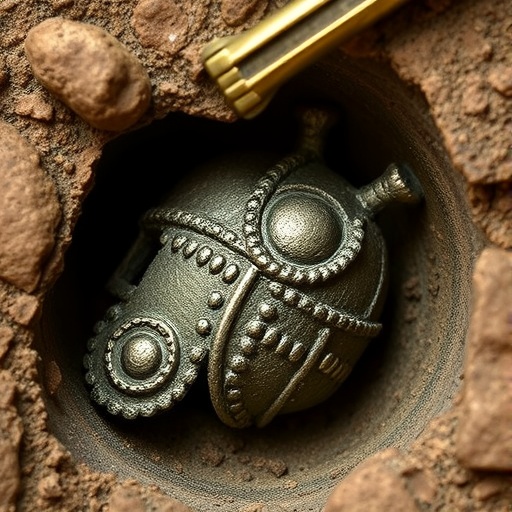
Among the most striking objects are ornaments with different artistic and cultural styles, including scarab-shaped pendants. Scarabs were associated with Egyptian symbolism and circulated widely through Mediterranean exchange networks. Their presence at Vulci does not prove that the objects or their makers came directly from Egypt, but it demonstrates that Etruscan communities participated in a world of long-distance contact in which motifs, technologies and prestige goods moved between regions. The pendants therefore provide material evidence for cultural interaction involving Etruscans and other Mediterranean peoples. In the tomb, their meaning may have included protection, status, exotic appeal or affiliation with prestigious traditions beyond central Italy.
By bringing archaeobotany and archaeometallurgy together, the study transforms a collection of grave goods into a record of interconnected choices. The plant remains reveal how natural materials were selected and engineered for mechanical purposes, while the metal analyses expose decisions about ores, alloying and surface appearance. Together, they show that elite Etruscan objects depended on sophisticated knowledge extending from forests and fields to furnaces and workshops. Tomb 129 also illustrates how technology could communicate identity: local resources grounded the objects in their landscape, while precious alloys and foreign-inspired ornaments connected the deceased to wider systems of exchange. The findings offer a vivid picture of early Etruria as a society capable of combining environmental expertise, advanced craftsmanship and international cultural curiosity.
Cite Scienmag News
Courtney Benton. (August 25, 2026). Ancient Etruscan Tomb Reveals Links Between Plant Remains and Metal Artifacts. Scienmag. https://scienmag.com/ancient-etruscan-tomb-reveals-links-between-plant-remains-and-metal-artifacts/
Courtney Benton. "Ancient Etruscan Tomb Reveals Links Between Plant Remains and Metal Artifacts." Scienmag, 25 August 2026, https://scienmag.com/ancient-etruscan-tomb-reveals-links-between-plant-remains-and-metal-artifacts/. Accessed 4 September 2026.
Courtney Benton. "Ancient Etruscan Tomb Reveals Links Between Plant Remains and Metal Artifacts." Scienmag. August 25, 2026. https://scienmag.com/ancient-etruscan-tomb-reveals-links-between-plant-remains-and-metal-artifacts/


