


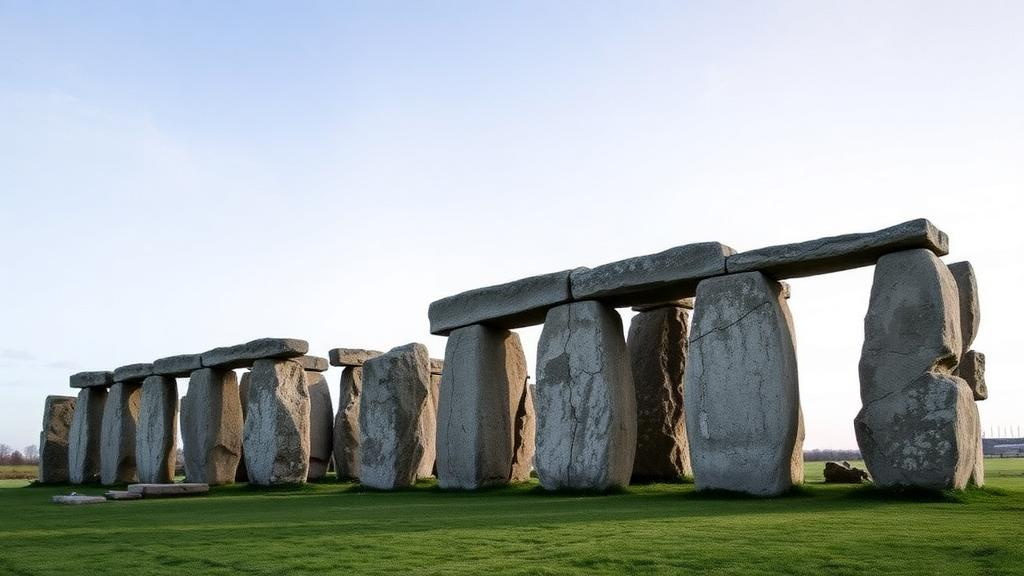
Britain’s tallest surviving prehistoric stone row has finally given up one of its most closely guarded secrets. The Devil’s Arrows, three towering monoliths that stand near Boroughbridge in North Yorkshire, were raised by communities who deliberately hauled stones weighing more than 25 tonnes each across at least 18 kilometres of rugged terrain, according to new research led by Curtin University in collaboration with the University of York. The study, published in the Proceedings of the Royal Society A, is the first to pin down the geological source of the gigantic stones, tracing them to the dramatic gritstone outcrops of Brimham Rocks, a landscape now protected by the National Trust and famous for its wind-sculpted rock formations.
The finding overturns a long-standing assumption about where the stones came from. Plumpton Rocks, a source considerably closer to the monument, had previously been identified as the most probable origin of the Arrows. By reading the microscopic mineral fingerprints locked inside the stones, the research team demonstrated that this earlier identification was wrong. The builders of the Devil’s Arrows, rather than taking the nearest convenient boulders, chose to quarry and transport their material from a far more distant and challenging location, a decision that speaks volumes about the values and beliefs of the people who undertook one of the most ambitious engineering projects of Neolithic and Early Bronze Age Britain.
The technical breakthrough at the heart of the study lies in a remarkably gentle sampling technique. Standing stones of this significance cannot simply be drilled or chipped without causing damage to monuments that have survived for four thousand years, so the team developed a low-impact method that uses adhesive tape to lift tiny mineral grains directly from the rock surface. The grains collected in this way are individual crystals of minerals such as zircon, which act as geological time capsules. When these crystals form deep within the Earth’s crust, they incorporate trace amounts of uranium, which decays to lead at precisely known rates, allowing scientists to calculate the age at which each grain crystallised.
Because the rocks at any given outcrop carry a distinctive population of crystal ages, effectively a geological fingerprint, the researchers could compare the age spectra recovered from the Devil’s Arrows with samples from candidate source areas. The match to Brimham Rocks proved decisive. The age distributions recorded in the stones aligned with the Brimham geology and excluded the alternatives, including the previously favoured Plumpton Rocks. Just as importantly, the data helped rule out natural transport mechanisms. Glaciers moving through the region during the Ice Age could in principle have carried large boulders across the landscape, and glacial erratics have long been invoked to explain the placement of many megaliths. The evidence from the mineral grains indicates that the Arrows were not glacial visitors but were intentionally selected, moved and erected by human hands.
The scale of that human effort is difficult to overstate. Each of the stones weighs in excess of 25 tonnes, and the tallest members of the row rise to around seven metres above the ground, with a substantial portion of each monolith set into the earth to keep them upright. Moving masses of this size across 18 kilometres of undulating terrain, without wheels, cranes or draught animals, would have required sledges, timber rollers, ropes, earthen ramps and, above all, extraordinary planning and coordination. Dr Anthony Clarke, lead author of the study from the Timescales of Mineral Systems Group within Curtin’s School of Earth and Planetary Sciences, emphasised that the logistics alone reveal a society capable of organising labour on a remarkable scale, marshalling hundreds of people over what must have been weeks, months or even years of sustained work.
What makes the new results especially provocative is what they suggest about motivation. If the builders had simply wanted large stones, closer sources were available. The decision to travel to Brimham Rocks instead implies that the source landscape itself carried meaning. Dr Clarke noted that prehistoric people placed real importance on the landscape, and that the location from which the stones came likely held significance for them. Brimham Rocks, with its extraordinary weathered outcrops of Millstone Grit, would have been one of the most visually striking natural places in the region, a landmark that may have been woven into local myth, ritual or identity long before a single stone was cut. In this reading, the Arrows are not merely an engineering achievement but a physical link between two special places, carrying the authority of one landscape into another.
Co-author Dr Jim Leary of the University of York framed the discovery as a fundamental reshaping of how archaeologists understand monument-building in prehistoric Britain. Ancient communities, he argued, were making deliberate and meaningful choices about where their stones came from, choices bound up with landscape, shared belief systems and the social value of effort itself. This perspective aligns with a broader shift in archaeological thinking over recent decades, away from viewing megalithic monuments purely in terms of function or efficiency and towards seeing them as expressions of worldview, memory and communal identity. The journey of a stone from its source to its final resting place may have been as symbolically charged as the monument it ultimately formed, with the act of transport itself serving to bind communities together and to embed the finished structure with stories that everyone involved could recount.
The Devil’s Arrows themselves remain one of the most enigmatic monuments of the British Neolithic and Early Bronze Age. Standing in a lowland setting near Boroughbridge, they form a rare example of a stone alignment in such terrain, oriented roughly north to south. Only three stones survive today, though evidence suggests the row may originally have included more. The stones are believed to have been transported and erected during the Late Neolithic or Early Bronze Age, possibly around 2000 BC, a period that also saw the major phases of activity at Stonehenge and other great ceremonial centres. Their sheer height makes them the tallest surviving stone row in Britain, and their presence on the low ground between the rivers Ure and Nidd has invited speculation for centuries about their role in processional routes, territorial markers or astronomical observations, questions that the new geological evidence will now help to reframe.
The research also opens a practical path forward for the study of standing stones everywhere. Because the tape-based sampling method removes nothing visible from the monument, it can be applied to stones whose origins remain unknown, including many of the several hundred megalithic monuments scattered across the British Isles and beyond. Dr Clarke and his colleagues plan to extend the technique to other standing stones with unresolved sources and to conduct targeted excavations at both the Devil’s Arrows and the newly identified source site at Brimham Rocks. Those excavations could recover evidence for the extraction of the stones, traces of the routes they travelled, and dating material that would establish more precisely when the operation took place, turning a geological provenance study into a fuller narrative of one of prehistoric Britain’s most extraordinary construction projects.
For the National Trust, which cares for Brimham Rocks, the discovery forges a direct and unexpected bond between two of Yorkshire’s most celebrated landscapes. Justin Scully, General Manager for Fountains Abbey and Studley Royal and Brimham Rocks, welcomed the research as a new chapter in the story of the stones, one that deepens understanding of the people who shaped this landscape thousands of years ago and adds to the meaning that local communities attach to the Arrows today. The study, titled Deliberate Prehistoric Sourcing of the Devil’s Arrows, Britain’s Tallest Stone Row, stands as a striking demonstration of how modern mineral science can illuminate ancient intention. Four thousand years after the monoliths were raised, the microscopic crystals inside them have testified that their journey was no accident of ice or convenience, but a conscious act of devotion, ambition and skill.
Subject of Research: Provenance of the stones of the Devil's Arrows prehistoric monument in Yorkshire
Article Title: Prehistoric builders hauled 25-tonne stones 18km to build Britain’s tallest stone row
Article References: Prehistoric builders hauled 25-tonne stones 18km to build Britain’s tallest stone row. (n.d.). Original publication
Image Credits: AI Generated
DOI: Not provided
Keywords: Devil's Arrows, Brimham Rocks, Neolithic, megaliths, standing stones, geochronology, zircon dating, North Yorkshire, prehistoric monuments, Curtin University, stone transport, Proceedings of the Royal Society A
Cite Scienmag News
Violet Maxwell. (October 6, 2026). Ancient builders hauled 25-tonne stones 18 kilometres to raise Britain’s tallest stone row. Scienmag. https://scienmag.com/ancient-builders-hauled-25-tonne-stones-18-kilometres-to-raise-britains-tallest-stone-row/
Violet Maxwell. "Ancient builders hauled 25-tonne stones 18 kilometres to raise Britain’s tallest stone row." Scienmag, 6 October 2026, https://scienmag.com/ancient-builders-hauled-25-tonne-stones-18-kilometres-to-raise-britains-tallest-stone-row/. Accessed 6 October 2026.
Violet Maxwell. "Ancient builders hauled 25-tonne stones 18 kilometres to raise Britain’s tallest stone row." Scienmag. October 6, 2026. https://scienmag.com/ancient-builders-hauled-25-tonne-stones-18-kilometres-to-raise-britains-tallest-stone-row/


