


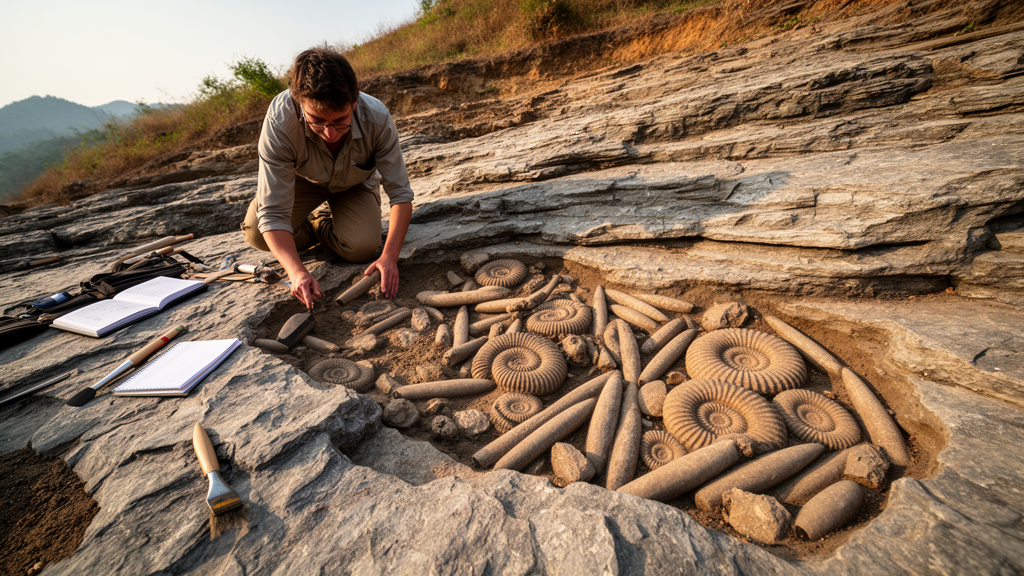
Deep in the sun-baked badlands of Kachchh in western India, a thin band of rock barely two metres thick has yielded one of the most remarkable ammonite hauls ever assembled from the Late Jurassic. Within a burrowed layer of mixed sandstone and carbonate in the Jhuran Formation, near the village of Lakhapar in the Jara Dome, palaeontologists recovered 85 ammonite specimens from a single fossil horizon. Of these, 72 belong to a single enigmatic genus: Hildoglochiceras, a discoidal, compressed ammonite with a distinctive lateral groove running along its flanks. The find has now become the subject of the first population-level study of this genus ever attempted, and the results are shaking up more than a century of assumptions about what these animals were, when they lived, and how far they wandered.
The study, published in the journal Zitteliana, treats the Lakhapar assemblage not as a scattering of isolated curiosities but as a true biological population. Using multivariate statistics, the researchers measured shell diameter, whorl height, whorl thickness, and umbilical width across dozens of specimens, then subjected the data to hierarchical clustering, principal component analysis, and linear regression modelling. The verdict is striking: the ammonites show high phenotype instability, with transient forms blurring the boundaries between the two named morphospecies, Hildoglochiceras kobelli and H. kobelliforme. Rather than two separate species, the statistical evidence points to something far more elegant — a dimorphic pair, in which the smaller, wider-umbilicated kobelliforme is the microconch and the larger, tighter-coiled kobelli is the macroconch of one and the same biological species.
Dimorphism — the existence of two distinct adult body forms within one species — is a well-known phenomenon in ammonites, generally interpreted as the difference between male and female animals. But proving it requires large samples from a single horizon, something Late Jurassic rocks in Kachchh rarely provide. Dominant depositional conditions in the basin, which was steadily filling with siliciclastic sediment towards the Early Cretaceous, meant that ammonites were generally rare except at a few horizons. The Lakhapar bed, roughly 357 metres above the base of the Jhuran Formation, is one of those exceptions. It interrupts largely restrictive conditions for ammonites in the area, recording a transgressive pulse and a maximum flooding zone — a moment when rising seas briefly opened the shelf to these free-swimming cephalopod relatives of squid and cuttlefish.
The horizon itself is a palaeontological treasure chest. Apart from the Hildoglochiceras assemblage, it contains haploceratids, a taramelliceratin ammonite, a single specimen of Aulacosphinctoides, an incomplete virgatosphinctin, and a benthic macrofauna of more than sixty taxa, including bivalves, gastropods, brachiopods, belemnites, echinoids, crinoids, decapods, and sponges. Wood fragments are common, most of them bored by bivalves. Vertebrate remains include rib fragments, vertebrae, and an articulated flipper of a marine reptile, probably an ichthyosaur. The bed records a time of low net sedimentation, when the influx of coarse-grained siliciclastics gradually ceased and carbonate mud accumulated during extended low-energy periods, with intense bioturbation mixing the two sediment types into a poorly sorted, condensed unit.
The statistical analysis went further than simple clustering. Linear regression revealed that the diameter of the umbilicus — the coiled opening at the centre of the shell — is best predicted by the combined effect of shell diameter and whorl height, with a regression coefficient of 0.96 and a p-value below 0.0001. Whorl thickness, by contrast, contributes the least to umbilical formation, with p-values of 0.09 and 0.46 in the relevant models. This means that some variation in shell thickness is essentially irrelevant at the population level, and that the ammonites were constructionally constrained in how their shells could grow. The principal component analysis separated the assemblage into two distinct clusters corresponding to the microconch and macroconch morphs, but also revealed about eighteen specimens sitting halfway between the two — a character overlap that the authors interpret as evidence of a single palaeobiological population rather than a mixture of species.
The implications extend well beyond Kachchh. Hildoglochiceras has long been known from the Himalayas, Pakistan, Madagascar, Tanzania, and possibly Argentina, but always as scattered single specimens or small samples with imprecise stratigraphy. The new study confirms the genus is endemic to the shelf areas fringing the Trans-Erythraean Trough, the seaway that would eventually become the Indian Ocean. Its restriction to these palaeomargins explains why the ammonite never achieved the wide geographic range of its Tethyan cousins. The comprehensive review of biostratigraphic interpretations conducted by the authors shows that the assumed range of Hildoglochiceras has fluctuated wildly over the decades — from the uppermost Kimmeridgian to the lowermost Upper Tithonian — but most probably the genus was restricted to, or at least better represented in, Lower Tithonian horizons.
Part of the confusion stems from a misinterpretation inherited from the middle of the twentieth century. Arkell in 1956 wrongly assumed that Hildoglochiceras co-occurred with Pseudolissoceras in Mexico, based on a careless reading of Imlay’s work. Zeiss in 1968 accepted this error and promoted a correlation of Hildoglochiceras horizons with the Tethyan Semiforme Zone in Europe, an interpretation that was uncritically accepted for decades. The Mexican-Cuban forms were later correctly reinterpreted as the genus Salinites, which is Late Tithonian to Early Berriasian in age. The new study argues that the usual correlation with the Semiforme/Verruciferum Zone is not supported by published ammonite biostratigraphy, and instead correlates the Lakhapar Hildoglochiceras Horizon with the lower part of the Albertinum/Darwini Zone in the Secondary Standard Scale for European and West-Tethyan ammonite bio-chronostratigraphy.
The single taramelliceratin specimen in the assemblage, tentatively assigned to the Taramelliceras compsum–kachhense group or to Parastreblites sp. gr. hoelderi, provides a crucial biostratigraphic anchor. Its stratigraphic range in west-Tethyan areas extends to the lower part of the Lower Tithonian, and its co-occurrence with Hildoglochiceras in Kachchh and Madagascar suggests that the oldest records of the latter genus are older than usually interpreted. The specimen may have been reworked, suggesting that the emersion surface at the base of the Hildoglochiceras Horizon — marked by an irregular, iron-crusted top of the underlying calcareous sandstone — may represent a wide stratigraphical gap. The lowermost level of the horizon contains abundant juvenile Hildoglochiceras and haploceratids, hinting at a sudden colonisation event when conditions briefly became favourable.
What emerges from this study is a portrait of an ammonite genus that was environmentally restricted, phenotypically unstable, and stratigraphically elusive. Hildoglochiceras thrived during transgressive pulses on epicontinental shelves surrounding the Trans-Erythraean Trough, but its records are scattered across areas where ammonite-poor or barren siliciclastic deposits, stratigraphic gaps, and local tectonic forcing conspired to mask its true range. The authors favour a local rather than wide regional significance for Hildoglochiceras records before they can be used for precise correlation across the trough. Future research with bed-by-bed sampling is needed before inferring the age of the youngest records within the Tithonian, but variation in biostratigraphic ranges must be expected from separate areas, each of which should be interpreted with clear statements about data reliability.
For now, the Lakhapar assemblage stands as the most relevant record of Hildoglochiceras available anywhere in the world. It demonstrates that these ammonites, far from being a diverse array of species, were probably a single dimorphic species whose two adult forms had been mistaken for separate taxa for over a century. It confirms the genus as an endemic inhabitant of the shelves fringing the proto-Indian Ocean. And it shows that even a thin band of rock in a remote Indian basin, when subjected to modern multivariate analysis, can overturn assumptions that have persisted since the days of Oppel, Waagen, and Spath. The Hildoglochiceras Horizon of the Jara Dome is a reminder that the fossil record is not a tidy catalogue of species but a dynamic, environmentally driven story — one that palaeontologists are only now beginning to read with the statistical tools it deserves.
Subject of Research: First population-level study of the ammonite genus Hildoglochiceras Spath, and the Lower Tithonian record of the Hildoglochiceras Horizon in the Kachchh Basin, India
Article Title: First population-level study of the ammonite genus Hildoglochiceras Spath, and the Lower Tithonian record of the Hildoglochiceras Horizon in the Kachchh Basin, India
Article References: Pandey, D. K., Fürsich, F. T., Alberti, M., Das, R., & Olóriz Sáez, F. (2022). First population-level study of the ammonite genus Hildoglochiceras Spath, and the Lower Tithonian record of the Hildoglochiceras Horizon in the Kachchh Basin, India. Zitteliana, 96, 1-49. https://doi.org/10.3897/zitteliana.96.73892
Image Credits: AI Generated
DOI: 10.3897/zitteliana.96.73892
Keywords: First, population-level, ammonite, genus, Hildoglochiceras, Spath, Lower, Tithonian, record, Horizon, Kachchh, Basin
Cite Scienmag News
Gavin Prescott. (October 17, 2026). Ancient Ammonite Graveyard in India Rewrites the Story of a Mysterious Jurassic Squid-Kin. Scienmag. https://scienmag.com/ancient-ammonite-graveyard-in-india-rewrites-the-story-of-a-mysterious-jurassic-squid-kin/
Gavin Prescott. "Ancient Ammonite Graveyard in India Rewrites the Story of a Mysterious Jurassic Squid-Kin." Scienmag, 17 October 2026, https://scienmag.com/ancient-ammonite-graveyard-in-india-rewrites-the-story-of-a-mysterious-jurassic-squid-kin/. Accessed 17 October 2026.
Gavin Prescott. "Ancient Ammonite Graveyard in India Rewrites the Story of a Mysterious Jurassic Squid-Kin." Scienmag. October 17, 2026. https://scienmag.com/ancient-ammonite-graveyard-in-india-rewrites-the-story-of-a-mysterious-jurassic-squid-kin/


