Approximately 3,500 years ago, in the Bronze Age settlement of Cabezo Redondo, located in present-day Villena in southeastern Spain, a catastrophic fire swept through the village, razing dwellings and workshops to ashes. Yet, this very destruction paradoxically bestowed an extraordinary preservation boon to archaeologists: the remains of a nearly complete warp-weighted loom, a remarkably rare find involving largely wooden structures from prehistoric times. This discovery offers an unprecedented glimpse into early textile technology and social organization during a transformative period in European prehistory.
The Cabezo Redondo find, recently detailed in Antiquity, emerges from a unique archaeological context created by the fire’s aftermath. According to Gabriel García Atiénzar, Professor of Prehistory at the University of Alicante, the collapse of the ceilings following the blaze sealed the site rapidly, entombing the loom components beneath charred rubble. This sealed environment prevented the usual decay processes, allowing the recovery not only of the characteristic clay loom weights but also the fragile wooden timbers and plant-fiber ropes integral to the loom’s function. Such exceptional preservation drastically expands our understanding of weaving technology in Bronze Age Mediterranean Europe, where direct evidence of wooden looms is scarce.
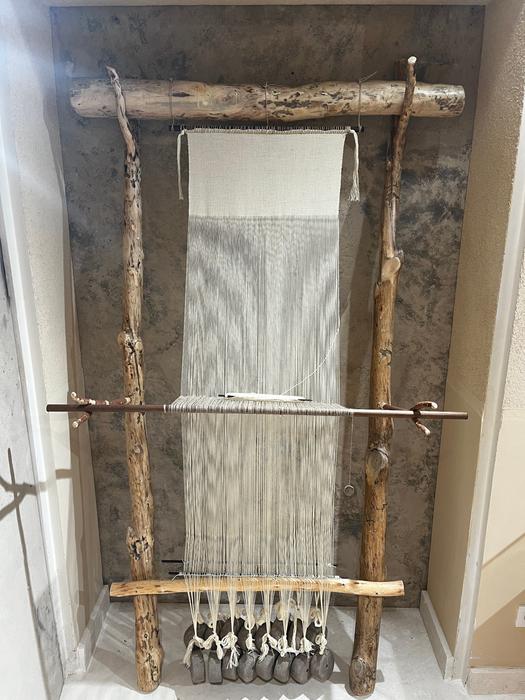
Excavation of the site revealed a raised platform on the settlement’s western slope, densely concentrated with 44 cylindrical clay weights, each featuring a central perforation and averaging around 200 grams. This array epitomizes the tools of a vertical warp-weighted loom, a technology that dates back thousands of years but rarely comes with such a complete assemblage. Alongside these weights, archaeologists identified several pine timbers arranged in parallel, their varying cross-sections suggesting the frame’s vertical and horizontal members. This physical configuration offers a rare, tangible reference for reconstructing the loom’s construction and operation in detail.
Critical to weaving technology are warp threads, which in this loom were fastened by esparto plant fiber cords passing through the weights’ perforations. The discovery of these plaited fibre remains alongside wooden and clay components is extraordinary. It enabled researchers to reconstruct not only the loom’s mechanics but also how textile production was organized spatially within the community. Such organic materials typically degrade quickly, making their survival here a scientific marvel. This finding provides a tangible window into the processes underpinning textile manufacture during a key period known as the “textile revolution” of the European Bronze Age.
The archaeobotanical analysis conducted by Yolanda Carrión from the Universitat de València identified the wooden elements as Aleppo pine, native to the region. Examination of growth rings indicates that the wood was selected from mature, long-lived trees capable of yielding large, straight timbers—demonstrating an intentional selection process for crafting durable loom components. The scholars hypothesized that these components rested against a wall within the building’s architecture, supported by the spatial layout of weights and timbers, forming a robust vertical frame essential for warp-weighted loom function.
This loom’s existence signals profound technological and economic shifts in Bronze Age textile production. The era’s so-called “textile revolution” entailed a diversification of spinning and weaving tools, expansion of wool-producing livestock, and intensification of fabric manufacture. According to Ricardo Basso Rial from the University of Granada, factors driving this revolution were multifaceted, involving innovations in technique alongside social changes such as cooperative labor. Cabezo Redondo exemplifies these developments, as evidenced by a variety of loom weights, including lighter ones capable of producing finer, more complex fabrics such as twills, although actual preserved cloth is rarely found.
The spatial context of the loom further hints at noteworthy social dynamics within the settlement. Located in an outdoor area shared by multiple households, the presence of this device implies collaborative textile production, contrasting with specialized craft areas dedicated to metalwork or ivory carving. This suggests a cooperative economic model for weaving activities, engaging different family groups in joint labor. Complementing this interpretation, bioanthropological data from female skeletal remains reveal dental wear patterns consistent with habitual spinning and weaving, underscoring the likely central role of women in textile manufacture within Cabezo Redondo.
Situated within the broader regional framework, Cabezo Redondo was not an isolated village but a significant political and economic hub during the second millennium BCE. Its size, monumental architecture, and extensive traded goods—including gold, silver, ivory, glass, and seashell beads—reflect its participation in expansive exchange networks spanning the Iberian Peninsula, Eastern Mediterranean, and Central Europe. While linked to the Argaric culture, researchers posit that Cabezo Redondo represents a “post-Argaric” phase, with its famed treasure likely contemporaneous with the loom, underscoring the settlement’s complexity and wealth.
The implications of this discovery extend beyond the technical reconstruction of prehistoric weaving. The detailed combination of archaeological evidence—loom weights, wooden timbers, fiber ropes, and contextual architecture—enables unprecedented insight into Bronze Age textile production’s technological sophistication and social organization. By moving from isolated artifacts to a coherent, functional loom, this research highlights how innovation and cooperation underpinned the “textile revolution” and reshaped economic practices in prehistoric Europe.
Future research avenues posited by the team include archaeometric studies of microscopic fibers to identify the raw materials’ precise characteristics and isotopic analyses to track the geographic origins of sheep wool. Such interdisciplinary approaches may illuminate the degree of specialization within textile production and clarify regional trade and resource procurement strategies. Cabezo Redondo thus offers an ideal laboratory for ongoing scientific inquiry, promising to deepen our understanding of Bronze Age social and technological transformations.
The Cabezo Redondo settlement’s excavation began in 1960 to protect it from destruction by gypsum quarrying, with systematic digs continuing under the leadership of scholars like José María Soler and Mauro S. Hernández. Occupied roughly from 2100 to 1250 BCE, the site extends over about one hectare, featuring terraced dwellings equipped for diverse craft and agricultural activities. Archaeobotanical and zooarchaeological evidence confirms an economy pivoting on intensive farming and livestock management, integrated into wider exchange and cultural networks across prehistoric Europe and the Mediterranean.
In sum, the discovery of the warp-weighted loom in Cabezo Redondo revolutionizes our comprehension of textile technologies in the European Bronze Age. Its preservation in a sealed archaeological context offers a rare, tangible artifact set through which researchers can reconstruct not only the mechanical workings of an ancient loom but also nuanced aspects of social organization, economic strategy, and cultural interaction during a pivotal epoch of technological innovation and economic diversification.
News Publication Date: 16-Mar-2026
Web References: Not provided in the original source
References: García Atiénzar, G., Martín de la Sierra Pareja, P., Barciela González, V., Hernández Pérez, M. S., Basso Rial, R., Carrión Marco, Y. (2026). Evidence of a warp-weighted loom in the Bronze Age settlement of Cabezo Redondo (south-east Spain). Antiquity. DOI: 10.15184/aqy.2026.10312
Cite Scienmag News
Courtney Benton. (March 27, 2026). Ancient 3,500-Year-Old Loom Uncovered, Shedding Light on Bronze Age Textile Revolution. Scienmag. https://scienmag.com/ancient-3500-year-old-loom-uncovered-shedding-light-on-bronze-age-textile-revolution/
Courtney Benton. "Ancient 3,500-Year-Old Loom Uncovered, Shedding Light on Bronze Age Textile Revolution." Scienmag, 27 March 2026, https://scienmag.com/ancient-3500-year-old-loom-uncovered-shedding-light-on-bronze-age-textile-revolution/. Accessed 28 October 2026.
Courtney Benton. "Ancient 3,500-Year-Old Loom Uncovered, Shedding Light on Bronze Age Textile Revolution." Scienmag. March 27, 2026. https://scienmag.com/ancient-3500-year-old-loom-uncovered-shedding-light-on-bronze-age-textile-revolution/