


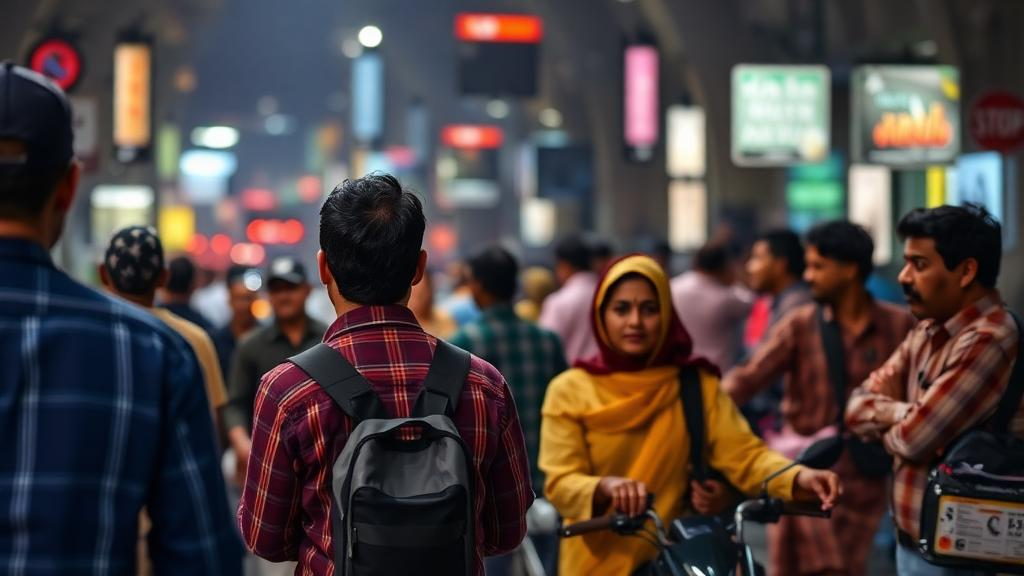
Across South Asia, millions of workers now earn their living through smartphone apps that dispatch food deliveries, ride-hailing trips, and personal care services. A new review published in Discover Global Society by Ajeet Kumar Pankaj of IISER Bhopal and Manish K. Jha of the Tata Institute of Social Sciences examines what this digital labour boom means for the people who power it. Drawing on cases from India, Pakistan, Bangladesh, Nepal, and Sri Lanka, and using the sociological concept of precarity as an analytical lens, the authors document how platform work reproduces the informality and marginalisation of the traditional informal economy, while adding new layers of algorithmic control. Their central finding is stark: despite the rapid growth of the gig workforce, social security and social policy provisions across the region remain largely inadequate, leaving workers exposed to job insecurity, low wages, long hours, and hazardous conditions.
The scale of the phenomenon is considerable. India is the region’s largest hub, with a gig workforce of roughly 7.7 million that the government think tank NITI Aayog projects will reach 23.5 million by 2029–30. Bangladesh holds the second-largest gig workforce in South Asia, while in Sri Lanka platform work functions mainly as a supplementary income source within the informal economy. Pakistan’s online gig work accounts for 2.9 percent of total employment, and the overwhelming majority of those workers, 97.1 percent, are engaged in physical, platform-based activities rather than remote digital tasks. According to a 2025 report by the International Labour Organization, India, Bangladesh, and Pakistan together account for nearly half of the world’s platform workers. These figures place South Asia at the centre of a global transformation in how work is organised, mediated, and remunerated.
The economics of platform labour reveal a sharp asymmetry between corporate revenue and worker earnings. The review notes that Zomato alone earned Rs 2,604 crores, about 27.2 million US dollars, in the 2019–20 financial year, and that both Zomato and Swiggy roughly doubled their turnover between 2018–19 and 2019–20. Yet after deducting fuel costs, vehicle loan instalments, and other fixed expenses, food delivery partners in India net approximately Rs 275, or about 2.86 US dollars, per day for eight hours of work. Platforms describe themselves as intermediaries or passive matchmakers and classify workers as independent contractors or partners, a terminology the authors identify as a deliberate strategy to negate the employer–employee relationship and thereby avoid the application of labour law. In practice, platforms retain control over terms and conditions, wages, and performance monitoring, exercising the authority of an employer without bearing its legal obligations.
At the technical heart of this control lies algorithmic management. Customer satisfaction metrics, delivery pace, and service quality are continuously monitored by software systems that rank workers, and those rankings are then used to justify dismissing those labelled as underperforming. Researchers cited in the review describe Uber’s reliance on two forms of algorithmic control: gatekeeping, which screens and monitors who may work, and guiding, which directs how drivers perform their tasks. Algorithmic pay determination, surge pricing, and performance rewards generate pronounced income volatility, forcing workers into contingent, task-based remuneration arrangements. Identification deactivation has become a recurrent disciplinary tool across the region, often applied through opaque and discretionary processes that workers find difficult to understand or contest. The platform design encourages competition and isolation among workers, producing what some scholars call a digital cage that discourages solidarity and collective action, even as workers may perceive themselves as free and self-directed entrepreneurs.
The human costs are severe and increasingly visible. In early January 2026, a Zepto delivery worker in Hyderabad died while rushing to pick up an order under the pressure of ten-minute food and grocery delivery promises. The review records that this was neither the first such death nor likely the last, as workers speed to meet deadlines that directly affect their ratings and efficiency. In Pakistan, the Fairwork assessment of seven platforms spanning ride-hailing, food delivery, e-commerce delivery, and personal care highlights risks ranging from road safety to crime and violence. In Bangladesh, a female worker on the hellotask platform reported that despite relatively better salary and flexibility, access to basic facilities such as sanitation during menstruation, meals, medicines, and childcare depended on maintaining a good relationship with the customer. Nepali gig workers, particularly women, cite flexibility as their main reason for entering the sector, yet the country lacks any legal definition of gig workers, leaving their employment status ambiguous. Sri Lankan workers face intense surveillance, harsh climatic conditions, and the absence of social security provisions.
The theoretical framework of precarity gives these observations analytical coherence. The concept originates with Pierre Bourdieu, who described an existence with no regular timetable, no fixed place of work, and a whole life lived under the sign of the provisional. Judith Butler extended the idea, defining precarity as politically induced conditions in which certain populations suffer from failing social and economic networks of support and become differentially exposed to injury, violence, and death. The authors argue that gig work exemplifies this politically induced character: the insecurity is not merely a by-product of individual platforms but a structural outcome of neoliberal labour restructuring, in which states have curtailed welfare provisions and normalised casual, short-term, and intermittent labour. Crucially, the review finds that technologically mediated precarity overlaps with and intensifies pre-existing social hierarchies of caste, gender, poverty, and religion, positioning platforms as new digital gatekeepers of inequality.
Against these odds, gig workers have organised. In India, unions such as the United Food Delivery Partners’ Union, the Indian Federation of App-based Transport Workers, and the All India Gig Workers Union have staged protests and collective actions against wage cuts, rising fuel prices, and declining incentives. In Pakistan, groups including the United Platform Workers of Sindh and the Informal Workers Coalition advocate for safety, social security, wage transparency, and an end to algorithmic surveillance. In Bangladesh, traditional unions have supported the Dhaka Ride-sharing Driver Union in demanding an end to police harassment, recognition of app-based riders as workers, a commission reduction from 25 to 10 percent, and tax exemptions. Digital tools are central to this mobilisation: WhatsApp groups, Telegram channels, and social media campaigns coordinate strikes, share grievances, and connect workers across geographies. In Hyderabad, personal care workers on the Urban Company platform have built WhatsApp networks that function as whisper networks, warning one another about abusive customers and circulating information about company policies, an informal justice mechanism foregrounding caste, class, and customer–worker power dynamics.
These struggles have begun to yield policy results, though unevenly. India’s Code on Social Security 2020 was the first law in the region to officially recognise gig workers as a distinct category eligible for social security benefits, though critics point to uncertainties in its implementation. At the sub-national level, the Telangana Gig and Platform Workers Bill of 2024 aims to institutionalise registration and welfare mechanisms, while the Tamil Nadu Platform Based Gig Workers’ Welfare Board, established in 2023, has subsidised e-scooter purchases for 2,000 registered workers and created an insurance programme offering up to Rs 5 lakh for accidental death or total disability, funded by an annual premium of just Rs 105 per worker. The Karnataka Platform-based Gig Workers Bill of 2025 goes further, proposing a 1 to 5 percent welfare fee on aggregators and a dedicated welfare board covering more than four lakh workers across ride-sharing, delivery, logistics, healthcare, and hospitality. In Pakistan, the Centre for Labour Research, working with the Fairwork project, has drafted a Platform Workers Protection Bill seeking to extend enforceable labour protections beyond the independent contractor classification. Bangladesh, Nepal, and Sri Lanka still lack dedicated legislation for gig workers.
The review also draws attention to gendered dimensions of exclusion. India has approximately 4.75 million domestic workers on official records, most of them economically vulnerable women, yet no comprehensive national legislation protects them, despite state-level efforts in Tamil Nadu, Maharashtra, and Delhi. Women in gig work face distinct challenges balancing unpredictable schedules with childcare and caregiving responsibilities, and the president of the Gig and Platform Service Workers Union reported facing exploitation, threats of police action, and legal notices after raising complaints. Nevertheless, women workers have actively led mobilisations, including nationwide protests demanding fair wages and social security. The authors conclude that collective worker voice, even in constrained institutional environments, can shape regulatory discourse and public accountability, and they call for reframing the legal category of employee to include gig workers, or creating an expanded worker category with a basic range of workplace rights.
The broader significance of the study lies in its demonstration that platform-mediated precarity reproduces cycles of income volatility, debt exposure, and structural dependency that existing labour law was never designed to address. The authors argue that effective legislative reform must be coupled with institutional oversight and accountability mechanisms, portable social security entitlements, and statutorily enforceable labour standards. They note that platforms consistently resist standardised wages and protections by claiming such measures would undermine flexibility, yet their absence entrenches informality and regulatory arbitrage. While platform cooperatives have been proposed as an alternative model, the authors observe that operational costs and technical constraints limit their viability, and that workers are primarily fighting not for a share of the platforms but for rights, recognition, fair treatment, algorithmic transparency, and welfare policy. For South Asia’s rapidly expanding digital workforce, the trajectory from informal exclusion to formal protection, the review suggests, will depend on whether states match the organising energy of workers with substantive law and rigorous enforcement.
Subject of Research: Precarity, informality, and social security policy for gig and platform workers in South Asia
Article Title: Social (in)security and social policy for gig workers in South Asia
Article References: Pankaj, A. K., & Jha, M. K. (2026). Social (in)security and social policy for gig workers in South Asia. Discover Global Society, 4(1), Article 205. https://doi.org/10.1007/s44282-026-00579-0
Image Credits: AI Generated
DOI: 10.1007/s44282-026-00579-0
Keywords: gig economy, platform workers, South Asia, precarity, algorithmic management, social security, informal labour, labour rights, India, unionisation, social policy, digital labour
Cite Scienmag News
Blake Davidson. (October 5, 2026). Algorithmic Control and Precarity: Gig Workers in South Asia Fight for Social Security. Scienmag. https://scienmag.com/algorithmic-control-and-precarity-gig-workers-in-south-asia-fight-for-social-security/
Blake Davidson. "Algorithmic Control and Precarity: Gig Workers in South Asia Fight for Social Security." Scienmag, 5 October 2026, https://scienmag.com/algorithmic-control-and-precarity-gig-workers-in-south-asia-fight-for-social-security/. Accessed 17 October 2026.
Blake Davidson. "Algorithmic Control and Precarity: Gig Workers in South Asia Fight for Social Security." Scienmag. October 5, 2026. https://scienmag.com/algorithmic-control-and-precarity-gig-workers-in-south-asia-fight-for-social-security/


