


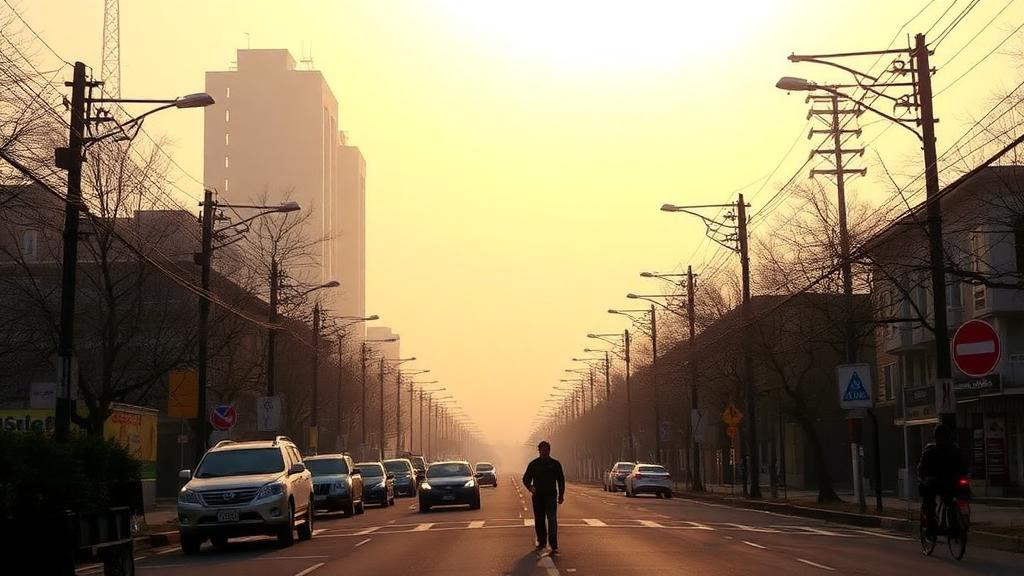
Tuberculosis has been preventable and curable for decades, yet it remains the deadliest single infectious disease on Earth. A sweeping new analysis published in Environmental Advances now offers one of the most detailed portraits yet of why the global fight is stalling—and points to an unexpected accomplice: the air we breathe. By linking disease-burden estimates from 204 countries and territories with World Health Organization program data and World Bank development indicators, researchers Jefferson A. Buendía and Eliana Martínez-Herrera found that the world is on course to still lose roughly 29 million healthy life-years to tuberculosis in 2050 if current trajectories continue, and that rising fine particulate air pollution tracks national TB trajectories as closely as the performance of treatment programs themselves.
The numbers behind the study are stark. Between 2000 and 2023, tuberculosis DALYs—a composite measure combining years of life lost to premature death with years lived in disability—fell from 80.1 million to 43.6 million, a 45.6 percent drop. Adjusted for population growth, the rate fell even faster, from 1,306.6 to 542.9 per 100,000 people, a decline of 58.5 percent. Yet the residual burden is enormous and unevenly shared. The African Region recorded the highest rate in 2023 at 1,372.2 per 100,000, and because its decline lagged behind other regions, it overtook South-East Asia as the largest absolute contributor, with 17.0 million DALYs against 14.5 million—a reversal of the pattern seen in 2000. Low-income countries carried rates of 1,448.3 per 100,000, roughly forty times the 36.5 per 100,000 seen in high-income nations.
Progress has also been strikingly uneven across the human lifespan. Among children under fifteen, DALYs fell 56.9 percent over the study period, from 15.0 to 6.5 million. Working-age adults saw an intermediate decline of 45.1 percent. But among adults aged 65 and older—the group with the highest DALY rate in 2023 at 939.4 per 100,000—the drop was only 32.9 percent, from 11.2 to 7.5 million. As a result, older adults now account for 17.2 percent of the global tuberculosis burden, up from 14.0 percent in 2000. The authors attribute this pattern to cumulative lifetime exposure, immunosenescence, and age-related comorbidity, and they warn that programmatic gains achieved for children have simply not been matched among the elderly, who represent a growing share of the disease’s remaining toll.
Methodologically, the study is notable for the care with which it separates two very different questions. Using a within-between specification first formalized by economist Yair Mundlak in 1978, the researchers split each time-varying predictor into two components: a country’s long-term average level, and how far a given year’s value departs from that average. The first component answers whether countries that are usually more exposed also carry more tuberculosis burden; the second asks whether burden moves when a country temporarily rises above or falls below its own norm. This distinction matters because the two answers can diverge dramatically, and conflating them has muddied much of the earlier literature on the social and environmental determinants of tuberculosis.
The between-country results paint a coherent picture of entrenched burden. Comparing countries at the 75th versus the 25th percentile of each predictor’s long-term national distribution, DALY rates were 52.1 percent higher where the fraction of tuberculosis associated with HIV was higher, 38.1 percent higher where undernutrition was more prevalent, and a striking 88.4 percent higher where vulnerable employment—insecure, unprotected work—was more common. Conversely, rates were 58.3 percent lower in countries with stronger universal health coverage and 31.5 percent lower where tuberculosis treatment coverage was more complete. These are associations, not causal estimates, but they describe with unusual precision the national profile in which tuberculosis remains endemic: HIV-driven epidemic pressure, malnutrition, precarious labor, and thin health systems.
The within-country story is more sobering. Short-term changes in treatment coverage, treatment success, universal health coverage, undernutrition, vulnerable employment, and PM2.5 were not independently associated with subsequent changes in DALY rates in the primary model. The authors caution that this is not evidence the conditions are unimportant. Year-to-year program audits, they argue, are unlikely to detect the true impact of structural conditions on tuberculosis, because policy responses, shifts in case detection, biological lags, and epidemic history all blur short-term national trends. The practical implication is that the factors identifying a high-burden country are not automatically the same factors that produce an immediate, measurable decline when they change within that country—a lesson with real consequences for how global agencies design and evaluate interventions.
Where the study breaks new ground is in its temporal analysis of which national changes tracked faster or slower improvement. Of eight annualized predictors examined, only two survived false-discovery-rate correction: treatment success and ambient PM2.5. Improving treatment success was associated with a more favorable annualized DALY-rate trajectory, while rising PM2.5 tracked a less favorable trajectory of comparable magnitude in the opposite direction. Crucially, the PM2.5 signal persisted even after the researchers added annualized changes in GDP per capita and urban population share to the model, indicating that air pollution is not simply proxying for broader economic development. The biological plausibility is well established: particulate exposure damages airway and alveolar epithelium, impairs the phagocytic and bactericidal function of alveolar macrophages, and blunts the cell-mediated immune response required to contain Mycobacterium tuberculosis. Laboratory work has shown that urban airborne particles directly impair human lung and blood immunity to the bacillus.
The authors are careful about what this means. As an ecological analysis, the study cannot establish causality, and they flag important residual confounders, including smoking prevalence, occupational particulate exposure, crowding, and—perhaps most importantly—household air pollution from solid-fuel cooking and heating, which is a well-established tuberculosis risk factor in its own right, typically far more concentrated than ambient PM2.5, and inseparable from outdoor pollution in country-level data. They also note that no study has yet evaluated whether an actual air-quality policy intervention was followed by a measurable reduction in tuberculosis burden, a gap they identify as a research priority. Still, if the association is even partly causal, clean-air policies pursued for cardiovascular, respiratory, and climate reasons could carry an additional, currently uncounted tuberculosis benefit, particularly in the high-burden, high-pollution settings of South and Southeast Asia and sub-Saharan Africa.
The projections to mid-century give the findings a policy horizon. Fitting log-linear trends for each of twenty age groups in every country, partially pooling slopes toward regional medians, and running two thousand simulations that sampled slope uncertainty and correlated global and regional shocks, the researchers project median DALYs of 38.2 million in 2030, 32.9 million in 2040, and 29.4 million in 2050—only 32.5 percent below the 2023 level. Internal validation lent credibility to the short-term calibration: data through 2015 projected 2020 within 8.7 percent, and data through 2020 projected 2023 within 0.3 percent. Twenty-one countries are projected to have more tuberculosis DALYs in 2050 than in 2023, with India remaining the largest contributor, followed by the Democratic Republic of the Congo, Indonesia, Pakistan, and Nigeria. These figures are continuation scenarios, not inevitabilities; modeling studies show that vaccination, screening, preventive therapy, rapid diagnosis, and effective treatment could bend the curve far more sharply.
The study’s conclusion is ultimately a call to reframe the fight against tuberculosis. The global decline is real, but too slow to meet the End TB targets of an 80 percent reduction in incidence and a 90 percent reduction in deaths by 2030 relative to 2015. What emerges is a two-part agenda: sustained investment in treatment completion and universal health coverage, alongside coordinated action on the structural conditions—nutrition, social protection, HIV-related epidemic pressure, and now air quality—that determine where the disease takes root and how fast it recedes. The finding that national air-quality trajectories move in lockstep with national tuberculosis trajectories places TB control squarely within the climate-and-health agenda, and suggests that the lungs of the world’s poorest billions may depend as much on what is in the air as on what is in the medicine cabinet.
Subject of Research: Country-level longitudinal analysis of air pollution, health coverage, and structural determinants of global tuberculosis burden with projections to 2050
Article Title: Air Pollution, Health Coverage, and Global Tuberculosis Trajectories: A Longitudinal Country-Level Analysis with Projections to 2050
Article References: Buendía, J. A., & Martínez-Herrera, E. (2026). Air Pollution, Health Coverage, and Global Tuberculosis Trajectories: A Longitudinal Country-Level Analysis with Projections to 2050. Environmental Advances, Article 100768. https://doi.org/10.1016/j.envadv.2026.100768
Image Credits: AI Generated
DOI: 10.1016/j.envadv.2026.100768
Keywords: tuberculosis, air pollution, PM2.5, DALYs, universal health coverage, undernutrition, HIV, treatment success, Global Burden of Disease, projection to 2050, vulnerable employment, End TB Strategy
Cite Scienmag News
Russell Cooper. (October 13, 2026). Air Pollution Emerges as a Key Marker of Slowing Global Tuberculosis Decline. Scienmag. https://scienmag.com/air-pollution-emerges-as-a-key-marker-of-slowing-global-tuberculosis-decline/
Russell Cooper. "Air Pollution Emerges as a Key Marker of Slowing Global Tuberculosis Decline." Scienmag, 13 October 2026, https://scienmag.com/air-pollution-emerges-as-a-key-marker-of-slowing-global-tuberculosis-decline/. Accessed 13 October 2026.
Russell Cooper. "Air Pollution Emerges as a Key Marker of Slowing Global Tuberculosis Decline." Scienmag. October 13, 2026. https://scienmag.com/air-pollution-emerges-as-a-key-marker-of-slowing-global-tuberculosis-decline/


