


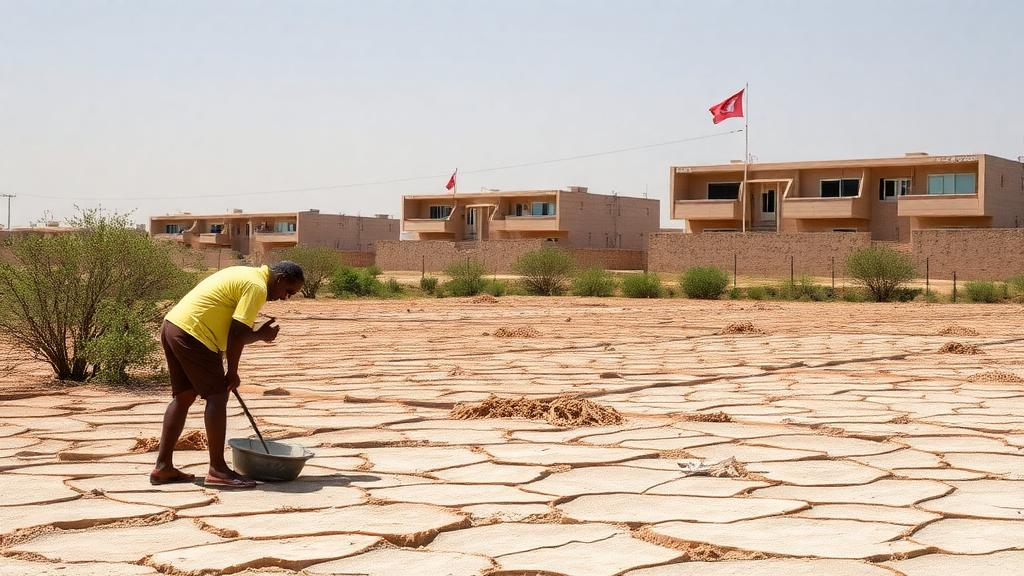
Droughts do not announce themselves the way hurricanes or earthquakes do. They creep forward over months and years, and by the time the damage becomes visible in empty reservoirs, withered fields and emergency water restrictions, the underlying moisture deficit has often been accumulating for seasons. A new study of nearly five decades of Spanish droughts has now quantified exactly how that slow build-up translates into real-world consequences, using an unlikely but powerful source of evidence: the national press.
Researchers led by Ahmed M. El Kenawy of the Instituto Pirenaico de Ecología, part of the Spanish National Research Council (CSIC), analysed drought-related articles published in El País, Spain’s largest-circulation general-interest newspaper, from the paper’s founding in May 1976 through the end of 2023. Using modern artificial intelligence tools, the team filtered and parsed more than 15,000 drought-relevant news items, extracting structured information about the impacts they described, the provinces they referred to, and the sectors affected. The result is a monthly, province-by-province record of how drought became socially visible across Spain over 48 years, a record the researchers then confronted with high-resolution climate data to ask a deceptively simple question: what kind of drought, lasting how long, actually produces impacts that people notice and report?
The answer, published in the journal Natural Hazards and Earth System Sciences, is that the timescale matters enormously. The team computed two standard drought indices, the Standardized Precipitation Index (SPI), which tracks precipitation deficits alone, and the Standardized Precipitation Evapotranspiration Index (SPEI), which subtracts atmospheric evaporative demand, essentially the drying power of a warmer atmosphere, from precipitation. Both indices were calculated at accumulation periods ranging from 1 to 48 months using a gridded climate dataset at 1.1-kilometre resolution covering Spain’s 47 mainland provinces plus the Balearic Islands. When these indices were correlated with the standardized frequency of media-reported impacts, a striking pattern emerged: short-term deficits of one to three months showed weak and inconsistent associations with impact reporting, with correlation coefficients below 0.3, while the strongest relationships appeared at accumulation windows of 12 to 30 months, where correlations reached roughly 0.6 to 0.8.
In other words, a single dry month rarely makes headlines in a way that tracks climate data, but a year or more of accumulating moisture deficit almost invariably does. The major peaks in drought-impact reporting, in the early 1980s, the mid-1990s, the early 2000s and the early 2010s, all coincided with drought index anomalies exceeding one to two standard deviations below normal. Wet periods, by contrast, produced strongly negative reporting anomalies, meaning drought essentially vanished from the public record when the climate signal disappeared.
Yet the two sectors the study examined, agriculture and hydrology, told subtly different stories about time. Hydrological impacts, such as reduced river discharge, reservoir depletion, falling groundwater levels and reduced hydropower generation, were most strongly associated with medium- to long-term moisture deficits of 12 to 48 months. This makes physical sense: rivers, aquifers and reservoirs are integrative systems with long memory, buffering short dry spells but steadily draining under persistent deficits. Agricultural impacts, including crop failures, planting delays, livestock feed shortages and mortality, responded to shorter accumulation windows of roughly 3 to 12 months, reflecting the rapid sensitivity of soil moisture and growing crops to seasonal water stress. Crucially, for both sectors, the dominant timescale lengthened as drought severity increased. Under extreme drought, even agricultural reporting shifted toward longer accumulation windows, suggesting that prolonged, multi-season deficits overwhelm even systems that normally respond quickly.
Perhaps the most consequential finding concerns temperature. Across nearly every timescale, severity class and province, the SPEI, which incorporates atmospheric evaporative demand, outperformed the precipitation-only SPI in explaining impact reporting, and the gap widened under moderate to extreme drought and at longer accumulation periods. For agricultural reporting, the divergence between the two indices appeared earlier, at short-to-intermediate timescales of 6 to 24 months, indicating that crop systems are particularly sensitive to the temperature-driven intensification of water stress. The implication is sobering: as the Mediterranean warms faster than the global average, precipitation-based drought monitoring alone will increasingly underestimate how bad droughts actually are. The same rainfall deficit produces more damage in a hotter world because the atmosphere pulls more water from soils, plants and reservoirs.
The study also documented a strongly nonlinear relationship between drought severity and impact reporting. Using a log-log regression framework, the team calculated a sensitivity coefficient expressing how reporting intensity responds proportionally to drought magnitude. This coefficient peaked at accumulation timescales of 12 to 36 months and rose disproportionately as droughts moved from moderate into severe and extreme categories. A complementary logistic analysis, which included months with no reports at all, showed that greater drought magnitude also raised the odds that any reporting occurred, with the most spatially coherent occurrence responses at short-to-intermediate timescales, particularly for SPEI. Together, these results point to a threshold-like amplification: severe droughts do not just produce somewhat more impact than moderate ones, they produce disproportionately more visible, socially salient consequences. The authors are careful to note that this reflects reporting sensitivity, not necessarily a direct measure of physical damage escalating at the same rate.
Space mattered as much as time. Principal component analysis of the provincial reporting series revealed a dominant national mode of coherent drought response, but also a clear east-west contrast separating the Mediterranean and southern regions from the interior and north. Hydrological reporting was spatially more coherent, with the strongest loadings in northwestern and central Spain where large basin-scale storage systems integrate climate signals, while agricultural reporting was more locally modulated, prominent in western and southwestern regions and fragmented by local factors such as soil properties, irrigation dependence and crop type. The spatial distribution of dominant accumulation timescales reinforced this divide: hydrological reporting clustered at 12 to 48 months, shifting toward the longest windows under severe drought, whereas agricultural reporting concentrated at 3 to 12 months with greater regional variability.
The researchers are candid about the limitations of their media-derived dataset. The monthly series measure reporting intensity and societal salience, not the number of unique impact events or the magnitude of physical damage; repeated coverage of a persistently low reservoir contributes multiple observations, and editorial priorities, changes in newsroom practice and uneven provincial coverage all shape what gets written. Impact categories and province references were extracted independently, so articles mentioning several provinces and several impacts cannot be resolved into precise geocoded events. Province-level sensitivity estimates, particularly under severe and extreme drought where samples shrink, carry wide confidence intervals, and the authors emphasize that the aggregated national and regional patterns are far more robust than any individual province-timescale coefficient. Standardization also cannot remove long-term changes in newspaper production or drought newsworthiness.
Even with those caveats, the framework offers a practical blueprint for the next generation of drought early warning systems. Because impacts are governed by accumulation timescales that differ by sector, effective monitoring must be multiscalar, tracking deficits over months to years rather than reacting to single dry spells. And because temperature-driven evaporative demand consistently sharpened the link between climate and consequences, operational systems should favour integrated, temperature-sensitive indicators like SPEI over precipitation-only metrics. As warming accelerates across the Mediterranean and beyond, the study’s central message is likely to travel well beyond Spain: the droughts that hurt most are not the sudden ones but the long ones, and the hotter the atmosphere becomes, the more each month of accumulated deficit is amplified into damage that people can see, feel and read about in the morning paper.
Subject of Research: Multiscalar and nonlinear relationships between drought indices and media-reported agricultural and hydrological drought impacts in Spain
Article Title: Multiscalar and nonlinear controls of drought impacts in Spain revealed by media-reported data
Article References: El Kenawy, A. M., Domínguez-Castro, F., Beguería, S., Vela-Tambo, J., Halifa-Marín, A., Adell-Michavila, M., Crespillo, A., Latorre, B., Franquesa, M., & Vicente-Serrano, S. M. (2026). Multiscalar and nonlinear controls of drought impacts in Spain revealed by media-reported data. Natural Hazards and Earth System Sciences, 26(10), 4977-4996. https://doi.org/10.5194/nhess-26-4977-2026
Image Credits: AI Generated
DOI: 10.5194/nhess-26-4977-2026
Keywords: drought, Spain, SPEI, SPI, evaporative demand, media-reported impacts, agriculture, hydrology, drought monitoring, nonlinear response, climate change, newspaper archives
Cite Scienmag News
Sloane Callahan. (October 13, 2026). Newspaper archives reveal how droughts quietly build before Spain feels the damage. Scienmag. https://scienmag.com/newspaper-archives-reveal-how-droughts-quietly-build-before-spain-feels-the-damage/
Sloane Callahan. "Newspaper archives reveal how droughts quietly build before Spain feels the damage." Scienmag, 13 October 2026, https://scienmag.com/newspaper-archives-reveal-how-droughts-quietly-build-before-spain-feels-the-damage/. Accessed 13 October 2026.
Sloane Callahan. "Newspaper archives reveal how droughts quietly build before Spain feels the damage." Scienmag. October 13, 2026. https://scienmag.com/newspaper-archives-reveal-how-droughts-quietly-build-before-spain-feels-the-damage/


