


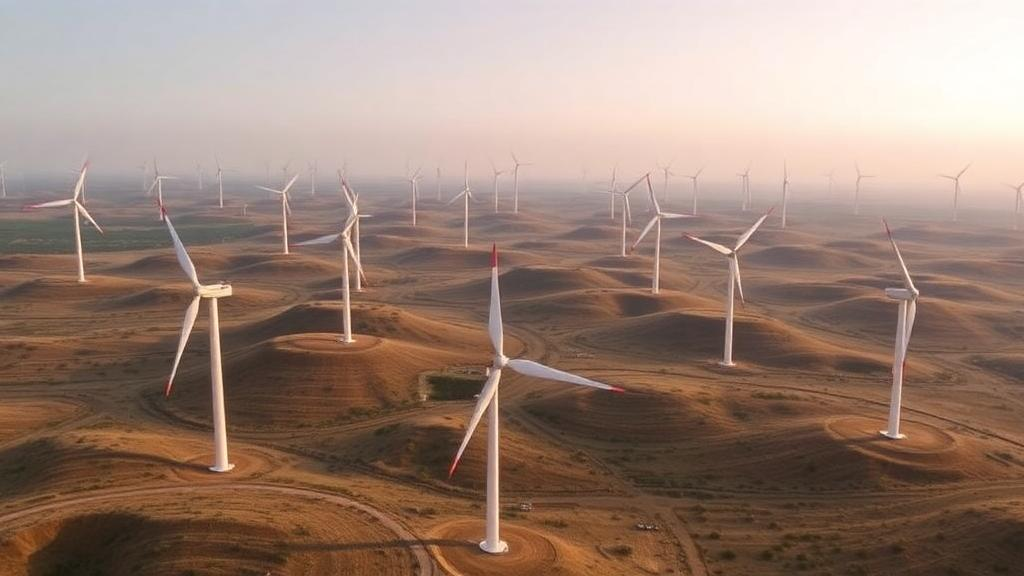
Every large wind farm carries a hidden tax on its own output. When wind sweeps through a row of turbines, each machine extracts energy from the airflow and leaves behind a slower, more turbulent wake. Turbines standing downstream of others therefore generate less electricity than they would in a free, undisturbed wind. Because a farm’s annual energy production depends so heavily on where each turbine sits, developers routinely run layout optimization algorithms that shuffle turbine positions in search of the arrangement that minimizes these wake losses. The problem is that such algorithms must recompute the farm’s expected yearly energy output hundreds of times across many wind speeds and directions, and each evaluation is expensive. A new study from the Technical University of Denmark, published as a preprint under review in the journal Wind Energy Science, puts a family of shortcuts to the test and arrives at a striking conclusion: the most useful models are not the most accurate ones, but those that best capture how turbines influence one another.
The research, carried out by Javier Andueza-Bueno, Leonardo Alcayaga, Mikkel Friis-Møller, and Pierre-Elouan Réthoré at DTU’s Department of Wind and Energy Systems, addresses a bottleneck that grows more pressing as wind farms scale up. Larger projects benefit from economies of scale, but they also suffer more from wake effects, which raises the stakes of the wind farm layout optimization problem, often abbreviated WFLO. A typical gradient-based optimization repeatedly adjusts turbine coordinates, computing the sensitivity of annual energy production, or AEP, to every small displacement. Because the objective function must be evaluated so many times, the mathematical machinery used to estimate AEP inside the loop determines whether an optimization finishes in minutes or in hours. The Danish team systematically compared several candidate models as objective functions in gradient-based optimizations, always benchmarking their results against a high-fidelity reference calculation.
The candidates fell into several distinct camps. The conventional approach integrates the farm’s power output across the full wind rose by splitting wind directions and speeds into a grid of rectangular bins, a scheme known as rectangular quadrature. The researchers tested this method in various forms, including deliberately coarse wind direction binning, to see how much of the integration machinery could be stripped away before optimization quality degraded. Alongside this established technique, they evaluated two more exotic alternatives: a novel method called FLOWERS, which the team also derived for the Nygaard TurbOPark wake model, and Bayesian Quadrature, a probabilistic integration scheme that treats the AEP calculation as a statistical estimation problem. They additionally experimented with the Stochastic Gradient Descent algorithm, an optimizer that avoids computing full gradients at every step by working with noisy, sampled estimates of the objective.
To keep the comparison honest, the authors ran their experiments across four different wind farms chosen to span a wide range of realistic conditions. These test cases varied in boundary shapes, wind roses, farm sizes, and the types of constraints imposed on turbine placement. Three different wake models were used to describe the aerodynamic interaction between machines, so that conclusions would not hinge on the quirks of a single engineering model. The performance of each AEP estimation scheme was judged along two independent axes: efficiency, meaning how long the optimization took, and efficacy, meaning the quality of the final layout it produced. This distinction matters because a fast method that converges to a mediocre layout is of little practical use to a developer deciding where to pour foundations.
The standout result belonged to FLOWERS. Across the test suite it achieved the greatest balance between speed and layout quality, cutting optimization times by more than 95 percent while producing layouts comparable to those found with the full reference calculation. In other words, an optimization that might previously have consumed hours of computation could deliver essentially the same design in a small fraction of the time, a change with obvious implications for how many layout iterations a project team can afford to explore. The method was not flawless: it encountered difficulties with strongly unimodal wind roses, distributions in which the wind resource is concentrated overwhelmingly in a single dominant direction, a situation common at sites with strong prevailing winds.
The conventional alternative proved slower but sturdier. Rectangular quadrature with coarse wind direction binning found layouts similar to FLOWERS and to the reference, with optimization time reductions between 40 and 70 percent. Notably, this simplified quadrature worked well only in combination with the Gaussian Bastankhah wake model, one of the most widely used analytical descriptions of wake expansion in the field. Despite being less efficient than FLOWERS, coarse quadrature displayed greater versatility, holding up even in those strongly unimodal wind conditions where FLOWERS struggled. For developers working across a portfolio of sites with very different wind climates, that robustness may outweigh raw speed, and the study’s results suggest the two methods are complementary tools rather than direct competitors.
Perhaps the most conceptually interesting finding concerns Bayesian Quadrature, which exemplifies a broader lesson about what an objective function must do inside an optimization loop. As a probabilistic integration method, Bayesian Quadrature can estimate annual energy production quite accurately as a number. Yet the study found that probabilistic methods struggled to properly capture the underlying physics of turbine interactions within the optimization. When a turbine was nudged, the method did not reliably reflect the positive or negative consequences of that modification, so the optimizer lacked the directional information it needed to improve the layout. Accuracy of the final AEP estimate, in other words, is not the property that matters most; fidelity to the local gradients of turbine interaction is. This reframes how the field should judge candidate surrogate models for WFLO.
The paper also weighed in on a more technical modeling choice: whether the thrust coefficient of each turbine, which governs how strongly the rotor decelerates the incoming air, should be computed using the local wind speed experienced at the rotor or the undisturbed free-flow wind speed. Within a wind farm layout optimization framework, the authors found the results to be remarkably similar under either convention. That observation simplifies the practical implementation of fast AEP models, since modelers need not worry that this particular simplification will steer the optimizer toward distorted layouts. Combined with the other results, it reinforces the paper’s central message that certain physics can be safely approximated while the essential wake interactions must be preserved.
Stochastic Gradient Descent occupied its own niche in the comparison. The algorithm produced consistent layouts across runs, an appealing property in a field where optimization outcomes can be sensitive to starting conditions. However, it carried the highest computational cost of all the methods tested, which tempers its attractiveness despite its reliability. Because SGD avoids full gradient evaluations by design, it might seem suited to the very problem this paper targets, yet the results indicate that a well-chosen deterministic AEP model paired with a standard gradient-based optimizer can outperform it decisively on both fronts. The work thus provides practitioners with an evidence-based ranking of options that have previously coexisted without systematic comparison.
The broader significance of the study lies in how it recalibrates expectations for computational wind energy research. As offshore and onshore farms grow larger, the wake problem intensifies, and the ability to run many rapid layout optimizations during early project development could translate into measurable gains in energy production and reductions in levelized cost of electricity. A method that shrinks optimization time by 95 percent changes not just the runtime of a single study but the scope of the design space a development team can realistically search. By demonstrating that capturing the sensitivity of turbine interactions trumps raw estimation accuracy, the DTU team offers the field a practical design principle for building the next generation of fast AEP models, one that FLOWERS currently embodies most successfully, with coarse quadrature standing by as its versatile fallback.
Subject of Research: Efficient annual energy production models for wind farm layout optimization
Article Title: A comparison of efficient AEP models for Wind Farm Layout Optimization
Article References: A comparison of efficient AEP models for Wind Farm Layout Optimization. (n.d.). https://doi.org/10.5194/wes-2026-182
Image Credits: AI Generated
DOI: 10.5194/wes-2026-182
Keywords: wind energy, wind farm layout optimization, wake effects, annual energy production, FLOWERS, Bayesian quadrature, stochastic gradient descent, TurbOPark, wake models, computational optimization, wind turbines, DTU
Cite Scienmag News
Alan Morgan. (October 13, 2026). Faster Wake Models Could Slash Wind Farm Layout Optimization Times by Over 95 Percent. Scienmag. https://scienmag.com/faster-wake-models-could-slash-wind-farm-layout-optimization-times-by-over-95-percent/
Alan Morgan. "Faster Wake Models Could Slash Wind Farm Layout Optimization Times by Over 95 Percent." Scienmag, 13 October 2026, https://scienmag.com/faster-wake-models-could-slash-wind-farm-layout-optimization-times-by-over-95-percent/. Accessed 13 October 2026.
Alan Morgan. "Faster Wake Models Could Slash Wind Farm Layout Optimization Times by Over 95 Percent." Scienmag. October 13, 2026. https://scienmag.com/faster-wake-models-could-slash-wind-farm-layout-optimization-times-by-over-95-percent/


