

Tuesday, October 27, 2026
Science
No Result
View All Result
  • Login
  • HOME
  • SCIENCE NEWS
  • CONTACT US
  • HOME
  • SCIENCE NEWS
  • CONTACT US
No Result
View All Result
Scienmag
No Result
View All Result
Home Science News Technology and Engineering

AI-Supported Training Linked to Better Recruitment Skills in Education Graduates

October 27, 2026
in Technology and Engineering
Courtney Benton
By Courtney Benton Scienmag Editorial Profile - Science and Technology Policy
Reading Time: 2 mins read
0
AI-Supported Training Linked to Better Recruitment Skills in Education Graduates

AI-Supported Training Linked to Better Recruitment Skills in Education Graduates

65
SHARES
587
VIEWS
Share on FacebookShare on Twitter
ADVERTISEMENT

A structured human resource development programme supported by generative AI was associated with higher expert-rated quality of recruitment-task materials among graduates seeking education-sector posts in Guangdong, China, according to a study published in Scientific Reports. The trial compared the AI-supported programme against career guidance matched on topics, duration and facilitator contact, and measured outcomes with blinded expert ratings rather than the self-report questionnaires that typically dominate graduate employability research.

The study involved 186 graduates assigned as twelve intact cohorts, six per condition, with allocation crossed over institution, facilitator and schedule. Experts, who did not know which programme participants had completed, gave a global rating from 0 to 100 to recruitment-task materials produced on site, under invigilation and without access to AI, both before and after the programmes. This design meant the assessments captured performance under controlled conditions rather than perceptions of learning.

Among the 168 participants with post-test data, representing overall attrition of 9.7 percent, the adjusted difference favoured the AI-supported programme by 5.38 points on the 0–100 scale, with a 95 percent confidence interval of 2.76 to 8.01 and a standardised effect size of d = 0.60. The result was stable across eight different statistical specifications, suggesting it was not an artefact of a particular modelling choice.

By contrast, four newly developed self-report scales showed smaller differences, with effect sizes ranging from d = 0.12 to 0.29, and none remained statistically significant after Holm correction for multiple comparisons. The researchers noted that each scale could only detect differences of about d = 0.4, meaning the study may have been underpowered to identify smaller effects on self-reported outcomes. Notably, the effect on expert ratings exceeded the mean effect on self-report measures by 0.37 standard deviations, with a confidence interval of 0.10 to 0.63.

The authors flagged important limitations. The expert ratings were made without a pre-specified rubric, which limits how they can be interpreted. Component analyses were described as exploratory, and the design cannot separate the contribution of AI itself from the structured practice and feedback embedded in the programme. The findings therefore establish an association between the combined AI-supported, structured approach and better-rated task performance, rather than isolating AI as the active ingredient.

Subject of Research: Effects of an AI-supported structured human resource development programme on expert-rated recruitment task quality among education graduates in China

Article Title: Structured human resource development with AI support is associated with higher expert rated recruitment task quality among education graduates

Article References: He, Y., Haja Maideen, M., & Liang, Z. (2026). Structured human resource development with AI support is associated with higher expert rated recruitment task quality among education graduates. Scientific Reports. https://doi.org/10.1038/s41598-026-76662-y

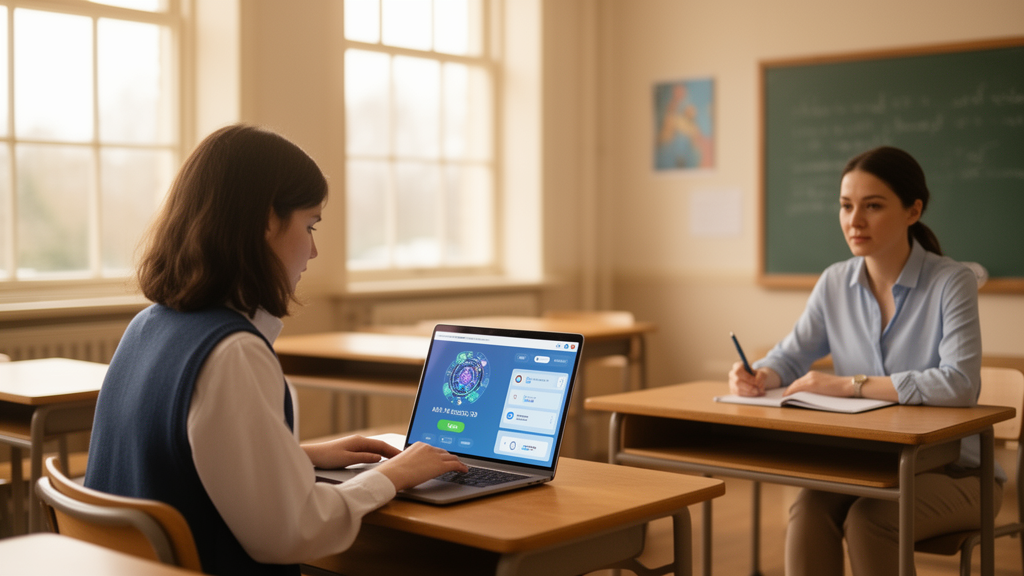
Image Credits: AI Generated

DOI: 10.1038/s41598-026-76662-y

Keywords: generative AI, graduate employability, human resource development, career guidance, education graduates, expert ratings, cluster allocation, self-report measures, Guangdong China, recruitment tasks, Structured, human

Cite Scienmag News

Courtney Benton. (October 27, 2026). AI-Supported Training Linked to Better Recruitment Skills in Education Graduates. Scienmag. https://scienmag.com/ai-supported-training-linked-to-better-recruitment-skills-in-education-graduates/


Courtney Benton. "AI-Supported Training Linked to Better Recruitment Skills in Education Graduates." Scienmag, 27 October 2026, https://scienmag.com/ai-supported-training-linked-to-better-recruitment-skills-in-education-graduates/. Accessed 27 October 2026.

Courtney Benton. "AI-Supported Training Linked to Better Recruitment Skills in Education Graduates." Scienmag. October 27, 2026. https://scienmag.com/ai-supported-training-linked-to-better-recruitment-skills-in-education-graduates/

Tags: AI-enhanced career guidanceAI-supported training in education graduatesblinded expert assessment of training outcomescareer guidancecluster allocationeducation graduateseducation-sector recruitment improvementexperimental study on AI training effectivenessexpert ratingsgenerative AIgenerative AI in training programsgraduate employabilityGuangdong Chinahumanhuman resource developmenthuman resource development in educationimpact of AI on graduate employabilitylongitudinal effects of AI-supported learningperformance evaluation in HR trainingrecruitment skills developmentrecruitment tasksself-report measuresstructuredstructured professional development
Share26Tweet16
Previous Post

Long Hours in Hot or Cold Workplaces Show No Clear Link to Depressive Symptoms in Korean Workers

Next Post

AI Scheduler Learns Offline to Meet Conflicting LLM Latency Goals

Related Posts

Resistance-Based Features Boost Machine Learning Fault Detection in Power Grids
Technology and Engineering

Resistance-Based Features Boost Machine Learning Fault Detection in Power Grids

October 27, 2026
Sleep efficiency, not sleep length, tracks autonomic recovery in elite female footballers
Technology and Engineering

Sleep efficiency, not sleep length, tracks autonomic recovery in elite female footballers

October 27, 2026
AI Scheduler Learns Offline to Meet Conflicting LLM Latency Goals
Technology and Engineering

AI Scheduler Learns Offline to Meet Conflicting LLM Latency Goals

October 27, 2026
Long Hours in Hot or Cold Workplaces Show No Clear Link to Depressive Symptoms in Korean Workers
Technology and Engineering

Long Hours in Hot or Cold Workplaces Show No Clear Link to Depressive Symptoms in Korean Workers

October 27, 2026
FTO Variant rs9939609 Tied to Type 2 Diabetes and Obesity Risk in Thai Adults
Technology and Engineering

FTO Variant rs9939609 Tied to Type 2 Diabetes and Obesity Risk in Thai Adults

October 27, 2026
New AI framework fuses visible and infrared images for sharper object detection
Technology and Engineering

New AI framework fuses visible and infrared images for sharper object detection

October 27, 2026
Next Post
AI Scheduler Learns Offline to Meet Conflicting LLM Latency Goals

AI Scheduler Learns Offline to Meet Conflicting LLM Latency Goals

  • Mothers who receive childcare support from maternal grandparents show more optimized

    Mothers who receive childcare support from maternal grandparents show more parental warmth, finds NTU Singapore study

    27656 shares
    Share 11059 Tweet 6912
  • University of Seville Breaks 120-Year-Old Mystery, Revises a Key Einstein Concept

    1061 shares
    Share 424 Tweet 265
  • Bee body mass, pathogens and local climate influence heat tolerance

    682 shares
    Share 273 Tweet 171
  • Researchers record first-ever images and data of a shark experiencing a boat strike

    546 shares
    Share 218 Tweet 137
  • Groundbreaking Clinical Trial Reveals Lubiprostone Enhances Kidney Function

    531 shares
    Share 212 Tweet 133
Science

Embark on a thrilling journey of discovery with Scienmag.com—your ultimate source for cutting-edge breakthroughs. Immerse yourself in a world where curiosity knows no limits and tomorrow’s possibilities become today’s reality!

RECENT NEWS

  • Resistance-Based Features Boost Machine Learning Fault Detection in Power Grids
  • Sleep efficiency, not sleep length, tracks autonomic recovery in elite female footballers
  • AI Scheduler Learns Offline to Meet Conflicting LLM Latency Goals
  • AI-Supported Training Linked to Better Recruitment Skills in Education Graduates

Categories

  • Agriculture
  • Anthropology
  • Archaeology
  • Athmospheric
  • Biology
  • Biotechnology
  • Blog
  • Bussines
  • Cancer
  • Chemistry
  • Climate
  • Earth Science
  • Editorial Policy
  • Marine
  • Mathematics
  • Medicine
  • Pediatry
  • Policy
  • Psychology & Psychiatry
  • Science Education
  • Science News
  • Social Science
  • Space
  • Technology and Engineering

Subscribe to Blog via Email

Enter your email address to subscribe to this blog and receive notifications of new posts by email.

Join 5,151 other subscribers

© 2025 Scienmag - Science Magazine

Welcome Back!

Login to your account below

Forgotten Password?

Retrieve your password

Please enter your username or email address to reset your password.

Log In
No Result
View All Result
  • HOME
  • SCIENCE NEWS
  • CONTACT US

© 2025 Scienmag - Science Magazine

Discover more from Science

Subscribe now to keep reading and get access to the full archive.

Continue reading