

Tuesday, October 27, 2026
Science
No Result
View All Result
  • Login
  • HOME
  • SCIENCE NEWS
  • CONTACT US
  • HOME
  • SCIENCE NEWS
  • CONTACT US
No Result
View All Result
Scienmag
No Result
View All Result
Home Science News Technology and Engineering

New AI framework fuses visible and infrared images for sharper object detection

October 27, 2026
in Technology and Engineering
Blake Davidson
By Blake Davidson Scienmag Editorial Profile - Data Science
Reading Time: 3 mins read
0
New AI framework fuses visible and infrared images for sharper object detection

New AI framework fuses visible and infrared images for sharper object detection

65
SHARES
587
VIEWS
Share on FacebookShare on Twitter
ADVERTISEMENT

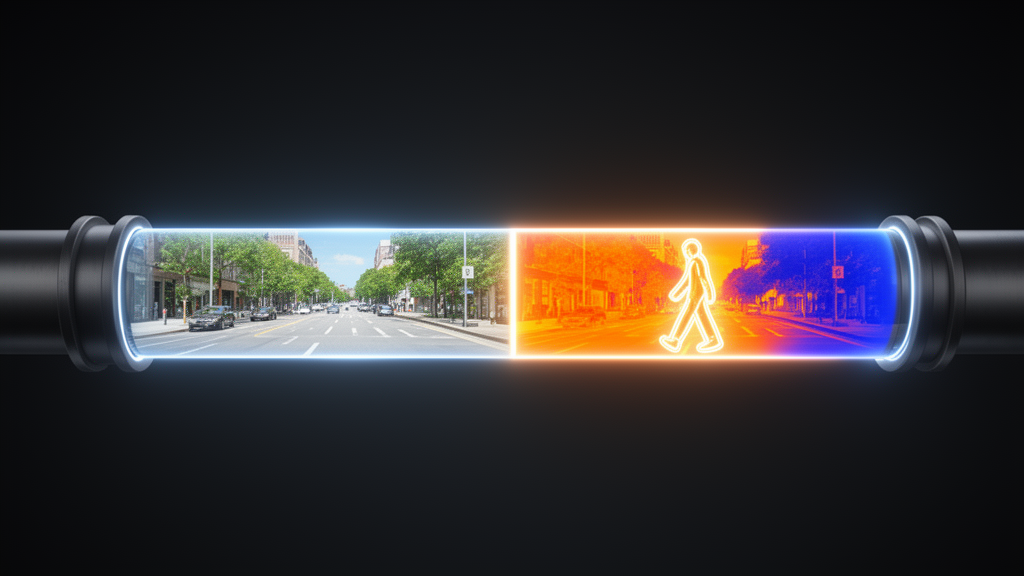
Researchers have unveiled a cross-modal object detection algorithm called DARF, designed to help computers see reliably in conditions where ordinary cameras struggle, such as darkness, glare and cluttered backgrounds. The work, published in Scientific Reports, builds on the popular YOLOv8 detection architecture and combines two new modules that strengthen early image features and blend visible-light and infrared information more intelligently than previous approaches. The problem DARF addresses is well known in computer vision.

In low illumination or visually busy scenes, visible-light images often lose target textures and overall quality, making pedestrians or objects hard to detect. Infrared images can fill in target contours and edges because they capture heat signatures rather than reflected light, but they lack color and surface texture. Existing visible-infrared detection methods have struggled to exploit both streams without letting one interfere with the other.

The authors identify two specific shortcomings in prior systems. First, the shallow features at the front end of a detection network are typically weak at extracting multi-directional and multi-scale details, undermining the fundamental representations on which later stages depend. Second, most fusion strategies rely on simple feature concatenation or fixed-weight aggregation, which cannot separate shared information from modality-specific complementary information, nor adjust the relative contribution of the visible and infrared channels as scene conditions change.

The result is significant inter-modal interference that degrades detection accuracy. DARF responds with a two-part strategy the team describes as front-end basic feature enhancement followed by back-end dual-modal adaptive fusion. The first improvement, a Multi-branch Direction-Aware Feature module known as MDAF, is embedded at the front of the backbone network.

By processing features along multiple directions and scales, it enriches the shallow representations before any fusion takes place, giving the network a stronger foundation for the cross-modal work that follows. The second improvement, a Dual-Modal Adaptive Routing fusion module called DMAR, sits between the backbone and the detection neck, the part of the architecture that feeds final predictions. Rather than concatenating the two image streams or weighting them with fixed coefficients, DMAR performs fine-grained adaptive fusion, dynamically routing information so that the network can emphasize whichever modality is more informative for a given scene and location within the image.

The reported results show that DARF achieves higher detection accuracy than representative existing methods on both datasets. According to the authors, this supports the effectiveness of both the MDAF enhancement module and the DMAR adaptive routing fusion module, as well as the overall framework that combines them within a YOLOv8-based detector. The study is an algorithmic contribution evaluated on benchmark datasets rather than a deployment trial, so real-world performance in specific applications such as nighttime surveillance or autonomous driving remains to be demonstrated.

The paper was published as an open-access article on 26 October 2026 by Senyi Zhang, Jianguang Zhao and Jingjing Fan, and is being shared early as a citable, peer-reviewed accepted version subject to further editorial processing before the final Version of Record appears.

Subject of Research: Direction-aware adaptive routing fusion for visible-infrared cross-modal object detection

Article Title: DARF: direction-aware adaptive routing fusion for cross-modal detection

Article References: Zhang, S., Zhao, J., & Fan, J. (2026). DARF: direction-aware adaptive routing fusion for cross-modal detection. Scientific Reports. https://doi.org/10.1038/s41598-026-75364-9

Image Credits: AI Generated

DOI: 10.1038/s41598-026-75364-9

Keywords: object detection, computer vision, infrared imaging, cross-modal fusion, YOLOv8, deep learning, LLVIP dataset, KAIST dataset, feature fusion, low-light detection, adaptive routing, Scientific Reports

Cite Scienmag News

Blake Davidson. (October 27, 2026). New AI framework fuses visible and infrared images for sharper object detection. Scienmag. https://scienmag.com/new-ai-framework-fuses-visible-and-infrared-images-for-sharper-object-detection/


Blake Davidson. "New AI framework fuses visible and infrared images for sharper object detection." Scienmag, 27 October 2026, https://scienmag.com/new-ai-framework-fuses-visible-and-infrared-images-for-sharper-object-detection/. Accessed 27 October 2026.

Blake Davidson. "New AI framework fuses visible and infrared images for sharper object detection." Scienmag. October 27, 2026. https://scienmag.com/new-ai-framework-fuses-visible-and-infrared-images-for-sharper-object-detection/

Tags: adaptive routingadvanced computer vision techniquescluttered background object recognitioncomputer visioncross-modal fusionDARF cross-modal detection algorithmdeep learningearly image feature strengtheningfeature fusionheat and visible light information integrationheat signature-based infrared imaginginfrared imagingintelligent sensor data blendingKAIST datasetLLVIP datasetlow-light and nighttime object detectionlow-light detectionmulti-scale feature extractionmultimodal object detectionobject detectionScientific Reportsvisible-infrared image fusionYOLOv8YOLOv8 architecture enhancement
Share26Tweet16
Previous Post

Herbarium Records Reveal Hidden Gaps in Prairie Sedge Conservation

Next Post

FTO Variant rs9939609 Tied to Type 2 Diabetes and Obesity Risk in Thai Adults

Related Posts

Long Hours in Hot or Cold Workplaces Show No Clear Link to Depressive Symptoms in Korean Workers
Technology and Engineering

Long Hours in Hot or Cold Workplaces Show No Clear Link to Depressive Symptoms in Korean Workers

October 27, 2026
FTO Variant rs9939609 Tied to Type 2 Diabetes and Obesity Risk in Thai Adults
Technology and Engineering

FTO Variant rs9939609 Tied to Type 2 Diabetes and Obesity Risk in Thai Adults

October 27, 2026
Research report: SLAM Project – Long-Term Ecological Study of the Impacts of Climate Change in the natural forest of Azores: VII – Long-term arthropod monitoring in Graciosa Island
Biology

Research report: SLAM Project – Long-Term Ecological Study of the Impacts of Climate Change in the natural forest of Azores: VII – Long-term arthropod monitoring in Graciosa Island

October 27, 2026
Hybrid retrieval and verification framework cuts hallucinations in medical AI
Technology and Engineering

Hybrid retrieval and verification framework cuts hallucinations in medical AI

October 27, 2026
Fractal Fingerprints of Chinese Mainland Seismicity Reveal Deep Tectonic Controls
Technology and Engineering

Fractal Fingerprints of Chinese Mainland Seismicity Reveal Deep Tectonic Controls

October 27, 2026
Switching Headways, Not Lost Signals, Destabilises Self-Driving Platoons
Technology and Engineering

Switching Headways, Not Lost Signals, Destabilises Self-Driving Platoons

October 27, 2026
Next Post
FTO Variant rs9939609 Tied to Type 2 Diabetes and Obesity Risk in Thai Adults

FTO Variant rs9939609 Tied to Type 2 Diabetes and Obesity Risk in Thai Adults

  • Mothers who receive childcare support from maternal grandparents show more optimized

    Mothers who receive childcare support from maternal grandparents show more parental warmth, finds NTU Singapore study

    27656 shares
    Share 11059 Tweet 6912
  • University of Seville Breaks 120-Year-Old Mystery, Revises a Key Einstein Concept

    1061 shares
    Share 424 Tweet 265
  • Bee body mass, pathogens and local climate influence heat tolerance

    682 shares
    Share 273 Tweet 171
  • Researchers record first-ever images and data of a shark experiencing a boat strike

    546 shares
    Share 218 Tweet 137
  • Groundbreaking Clinical Trial Reveals Lubiprostone Enhances Kidney Function

    531 shares
    Share 212 Tweet 133
Science

Embark on a thrilling journey of discovery with Scienmag.com—your ultimate source for cutting-edge breakthroughs. Immerse yourself in a world where curiosity knows no limits and tomorrow’s possibilities become today’s reality!

RECENT NEWS

  • Long Hours in Hot or Cold Workplaces Show No Clear Link to Depressive Symptoms in Korean Workers
  • FTO Variant rs9939609 Tied to Type 2 Diabetes and Obesity Risk in Thai Adults
  • New AI framework fuses visible and infrared images for sharper object detection
  • Herbarium Records Reveal Hidden Gaps in Prairie Sedge Conservation

Categories

  • Agriculture
  • Anthropology
  • Archaeology
  • Athmospheric
  • Biology
  • Biotechnology
  • Blog
  • Bussines
  • Cancer
  • Chemistry
  • Climate
  • Earth Science
  • Editorial Policy
  • Marine
  • Mathematics
  • Medicine
  • Pediatry
  • Policy
  • Psychology & Psychiatry
  • Science Education
  • Science News
  • Social Science
  • Space
  • Technology and Engineering

Subscribe to Blog via Email

Enter your email address to subscribe to this blog and receive notifications of new posts by email.

Join 5,151 other subscribers

© 2025 Scienmag - Science Magazine

Welcome Back!

Login to your account below

Forgotten Password?

Retrieve your password

Please enter your username or email address to reset your password.

Log In
No Result
View All Result
  • HOME
  • SCIENCE NEWS
  • CONTACT US

© 2025 Scienmag - Science Magazine

Discover more from Science

Subscribe now to keep reading and get access to the full archive.

Continue reading