


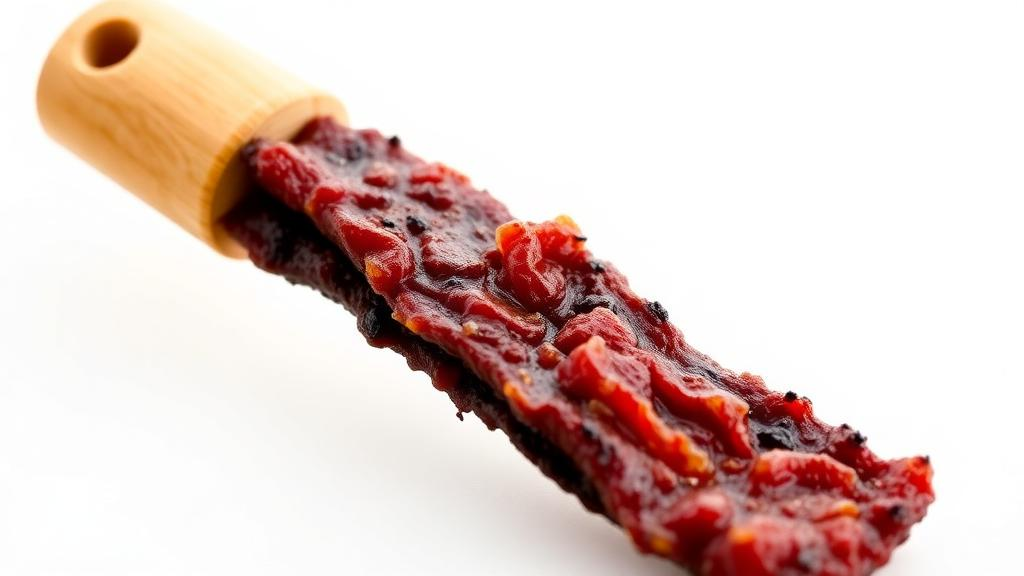
Pork jerky occupies a curious place in the world of food science: a product whose entire identity hinges on a single, deceptively simple variable. How long the meat sits in the drying oven determines whether it emerges tender and aromatic or tough, pale, and bland. Now a research team writing in Food Chemistry: X has combined an ultra-sensitive analytical instrument with interpretable machine learning to decode precisely what happens inside pork jerky as it dries, and their results point to a surprisingly precise sweet spot: five hours at 80 degrees Celsius.
The study, led by Xinyu Chen and Haoran Huang, focused on the later stages of hot-air drying, sampling marinated pork slices at 4, 4.5, 5, 5.5, and 6 hours, alongside an undried control. The researchers tracked moisture content, color, browning intensity, fluorescent Maillard reaction intermediates, and free amino acids across 180 sample units drawn from three biological replicates. Drying time exerted a highly significant effect on nearly every quality parameter measured, with statistical models confirming that the observed changes were driven by the drying process itself rather than by variation between procurement days or processing batches.
The chemical story that emerged is one of competing reactions unfolding at different speeds. As water evaporates, the food matrix contracts and flavor precursors become concentrated, accelerating lipid oxidation, Maillard reactions, and Strecker degradation. The team measured browning absorbance at 420 nanometers, which jumped from 16.82 in raw samples to 48.76 after just four hours and peaked at 67.80 at 5.5 hours. Fluorescence intensity, an early marker of Maillard progression, climbed steadily from roughly 6,000 to nearly 28,000 arbitrary units over the drying period, signaling the continuous accumulation of reactive intermediates even as the product approached its final low-moisture state.
Color told a parallel tale. Lightness values rose from 54.35 in raw meat to above 64 after five hours, a shift attributed to reduced surface moisture and thermal denaturation of myofibrillar proteins, both of which increase light scattering. Redness declined continuously as myoglobin degraded and oxidized, falling from 14.27 to 8.44 over six hours, while yellowness climbed from 21.18 to 27.71, reflecting the formation of Maillard intermediates and brown melanoidins. Together, these shifts describe jerky that becomes progressively lighter, less red, and more yellow-brown as drying proceeds, with the most dramatic changes occurring between four and five and a half hours.
Free amino acids, which contribute directly to taste and serve as precursors for aroma compounds, followed intricate trajectories. Glutamic acid, the dominant umami contributor, rose more than 50 percent to 1,286 milligrams per 100 grams of dry matter. Lysine surged more than twelvefold, while sweet-tasting alanine nearly doubled. In contrast, arginine collapsed from 443 to under 20 milligrams within the first four hours, and phenylalanine and tyrosine fell by roughly a third, likely consumed by Strecker degradation and related thermal reactions. The researchers note that the high initial arginine and aspartic acid levels partly reflect fish sauce in the marinade, a fermented seasoning naturally rich in free amino acids.
The volatile chemistry proved even more dynamic. Using gas chromatography-ion mobility spectrometry, or GC-IMS, the team identified 53 volatile organic compounds, including 19 aldehydes, 12 alcohols, 7 ketones, 8 heterocyclic compounds, 4 esters, 2 acids, and one miscellaneous compound. Crucially, individual compounds did not follow uniform trends. Pyrazines such as 2-ethyl-6-methylpyrazine spiked sharply after four hours and then declined, while furaneol dropped dramatically from its raw-sample level. Butanal dimers climbed steadily throughout, and furfuryl alcohol surged fifteenfold after drying began and then held relatively steady. Each measured signal represents a net balance between formation, volatilization, and thermal degradation, which is exactly why the researchers turned to machine learning to make sense of it.
The modeling strategy paired two fundamentally different algorithms. Support vector regression, which finds smooth nonlinear relationships in a kernel-defined feature space, and extra trees regression, which averages many randomized decision trees, were each trained to predict every physicochemical index directly from the 53 GC-IMS peak volumes. Both performed remarkably well, with test-set coefficients of determination between 0.989 and 0.998, but support vector regression was consistently more accurate, achieving a root mean square error of 0.602 for browning absorbance compared with 1.779 for extra trees. The similarity of results across training, validation, and test sets indicated no overfitting, demonstrating that the volatile fingerprints genuinely encode information about moisture, browning, and color.
High accuracy alone, however, says nothing about which compounds matter. To open the black box, the team applied SHAP, or SHapley Additive exPlanations, a framework that decomposes every prediction into contributions from individual variables. For moisture prediction, 1,2-dimethoxyethane and 1-pentanol dominated the support vector model, while heptanal and furfuryl alcohol led the extra trees version. Hexanal, a classic lipid oxidation product, ranked first for predicting both lightness and redness. The analysis also revealed that feature contributions shifted across drying stages, with many VOCs showing high importance in raw samples and different compounds taking over during the four-to-six-hour window, meaning no single global ranking fully captures the chemistry.
Importantly, several compounds appeared among the top predictors for both algorithms, including pentanal, furaneol, ethyl propanoate, 2-butanone, and 3-isobutyl-2-methoxypyrazine. Because their importance survived two very different modeling structures, the authors consider them comparatively robust candidate markers linking volatile profiles to quality attributes. The researchers are careful to emphasize that SHAP values explain model behavior and statistical associations within this dataset; they do not prove that these individual compounds directly participate in or cause the underlying reactions.
The sensory panel provided the human verdict, and it aligned neatly with the instrumental data. Scores for color, texture, and overall acceptability rose from four hours to a peak at five hours, where color reached 8.53, texture 8.63, and overall acceptability 8.43 on a nine-point scale, before declining at longer drying times. Aroma followed a similar pattern, though the difference between five and five and a half hours was not statistically significant. The convergence of sensory, physicochemical, and machine-learning evidence suggests a practical path forward: quality-control systems that read a jerky’s volatile fingerprint could verify drying endpoints without destructive testing. The authors caution that their models were built on a single raw-material source and drying range, so validation on independent production batches and earlier drying stages remains the next challenge before the approach reaches the factory floor.
Subject of Research: Effects of drying time on the physicochemical properties and volatile compounds of pork jerky analyzed by GC-IMS and interpretable machine learning
Article Title: Effects of drying time on physicochemical properties and volatile organic compounds of pork jerky revealed by GC-IMS and interpretable machine learning
Article References: Effects of drying time on physicochemical properties and volatile organic compounds of pork jerky revealed by GC-IMS and interpretable machine learning. (n.d.). Original publication
Image Credits: AI Generated
DOI: Not provided
Keywords: pork jerky, GC-IMS, machine learning, SHAP, Maillard reaction, drying time, volatile organic compounds, food chemistry, support vector regression, extra trees regression, free amino acids, sensory evaluation
Cite Scienmag News
Bethany Barker. (October 11, 2026). AI Sniffs Out the Perfect Pork Jerky by Reading Its Aroma Fingerprints. Scienmag. https://scienmag.com/ai-sniffs-out-the-perfect-pork-jerky-by-reading-its-aroma-fingerprints/
Bethany Barker. "AI Sniffs Out the Perfect Pork Jerky by Reading Its Aroma Fingerprints." Scienmag, 11 October 2026, https://scienmag.com/ai-sniffs-out-the-perfect-pork-jerky-by-reading-its-aroma-fingerprints/. Accessed 11 October 2026.
Bethany Barker. "AI Sniffs Out the Perfect Pork Jerky by Reading Its Aroma Fingerprints." Scienmag. October 11, 2026. https://scienmag.com/ai-sniffs-out-the-perfect-pork-jerky-by-reading-its-aroma-fingerprints/


