


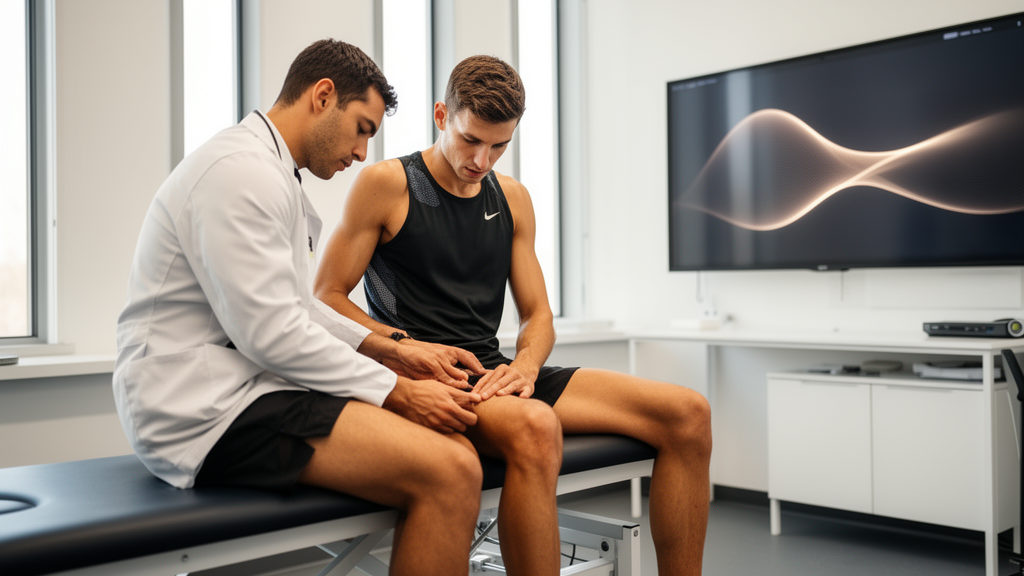
Knee pain is one of the most persistent threats to a distance runner’s career, and a new study suggests that a machine learning technique prized for its honesty about its own uncertainty may help coaches anticipate it. Researchers report that a Gaussian process regression (GPR) model, trained on just six routinely measurable training and body characteristics, can predict a continuous self-reported knee pain severity score in professional male distance runners with a mean squared error of 0.020 on a held-out test set. The work, published in Frontiers in Public Health, positions the model as a symptom-based decision-support tool rather than a diagnostic system, but its probabilistic design offers a glimpse of how data-driven monitoring could reshape injury prevention in elite endurance sport.
The study recruited fifty professional male distance runners aged 20 to 30 years from athletics clubs in Ankara, Turkey. To qualify, athletes had to be officially registered with a national athletics federation, have completed at least five years of systematic endurance training, train at least six days per week, exceed 100 kilometers of weekly running volume, and compete regularly at national or regional level. Anyone with an acute injury preventing training, recent surgery, or a condition limiting participation was excluded. The researchers collected data through structured questionnaires and physical assessment, and all data were anonymized before analysis under ethical approval from the Ethics Committee of the International University of Science and Technology.
Six predictors fed the model: resistance training frequency over the preceding four weeks, recorded on a five-level ordinal scale; self-reported weekly running distance, which averaged 121.7 kilometers with a standard deviation of 13.95 across the cohort; dominant training surface, coded from predominantly soft surfaces such as grass, tartan, or trails through mixed surfaces to predominantly hard asphalt or concrete; running technique, captured as a binary foot-strike category of midfoot or heel strike based on coach observation and self-report; the count of prior knee problems in the previous twelve months, where an episode meant pain or injury that forced at least seven days of modified training or a medical consultation; and body mass index, which ranged from 18.4 to 20.9 with a mean of 19.81, reflecting the lean physiques typical of elite distance runners.
The outcome variable was deliberately different from most sports-injury studies. Instead of a clinician-confirmed diagnosis, each athlete rated knee pain severity during training and competition on a numerical scale from 0 to 10, which the researchers normalized to a continuous score between 0 and 1. The cohort’s mean score was 0.428 with a standard deviation of 0.228, and scores ranged from 0.10 to 0.90. The authors emphasize that this measure reflects perceived knee-related discomfort and functional limitation, so the model should be read as symptom-based risk modeling, not injury prediction.
Gaussian process regression is a non-parametric, supervised learning approach that treats predictions as a distribution over functions rather than fitting a rigid equation. A Gaussian prior over functions is updated with observed data to yield a Gaussian posterior, and a kernel function, here a radial basis function kernel, defines the covariance between data points. The kernel’s parameters control the vertical amplitude of variation and the length scale that governs smoothness, and the model is trained by optimizing these hyperparameters to maximize the log marginal likelihood of the data. The practical payoff is twofold: GPR can capture nonlinear relationships without imposing a fixed functional form, and it produces a predictive variance for every estimate, allowing 95% credible intervals around each pain severity prediction.
Given the small sample size of fifty athletes, the researchers argue that this built-in regularization and uncertainty quantification make GPR particularly well suited to elite sport settings, where cohorts are inherently limited and measurements are noisy. The dataset was randomly divided with a fixed seed into 70% training and 30% test sets. Hyperparameter optimization was performed exclusively within the training data using five-fold cross-validation and grid search based on mean squared error, and the optimized model was then evaluated on the untouched test set. A complementary five-fold cross-validation assessment yielded a mean MSE of 0.028, close to the held-out test error of 0.020, indicating stable performance. For context, a simple mean-prediction baseline produced an MSE of 0.047, so the GPR model clearly outperformed that reference within this cohort, achieving a test RMSE of 0.144, an MAE of 0.116, and an R-squared of 0.475.
The most striking findings came from the sensitivity analysis. The researchers varied each predictor across its observed range while holding the remaining values from the corresponding test-set observations, an exploratory exercise they explicitly distinguish from formal feature-importance or causal analysis. Predictions showed pronounced sensitivity to resistance training frequency and to BMI, with the BMI response following a distinctly nonlinear pattern across the observed range. Weekly running distance and prior knee problems also contributed to variation in predicted pain severity, though the distance response varied across cases, suggesting dependence on other inputs. Training surface and running technique showed comparatively smaller sensitivity patterns, which the authors attribute partly to simplified encoding and limited variability within the cohort rather than to irrelevance. Alternative categorical encoding was tested and did not materially change performance or conclusions.
Joint response surfaces added another layer of insight. Within the fitted model, combinations of higher BMI and lower resistance training frequency were associated with higher predicted knee pain severity, and in parts of the modeled range, greater weekly running distance combined with lower resistance training frequency was likewise associated with higher predicted severity. The authors are careful to stress that these surfaces describe the fitted GPR response across pairs of predictors and are not formal statistical tests of interaction, nor evidence of causal relationships. Observational modeling of this kind cannot exclude reverse causality, for example pain influencing an athlete’s training choices, and the sensitivity analysis is exploratory rather than a global feature-importance ranking.
The study’s limitations are substantial and clearly stated. The outcome is subjective and does not represent a clinical diagnosis. The cohort is small, exclusively male, aged 20 to 30, and drawn from a single geographic setting, so the findings should not be generalized to female runners, recreational runners, older athletes, or other populations without external validation. Simplified feature encoding for technique and surface may attenuate effects that more detailed biomechanical measures would reveal. The authors call for external validation in independent cohorts, longitudinal modeling of pain trajectories across training cycles, and the inclusion of richer predictors such as session-RPE, recovery and sleep metrics, wearable-derived workload measures, strength test data, footwear characteristics, and more granular surface exposure, as well as extension to broader populations and other symptom targets such as low back pain.
Even with those caveats, the work points toward a practical shift in how elite training groups might monitor knee health. Because the model relies only on routinely obtainable information, tracking modifiable factors such as resistance training frequency and BMI alongside weekly mileage and injury history could be folded into everyday monitoring without specialized laboratory equipment. The uncertainty output matters as much as the point estimate: a high predicted pain severity with narrow uncertainty carries different weight than one with wide intervals that signal sparse data support. The authors frame the framework as decision support for symptom-based risk modeling, explicitly not a diagnostic system, but in a sport where patellofemoral pain, iliotibial band symptoms, and patellar tendinopathy routinely disrupt training and competition, an uncertainty-aware early-warning signal built from ordinary training logs could prove a quietly powerful addition to the coach’s toolkit.
Subject of Research: Machine learning prediction of self-reported knee pain severity in professional male distance runners using Gaussian process regression
Article Title: Predicting knee pain severity in professional distance runners using gaussian process regression
Article References: Sadır, Y., İnan, M., Karadağ, M., Ceylan, L., Ceylan, T., Sajedi, H., Öz, F., Şahinler, Y., Alimoradi, M., Alghosi, M., & Konrad, A. (2026). Predicting knee pain severity in professional distance runners using gaussian process regression. Frontiers in Public Health, 14, 1973629. https://doi.org/10.3389/fpubh.2026.1973629
Image Credits: AI Generated
DOI: 10.3389/fpubh.2026.1973629
Keywords: Gaussian process regression, knee pain, distance running, machine learning, injury prevention, resistance training, BMI, training load, uncertainty quantification, sports science, athlete monitoring, overuse injury
Cite Scienmag News
Ophelia Keating. (October 27, 2026). AI Model Predicts Knee Pain Severity in Professional Distance Runners. Scienmag. https://scienmag.com/ai-model-predicts-knee-pain-severity-in-professional-distance-runners/
Ophelia Keating. "AI Model Predicts Knee Pain Severity in Professional Distance Runners." Scienmag, 27 October 2026, https://scienmag.com/ai-model-predicts-knee-pain-severity-in-professional-distance-runners/. Accessed 27 October 2026.
Ophelia Keating. "AI Model Predicts Knee Pain Severity in Professional Distance Runners." Scienmag. October 27, 2026. https://scienmag.com/ai-model-predicts-knee-pain-severity-in-professional-distance-runners/


