


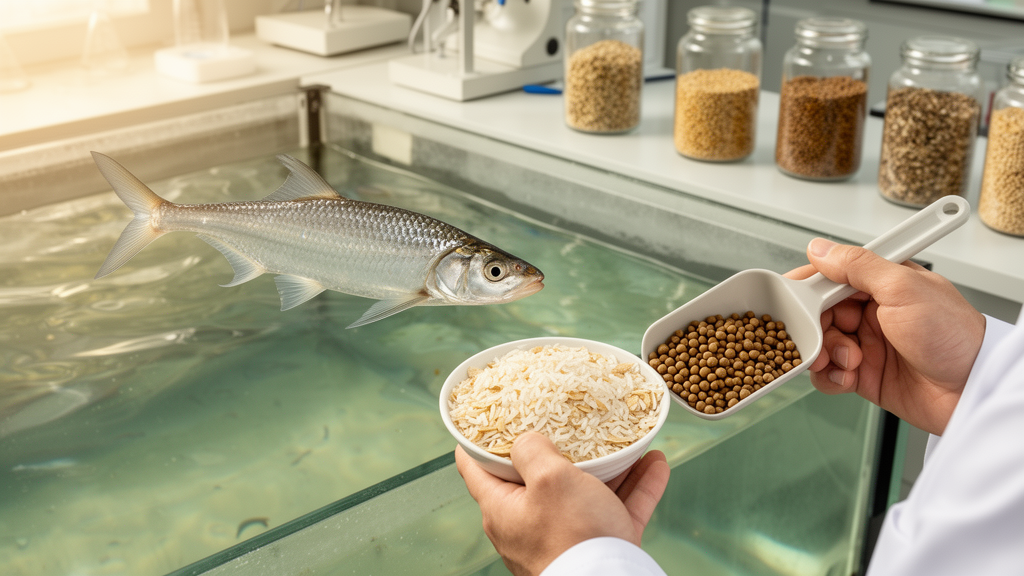
A 60-day feeding trial at the University of the Philippines Visayas has found that rice milling by-product fermented with the straw mushroom Volvariella volvacea can fully replace soybean meal in diets for juvenile milkfish (Chanos chanos) without statistically detectable losses in survival, growth, feed utilization, nutrient retention, whole-body composition, intestinal morphology, or gut microbial counts. At a 50 percent replacement level, the fermented ingredient actually outperformed the soybean meal control on several key production metrics. The study, conducted at the Institute of Aquaculture within the College of Fisheries and Ocean Sciences, evaluated solid-state fermented rice bran, abbreviated VFRB, as an alternative protein source in milkfish aquafeeds.
The researchers arranged the trial as a completely randomized design with five dietary treatments, each replicated in triplicate. One group of juvenile milkfish received a control diet built on soybean meal, while the other four groups received diets in which soybean meal was replaced with VFRB at 25, 50, 75, and 100 percent by weight. All experimental diets were formulated to be nutritionally comparable, containing 37 percent crude protein, 11 percent crude lipid, and energy levels ranging from approximately 4475 to 4624.47 kilocalories per kilogram.
The central finding was that complete replacement of soybean meal with the fermented rice bran did not produce any statistically detectable reduction in the measured physiological responses. In practical terms, milkfish juveniles fed a diet in which all of the soy protein had been swapped for mushroom-fermented rice bran survived, grew, and used their feed at levels indistinguishable from fish on the conventional soy-based ration, within the resolution of the measurements taken during the trial. The intermediate inclusion level produced the most striking results.
Fish receiving the 50 percent replacement diet showed significantly improved weight gain, specific growth rate, protein retention, lipid retention, and protein efficiency ratio compared with the control. At the same time, the feed conversion ratio, a measure of how much feed is required to produce a unit of fish biomass, was significantly reduced relative to the soybean meal control. Intestinal morphology also responded to the 50 percent diet.
Juvenile milkfish fed at this replacement level exhibited improved intestinal villi absorptive morphology. Microbiological analysis of the gut added a further dimension to the findings. Fish on the 50 percent VFRB diet carried lower total gut bacterial counts alongside higher gut lactic acid bacterial counts.
The authors report this shift in gut microbial counts, together with the improved intestinal morphology, as part of the measured response pattern associated with the intermediate replacement level. Taken together, the results position VFRB as a potentially sustainable, functional alternative protein source that could reduce reliance on conventional soybean meal in juvenile milkfish aquaculture feeds. The authors frame their conclusions in measured terms: the trial demonstrates that complete substitution produced no statistically detectable declines in the measured physiological responses, while the 50 percent replacement enhanced growth, nutrient utilization, and intestinal morphology under the controlled experimental conditions tested.
The scope of the evidence remains bounded by the trial design. The study was conducted on juvenile milkfish over 60 days under controlled experimental conditions, with five treatments in triplicate, and the reported outcomes are limited to the performance, compositional, morphological, and microbiological measures taken during that period. The findings apply to the life stage and duration tested, and the authors describe VFRB as a potential alternative protein source rather than a validated commercial ingredient.
Within those limits, the trial offers a clear data point for aquafeed development: a rice milling by-product upgraded through solid-state fermentation with V. volvacea sustained juvenile milkfish performance at full soybean meal replacement and improved several growth and gut-related measures at half replacement, supporting its continued evaluation as a protein source in milkfish diets.
Subject of Research: Solid-state fungal fermentation of rice milling by-product as an alternative protein to soybean meal in juvenile milkfish aquafeeds
Article Title: Solid-state Volvariella volvacea-fermented rice milling by-product as a potential sustainable alternative protein source to soybean meal in juvenile milkfish (Chanos chanos) diet
Article References: De Leon, M. H. F., Gayosa, V. E. D., Lumayno, S. D. P., Añasco, C. P., del Castillo, C. S., & Traifalgar, R. F. M. (2026). Solid-state Volvariella volvacea-fermented rice milling by-product as a potential sustainable alternative protein source to soybean meal in juvenile milkfish (Chanos chanos) diet. Frontiers in Sustainable Food Systems, 10, 1992320. https://doi.org/10.3389/fsufs.2026.1992320
Image Credits: AI Generated
DOI: 10.3389/fsufs.2026.1992320
Keywords: milkfish, aquaculture, soybean meal alternative, rice bran, solid-state fermentation, Volvariella volvacea, feed conversion ratio, gut microbiota, intestinal morphology, sustainable aquafeeds, protein retention, Philippines
Cite Scienmag News
Alan Morgan. (October 27, 2026). Mushroom-Fermented Rice Bran Matches Soybean Meal in Juvenile Milkfish Feed Trial. Scienmag. https://scienmag.com/mushroom-fermented-rice-bran-matches-soybean-meal-in-juvenile-milkfish-feed-trial/
Alan Morgan. "Mushroom-Fermented Rice Bran Matches Soybean Meal in Juvenile Milkfish Feed Trial." Scienmag, 27 October 2026, https://scienmag.com/mushroom-fermented-rice-bran-matches-soybean-meal-in-juvenile-milkfish-feed-trial/. Accessed 27 October 2026.
Alan Morgan. "Mushroom-Fermented Rice Bran Matches Soybean Meal in Juvenile Milkfish Feed Trial." Scienmag. October 27, 2026. https://scienmag.com/mushroom-fermented-rice-bran-matches-soybean-meal-in-juvenile-milkfish-feed-trial/


