


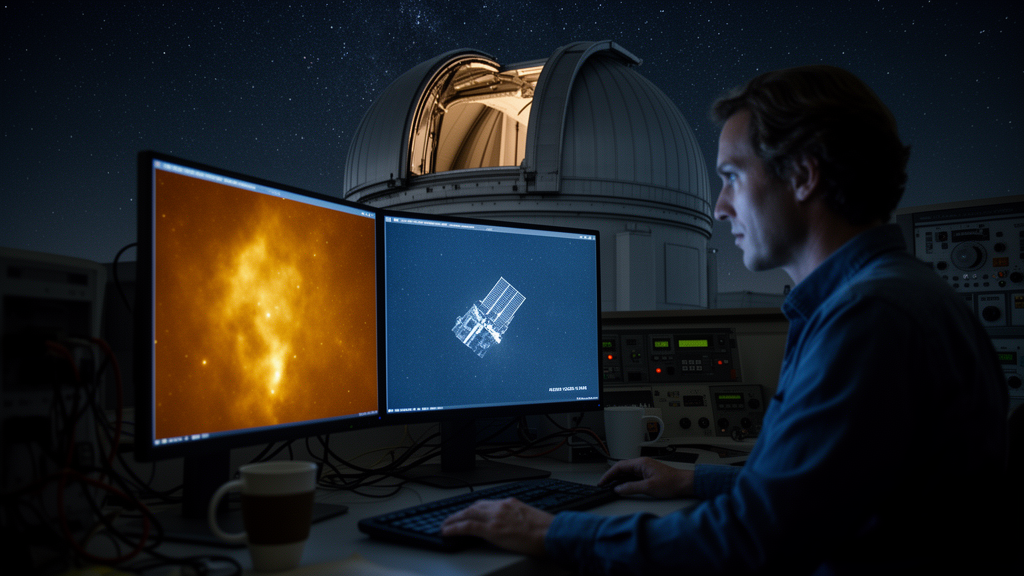
Space debris is one of the fastest-growing hazards in orbit, and spotting it reliably has long been a stubborn problem for spacecraft that must operate autonomously. A research team from the Xi'an Institute of Optics and Precision Mechanics and Northwestern Polytechnical University in China now reports a new artificial intelligence framework that pairs infrared and visible-light imagery to detect debris even when sunlight fails. Their system, called SPDNet, the Space Debris Perception and Detection Network, was described in a paper published in Frontiers in Astronomy and Space Sciences, and it achieved the best results yet reported among the fusion methods the authors tested on their benchmark dataset.
The core problem is one of physics. Visible-light cameras are cheap, compact and sharp, which is why they dominate space-based surveillance payloads. But the light that reaches them is reflected sunlight, so what a camera sees depends entirely on the geometry of the Sun, the spacecraft and the target.
When debris drifts into shadow, or when the observation platform itself blocks the light, visible images suffer severe darkening, crushed contrast and lost detail. Infrared cameras, by contrast, record thermal radiation emitted by the object itself, so they are largely indifferent to illumination angle. The trade-off is that infrared sensors offer limited resolution and capture little of the texture, edge and color information that makes objects easy to recognize.
Previous attempts to combine the two modalities generally followed a two-step recipe: first fuse the images into a single enhanced picture, then feed that picture to a detector. The authors argue this pipeline is fundamentally misaligned. Most fusion algorithms are optimized to make images look good to human eyes, preserving pleasing textures rather than the discriminative features a detector needs to find small, faint targets.
As a result, a fused image can be visually attractive yet still hide the very debris the mission is trying to find. SPDNet abandons the two-stage design entirely and trains enhancement, fusion and detection as one end-to-end system, so the detection loss directly shapes how the images are enhanced and combined. The architecture rests on three purpose-built modules.
The first, Light-Boosting Convolution, or LBC, tackles the low-light problem before feature extraction even begins. Rather than simply brightening the image, LBC uses a stack of five convolutional blocks with residual connections to predict an illumination enhancement residual, a correction term constrained between zero and one by a Sigmoid activation. Adding this residual to the original input restores structure in dark regions while preserving the original content.
Because the module sits inside the end-to-end training loop, gradients flowing back from the detection head teach it to enhance exactly the features that help the detector, not merely to raise brightness. The second module, Cross-Modal Attention, or CMA, addresses how the two sensor streams should talk to each other. Naively concatenating visible and infrared feature maps wastes their complementary strengths.
CMA is inserted after every stage of the two backbone networks and works through channel attention: each modality's feature map passes through a lightweight attention mapping built from two 3-by-3 convolutions, a ReLU activation, global average pooling and a Sigmoid gate. The resulting importance weights are then transferred to the opposite modality, so visible features are reinforced by infrared thermal information while infrared features gain structural detail from the visible branch. Residual addition, rather than concatenation, merges the enhanced features back with the originals, keeping modality-specific information intact throughout the hierarchical extraction process.
The third component, Multi-Scale Adaptive Fusion, or MSAF, deals with the enormous range of target sizes in debris imagery, from distant point-like specks to large nearby structures. Features drawn from a Feature Pyramid Network and a Path Aggregation Network, including a newly added large-object detection layer, are resized to a common resolution, passed through convolutional projections to produce spatial weight maps, and normalized with a Softmax operation so the weights are non-negative and sum to one at every location. A weighted element-wise summation then combines the four feature levels, letting the network emphasize whichever scale carries the most useful information at each point in the image.
Because no public dataset pairs real infrared and visible images of space debris, the team built one. They started from a publicly available Kaggle collection of visible-light images of orbital targets, then used Vega Prime simulation software to generate geometrically aligned infrared counterparts, matching viewing angle, target attitude, background and thermal radiation parameters for each frame. The result was 500 paired images at 640 by 480 pixels.
After pair-level splitting to prevent data leakage, augmentation with flips, 36-degree rotations mimicking tumbling debris and Gamma corrections simulating changing solar angles expanded the set to 11,000 samples, 7,500 for training and 3,500 for testing. Training ran for 300 epochs on an RTX 4060 Laptop GPU using stochastic gradient descent. The numbers tell a striking story.
On image fusion quality, SPDNet scored an average gradient of 88.9, spatial frequency of 87.286, mutual information of 5.946 and a Chen-Blum perceptual metric of 0.941, topping fifteen comparison methods that ranged from classical techniques like GFF and MGFF to recent deep models such as DIVFusion, CDDFuse, Diff-IF and PromptFusion. On detection, the system reached 78.48 percent mean average precision, 98.74 percent mAP at the 0.5 threshold, and 40.27 percent average precision on small objects, which the authors define as targets smaller than 20 by 20 pixels. For comparison, a visible-only detector managed just 23.45 percent mAP and 8.12 percent APsmall, while an infrared-only baseline reached 27.87 and 9.73 percent respectively.
Ablation experiments confirmed that each module matters: removing LBC dropped mAP to 66.52 percent, removing CMA to 67.41 percent and removing MSAF to 68.54 percent. The authors are careful about what these results do and do not prove. The infrared half of the dataset is simulated, and while the simulation controls viewing geometry and thermal parameters, it cannot reproduce real sensor noise, detector response or background radiation statistics.
The efficiency figures, 5.80 million parameters, 32.38 gigafloating-point operations and 44.7 milliseconds of latency, roughly 22.4 frames per second, were measured on a consumer laptop GPU, not on the radiation-hardened, power-constrained processors that actually fly on spacecraft. The team frames the work as evidence that the framework works under controlled paired visible-simulated infrared conditions, and lists simulation-to-real validation, embedded-platform profiling and model compression through quantization, pruning or distillation as the necessary next steps toward genuine on-orbit deployment. Even with those caveats, the study makes a compelling case that how you train matters as much as what you train on.
By letting the detection objective steer image enhancement and cross-modal fusion, SPDNet turns two imperfect sensors into a system more capable than either alone, precisely in the regime that matters most: small, faint objects against a noisy, badly lit sky. Whether the same gains survive contact with real infrared hardware and space-grade computing remains the open question, but the blueprint for answering it is now on the table.
Subject of Research: Infrared-visible fusion network for autonomous space debris detection under low-light conditions
Article Title: Infrared-visible space debris perception and detection with light-boosting convolution and cross-modal attention fusion
Article References: Yang, Y., Yao, D., Bu, F., Wen, Y., & Chen, R. (2026). Infrared-visible space debris perception and detection with light-boosting convolution and cross-modal attention fusion. Frontiers in Astronomy and Space Sciences, 13, 1930223. https://doi.org/10.3389/fspas.2026.1930223
Image Credits: AI Generated
DOI: 10.3389/fspas.2026.1930223
Keywords: space debris, infrared-visible fusion, low-light image enhancement, cross-modal attention, object detection, SPDNet, multi-scale fusion, space surveillance, deep learning, autonomous on-orbit sensing, image fusion, small object detection
Cite Scienmag News
Blake Davidson. (October 27, 2026). AI Fuses Infrared and Visible Light to Spot Space Debris in the Dark. Scienmag. https://scienmag.com/ai-fuses-infrared-and-visible-light-to-spot-space-debris-in-the-dark/
Blake Davidson. "AI Fuses Infrared and Visible Light to Spot Space Debris in the Dark." Scienmag, 27 October 2026, https://scienmag.com/ai-fuses-infrared-and-visible-light-to-spot-space-debris-in-the-dark/. Accessed 27 October 2026.
Blake Davidson. "AI Fuses Infrared and Visible Light to Spot Space Debris in the Dark." Scienmag. October 27, 2026. https://scienmag.com/ai-fuses-infrared-and-visible-light-to-spot-space-debris-in-the-dark/


