


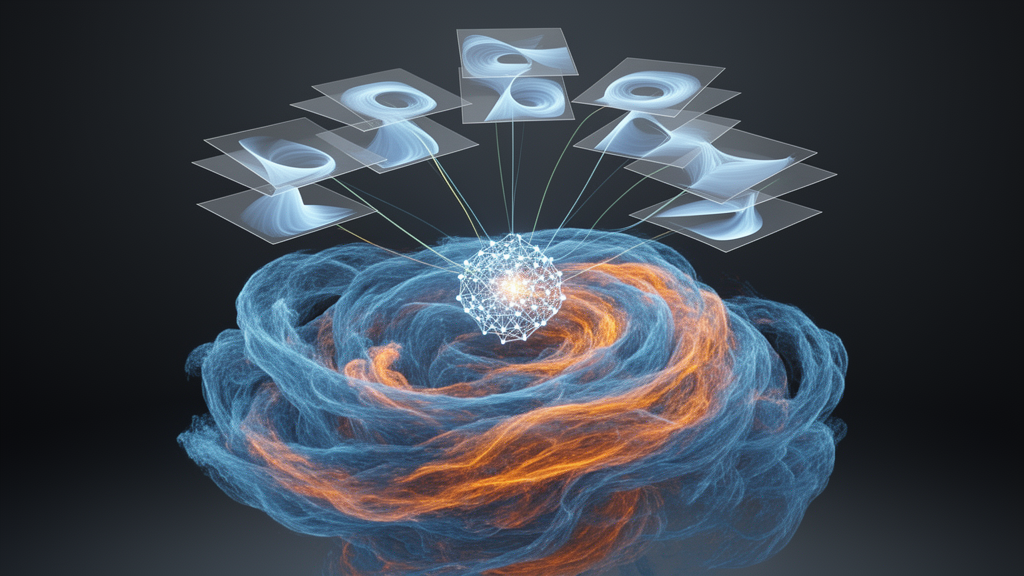
Turbulence is everywhere. It is the chaotic swirl of air over an aircraft wing, the churning plasma inside a fusion reactor, the roiling currents that carry heat and pollutants through the atmosphere and oceans. For decades, engineers have relied on turbulence models—mathematical approximations of this chaos—to design planes, turbines, and climate-resilient infrastructure. Yet even the best of these models stumble when a flow shifts from one physical regime to another, for example when a smooth boundary layer separates from a surface or when gentle channel flow gives way to a violent shock wave. A new study published in Communications Engineering by Hao-Chen Liu, Qingyong Luo, Xin-Lei Zhang, and Guowei He of the Institute of Mechanics at the Chinese Academy of Sciences proposes a way out of this impasse, using a machine learning architecture that behaves less like a single monolithic brain and more like a panel of specialists, each fluent in one dialect of turbulence.
The core problem the team set out to solve is generalization. In recent years, data-driven turbulence modeling has flourished: researchers train neural networks on high-fidelity simulation or experimental data, and the networks learn corrections to classical models such as the k-epsilon or Spalart-Allmaras closures. These learned models can dramatically improve accuracy—but usually only within the flow regime they were trained on. The reason is architectural. Most existing approaches use dense, monolithic networks in which every parameter participates in every prediction. Such networks tend to entangle the physics of different regimes into a single set of weights, so a model tuned to attached boundary layers may produce nonsense when asked about separated flow, and vice versa. The result is a patchwork of specialized models that engineers must manually select and swap as conditions change—an approach that is fragile, labor-intensive, and poorly suited to real-world applications where flows routinely traverse multiple regimes.
Liu and colleagues’ answer is a framework they call the factorized-gating mixture of experts, or FG-MoE. Mixture-of-experts architectures are not new to machine learning; they have powered large language models and other large-scale systems by dividing computation among specialized subnetworks, with a component called a router or gating network deciding which expert handles each input. What distinguishes FG-MoE is how it builds and controls its experts. Instead of one opaque router making high-dimensional decisions, the framework trains a set of regime-specific experts—each specializing in a distinct physical regime of turbulence—and blends their outputs using spatially varying probabilities. At every point in a flow field, the gating mechanism estimates how strongly each expert should contribute, producing a smooth, location-dependent combination rather than a hard switch between models.
The truly novel ingredient is the factorization of the gating function itself. Conventional routers are high-dimensional: they take the full set of local flow features and map them onto expert-selection probabilities through a dense layer, which is computationally expensive and notoriously difficult to interpret. FG-MoE replaces this monolithic router with a set of lightweight, physics-guided binary attributes—simple yes-or-no questions about the local flow state, such as whether a particular regime indicator is active. The overall gating probability is then approximated as a product of low-dimensional binary factor probabilities. This product-form decomposition slashes the complexity of the gating computation, because the network no longer has to learn an arbitrary mapping through a vast parameter space. Instead, it composes a handful of interpretable, physically motivated decisions into a final expert weighting.
Interpretability is not merely an aesthetic bonus here; it is central to why the approach matters for engineering. When a conventional neural network corrects a turbulence model, engineers often cannot tell why it made a particular prediction, which breeds distrust in safety-critical applications like aircraft certification or nuclear reactor design. With FG-MoE, the binary factors can be tied to recognizable flow physics, so the gating mechanism effectively explains itself: a given point in the flow is assigned to an expert because specific, legible conditions hold there. The authors argue that this transparency, combined with the reduced gating complexity, makes the framework a practical pathway for engineering turbulence modeling—one that decomposes complex turbulent flows into distinct physical regimes and then leverages the factorized gating strategy to keep the whole system interpretable, efficient, and scalable.
Scalability arrives in an unusually elegant form. In most machine learning systems, adding new capability means retraining the entire model, an expensive and disruptive process. FG-MoE is designed as a plug-and-play architecture: new experts can be added to the expert library without retraining the whole model. If engineers encounter a flow regime the current system handles poorly—say, a novel heat-transfer configuration in a gas turbine—they can train a dedicated expert for that regime and slot it into the existing framework, with the factorized gating mechanism automatically learning when to call on the newcomer. This modularity mirrors how human engineering knowledge actually accumulates: not by rewriting every textbook each time a new phenomenon is discovered, but by adding a chapter and cross-referencing it with the rest.
The evidence for the framework’s effectiveness comes from extensive numerical experiments spanning canonical benchmarks to complex, real-world engineering applications. Canonical cases—the well-instrumented standard flows that the turbulence community uses to judge models—allow head-to-head comparison against established baselines. The engineering applications then test whether the approach survives contact with the messy, multi-regime reality of industrial flows, where separation, reattachment, pressure gradients, and wall effects coexist in a single domain. Across this spectrum, the authors report that FG-MoE delivers consistently high-fidelity predictions across diverse flow regimes, in contrast to monolithic dense networks whose accuracy degrades sharply outside their training distribution. The consistency is the headline result: rather than excelling in one regime and failing in others, the expert-based system maintains its accuracy as the physics changes.
The implications reach across aerospace, energy, and environmental technology, the three domains the authors single out as being critically limited by turbulence model accuracy. In aerospace, better cross-regime turbulence prediction could sharpen estimates of drag, heat loads, and buffet onset, reducing the safety margins that currently inflate fuel consumption and design cost. In energy, gas turbines, wind farms, and fusion devices all involve flows that transition abruptly between regimes, and improved models could improve efficiency and reliability. In environmental applications, from urban wind comfort to pollutant dispersion, the ability to blend regime-specific knowledge smoothly across a domain could make simulations more trustworthy. Because the framework is modular and interpretable, it also offers a natural vehicle for incorporating new experimental or simulation data as it becomes available, without discarding the accumulated expertise encoded in existing experts.
There are, of course, caveats worth keeping in mind. The study is computational, resting on numerical experiments rather than new wind-tunnel measurements, and the quality of any data-driven turbulence model ultimately depends on the fidelity and breadth of its training data. The factorized gating relies on physics-guided binary attributes, which means someone must choose sensible regime indicators—a task that leans on domain expertise even as it reduces the burden on the learning algorithm. And while plug-and-play expansion avoids full retraining, each new expert still requires its own training data and validation. The published version of the paper is also an early-release, peer-reviewed accepted manuscript that the journal notes remains subject to further edits before the final Version of Record, so some details may be refined.
Even with those qualifications, the work represents a notable conceptual shift. For twenty years, data-driven turbulence modeling has largely pursued bigger, denser networks trained on ever-larger datasets, in the hope that raw capacity would yield universal closures. Liu, Luo, Zhang, and He make the opposite bet: that turbulence is best learned by dividing it—by training specialists, wiring them together through a gating mechanism that is deliberately simple, physically grounded, and mathematically factorized, and by making the whole assembly extensible. If the framework’s cross-regime performance holds up as it is tested against more industrial flows and, eventually, experimental data, the humble turbulence model may finally be on its way to becoming something engineers have long wanted: a system that knows which kind of chaos it is looking at, and admits it.
Subject of Research: Machine learning framework for cross-regime turbulence modeling using a factorized-gating mixture of experts
Article Title: Factorized-gating mixture of experts enables cross-regime turbulence modeling
Article References: Liu, H.-C., Luo, Q., Zhang, X.-L., & He, G. (2026). Factorized-gating mixture of experts enables cross-regime turbulence modeling. Communications Engineering. https://doi.org/10.1038/s44172-026-00802-5
Image Credits: AI Generated
DOI: 10.1038/s44172-026-00802-5
Keywords: turbulence modeling, mixture of experts, machine learning, fluid dynamics, aerospace engineering, neural networks, gating mechanism, data-driven modeling, flow regimes, interpretability, computational fluid dynamics, Chinese Academy of Sciences
Cite Scienmag News
Katie Riggs. (October 9, 2026). AI Learns to Master Turbulence by Splitting It Into Physics-Guided Experts. Scienmag. https://scienmag.com/ai-learns-to-master-turbulence-by-splitting-it-into-physics-guided-experts/
Katie Riggs. "AI Learns to Master Turbulence by Splitting It Into Physics-Guided Experts." Scienmag, 9 October 2026, https://scienmag.com/ai-learns-to-master-turbulence-by-splitting-it-into-physics-guided-experts/. Accessed 9 October 2026.
Katie Riggs. "AI Learns to Master Turbulence by Splitting It Into Physics-Guided Experts." Scienmag. October 9, 2026. https://scienmag.com/ai-learns-to-master-turbulence-by-splitting-it-into-physics-guided-experts/


