

Sunday, October 25, 2026
Science
No Result
View All Result
  • Login
  • HOME
  • SCIENCE NEWS
  • CONTACT US
  • HOME
  • SCIENCE NEWS
  • CONTACT US
No Result
View All Result
Scienmag
No Result
View All Result
Home Science News Medicine

AI Generates Rare Gut Lesion Images From a Single Photo to Sharpen Diagnostics

October 25, 2026
in Medicine
Ophelia Keating
By Ophelia Keating Scienmag Editorial Profile - Health Services Research
Reading Time: 2 mins read
0
AI Generates Rare Gut Lesion Images From a Single Photo to Sharpen Diagnostics

AI Generates Rare Gut Lesion Images From a Single Photo to Sharpen Diagnostics

65
SHARES
587
VIEWS
Share on FacebookShare on Twitter
ADVERTISEMENT

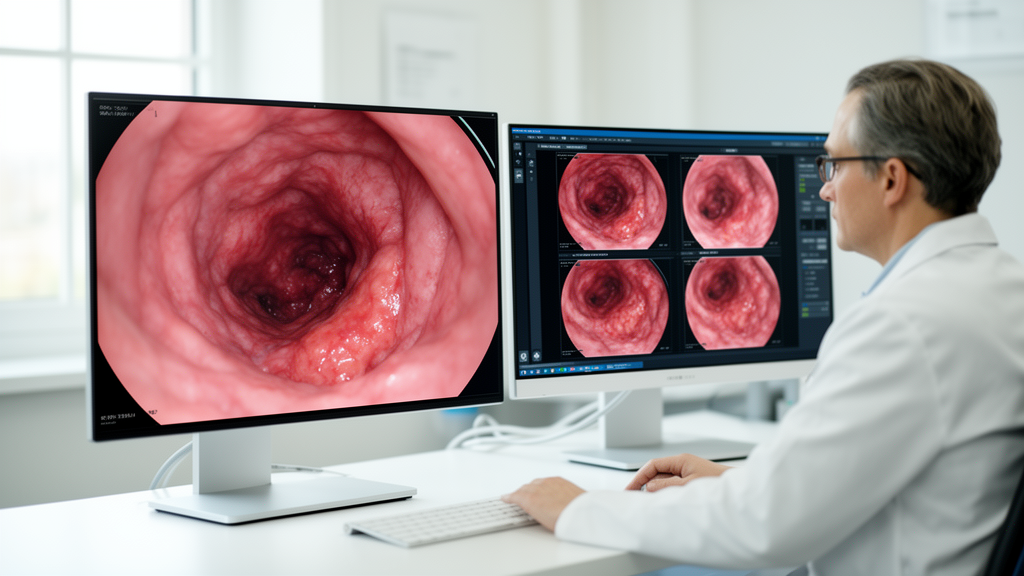
Rare gastrointestinal lesions are so infrequently encountered in routine endoscopy that clinicians in training may go years without seeing one, and the scarcity of real images has likewise limited the data available for developing reliable artificial intelligence models. Reporting in Nature Communications, a research team has now presented EndoRare, a one-shot, retraining-free generative framework that synthesizes diverse lesion exemplars from a single reference image. The technical core of the approach is language-guided concept disentanglement.

EndoRare separates the pathognomonic features that define a lesion from non-diagnostic attributes, encoding the defining features into a learnable prototype embedding. By varying only the non-diagnostic attributes across generated images, the system produces visually diverse exemplars while preserving the diagnostic content that matters for recognition, all without retraining the underlying model. The researchers validated the framework across four rare pathologies: calcifying fibrous tumor, juvenile polyposis syndrome, familial adenomatous polyposis, and Peutz-Jeghers syndrome.

An important checkpoint for any generative tool intended for medical use is whether its outputs look credible to specialists. Expert reviewers judged the EndoRare-generated images to be clinically plausible, indicating that the synthetic exemplars retained the features that define each pathology rather than producing superficially convincing but diagnostically empty images. The synthetic data also delivered measurable gains for machine learning.

When used to augment training sets, EndoRare-generated images significantly improved downstream AI classifiers, increasing true positive rates at low false-positive rates. Beyond algorithms, the team ran an exploratory reader study with novice endoscopists. Exposure to EndoRare-generated cases was associated with improved image-level recognition of the rare lesions, pointing to a role for synthetic exemplars in clinical education where real cases are too scarce to build a training curriculum around.

The authors are careful about scope. The reader study was exploratory, and the association between exposure to synthetic cases and improved recognition does not by itself establish a causal training benefit. The findings support EndoRare's potential as a data-efficient tool for rare-lesion education while motivating prospective controlled validation before any conclusions about deployment are drawn.

Even with those limitations, the work demonstrates that a single reference image can be stretched into a diverse, expert-endorsed set of training exemplars for pathologies that are rarely photographed. For rare gastrointestinal lesions, where both AI development and novice clinician training have been constrained by the same shortage of real cases, EndoRare offers a data-efficient way to address both needs from the same synthesized resource, pending the controlled studies that will determine how well the approach performs in practice.

Subject of Research: One-shot synthesis of rare gastrointestinal lesions improves diagnostic accuracy and clinical training

Article Title: One-shot synthesis of rare gastrointestinal lesions improves diagnostic accuracy and clinical training

Article References: Yu, J., Zhu, Y., Fu, P., Chen, T., Wang, Z., Wu, F., Li, Q., Zhou, P., Wang, S., & Yang, X. (2026). One-shot synthesis of rare gastrointestinal lesions improves diagnostic accuracy and clinical training. Nature Communications. https://doi.org/10.1038/s41467-026-78492-y

Image Credits: AI Generated

DOI: 10.1038/s41467-026-78492-y

Keywords: EndoRare, gastrointestinal endoscopy, rare lesions, generative AI, image synthesis, data augmentation, clinical training, Peutz-Jeghers syndrome, familial adenomatous polyposis, One-shot, synthesis, rare

Cite Scienmag News

Ophelia Keating. (October 25, 2026). AI Generates Rare Gut Lesion Images From a Single Photo to Sharpen Diagnostics. Scienmag. https://scienmag.com/ai-generates-rare-gut-lesion-images-from-a-single-photo-to-sharpen-diagnostics/


Ophelia Keating. "AI Generates Rare Gut Lesion Images From a Single Photo to Sharpen Diagnostics." Scienmag, 25 October 2026, https://scienmag.com/ai-generates-rare-gut-lesion-images-from-a-single-photo-to-sharpen-diagnostics/. Accessed 25 October 2026.

Ophelia Keating. "AI Generates Rare Gut Lesion Images From a Single Photo to Sharpen Diagnostics." Scienmag. October 25, 2026. https://scienmag.com/ai-generates-rare-gut-lesion-images-from-a-single-photo-to-sharpen-diagnostics/

Tags: AI in gastrointestinal medicineAI-generated medical imagesclinical trainingcredibility of AI-generated medical imagesdata augmentationdiagnostic feature preservation in AI modelsEndoRareendoscopy diagnostics enhancementfamilial adenomatous polyposisGastrointestinal endoscopygenerative AIimage synthesislanguage-guided concept disentanglementmedical image augmentationOne-shotpathology-specific image generationPeutz-Jeghers syndromerareRare gastrointestinal lesion imagingrare lesionsrare pathology visualizationsingle-photo lesion synthesisSynthesissynthetic lesion data for training
Share26Tweet16
Previous Post

Zipalertinib plus chemotherapy extends survival in EGFR exon 20 lung cancer

Next Post

Synthetic Peptide IL15.3 Calms Inflamed Immune Cells on Multiple Fronts

Related Posts

Three-Week Health Resort Program Eases Insomnia and Boosts Quality of Life Across BMI Categories
Medicine

Three-Week Health Resort Program Eases Insomnia and Boosts Quality of Life Across BMI Categories

October 25, 2026
Case report shows kidney preservation after renal hilar pheochromocytoma surgery
Medicine

Case report shows kidney preservation after renal hilar pheochromocytoma surgery

October 25, 2026
Survey Maps Organisational Support for Evidence-Based Practice in Finnish Occupational Health
Medicine

Survey Maps Organisational Support for Evidence-Based Practice in Finnish Occupational Health

October 25, 2026
Treat CKD: Decision support tool brings kidney risk calculations into primary care records
Medicine

Treat CKD: Decision support tool brings kidney risk calculations into primary care records

October 25, 2026
Review: Kidney fat compartments show distinct biology and treatment-linked remodeling
Medicine

Review: Kidney fat compartments show distinct biology and treatment-linked remodeling

October 25, 2026
Brazil’s medicinal plant list is far ahead of clinical evidence
Medicine

Brazil’s medicinal plant list is far ahead of clinical evidence

October 25, 2026
Next Post
Synthetic Peptide IL15.3 Calms Inflamed Immune Cells on Multiple Fronts

Synthetic Peptide IL15.3 Calms Inflamed Immune Cells on Multiple Fronts

  • Mothers who receive childcare support from maternal grandparents show more optimized

    Mothers who receive childcare support from maternal grandparents show more parental warmth, finds NTU Singapore study

    27656 shares
    Share 11059 Tweet 6912
  • University of Seville Breaks 120-Year-Old Mystery, Revises a Key Einstein Concept

    1061 shares
    Share 424 Tweet 265
  • Bee body mass, pathogens and local climate influence heat tolerance

    682 shares
    Share 273 Tweet 171
  • Researchers record first-ever images and data of a shark experiencing a boat strike

    546 shares
    Share 218 Tweet 137
  • Groundbreaking Clinical Trial Reveals Lubiprostone Enhances Kidney Function

    531 shares
    Share 212 Tweet 133
Science

Embark on a thrilling journey of discovery with Scienmag.com—your ultimate source for cutting-edge breakthroughs. Immerse yourself in a world where curiosity knows no limits and tomorrow’s possibilities become today’s reality!

RECENT NEWS

  • Synthetic Peptide IL15.3 Calms Inflamed Immune Cells on Multiple Fronts
  • AI Generates Rare Gut Lesion Images From a Single Photo to Sharpen Diagnostics
  • Zipalertinib plus chemotherapy extends survival in EGFR exon 20 lung cancer
  • Copper-Doped Bioactive Glass Ointment Speeds Wound Healing in Metabolic Syndrome

Categories

  • Agriculture
  • Anthropology
  • Archaeology
  • Athmospheric
  • Biology
  • Biotechnology
  • Blog
  • Bussines
  • Cancer
  • Chemistry
  • Climate
  • Earth Science
  • Editorial Policy
  • Marine
  • Mathematics
  • Medicine
  • Pediatry
  • Policy
  • Psychology & Psychiatry
  • Science Education
  • Science News
  • Social Science
  • Space
  • Technology and Engineering

Subscribe to Blog via Email

Enter your email address to subscribe to this blog and receive notifications of new posts by email.

Join 5,151 other subscribers

© 2025 Scienmag - Science Magazine

Welcome Back!

Login to your account below

Forgotten Password?

Retrieve your password

Please enter your username or email address to reset your password.

Log In
No Result
View All Result
  • HOME
  • SCIENCE NEWS
  • CONTACT US

© 2025 Scienmag - Science Magazine

Discover more from Science

Subscribe now to keep reading and get access to the full archive.

Continue reading