


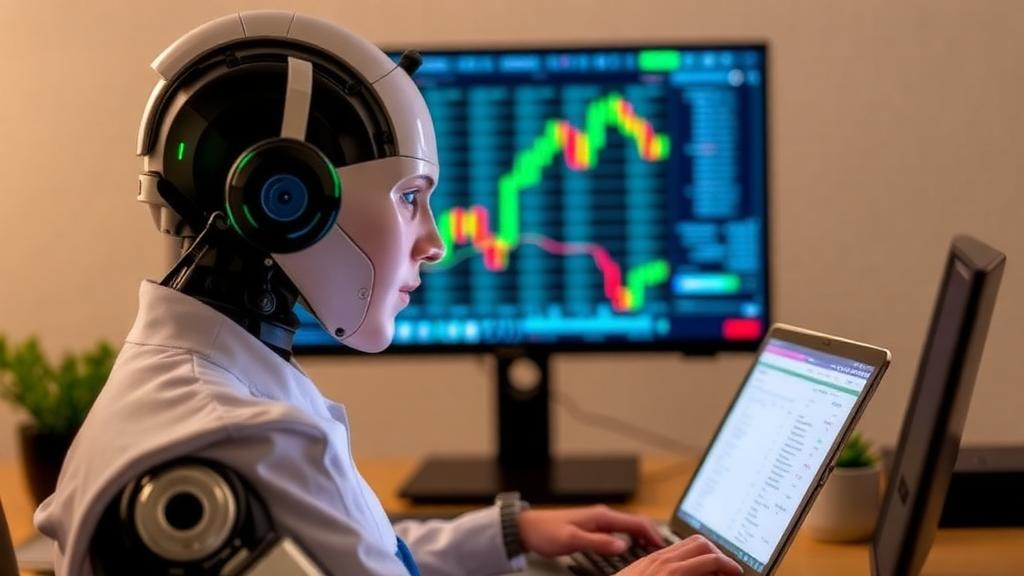
A team of researchers in India has built an artificial intelligence day trader that not only beats conventional algorithmic strategies on two of the world’s largest equity markets, but can also explain why it pulled the trigger on any given trade. The system, described in the International Journal of Machine Learning and Cybernetics by Muktinath Vishwakarma and Manish Kurhekar of Visvesvaraya National Institute of Technology, Nagpur, together with Jagdish Chakole of the Indian Institute of Information Technology, Nagpur, combines reinforcement learning with deep neural networks, classical technical analysis, and a battery of explainable AI techniques. The result is a trading agent whose internal view of the market is compact, statistically grounded, and, unusually for this field, open to inspection.
The central problem the researchers set out to solve is one that has haunted reinforcement learning applications to finance for years: state representation. A reinforcement learning agent learns by trial and error, mapping situations to actions in order to maximize a cumulative reward. In a video game, the situation is simply the pixels on screen. In financial markets, the raw situation is an endless stream of prices, volumes, and derived indicators, and deciding what information actually constitutes the agent’s current state is notoriously difficult. If the state is too impoverished, the agent cannot distinguish profitable situations from dangerous ones. If it is too rich, the learning process drowns in noise and the agent memorizes historical quirks rather than genuine market dynamics.
The team’s answer is a hybrid architecture that fuses two complementary ways of looking at market data. A convolutional neural network, the same class of model that excels at recognizing objects in photographs, processes market information arranged spatially, effectively treating chart patterns and indicator configurations as images to be classified. In parallel, an attention-based long short-term memory network handles the temporal dimension. LSTM networks, first introduced in the 1990s, are designed to retain information over long sequences, making them natural candidates for financial time series, while the attention mechanism allows the model to weigh which moments in the recent past matter most for the decision at hand. Together, these two branches produce a rich representation that captures both the visual geometry of the charts and the temporal evolution of the market.
But a rich representation is not, by itself, a good state for a Q-learning agent. Q-learning, a foundational reinforcement learning algorithm dating back to the work of Watkins and Dayan, maintains a table or function estimating the long-term value of taking each action in each state. When states are continuous, high-dimensional vectors produced by deep networks, the learning problem becomes unwieldy. The researchers therefore apply k-means clustering to the combined CNN and attention-LSTM output, compressing the continuous representation into a small, discrete set of market states. This compression serves a dual purpose: it makes the Q-learning problem tractable, and it turns the agent’s internal world into something a human analyst can actually enumerate and examine.
One of the more elegant touches in the design concerns how far back in time the agent should look. Rather than fixing an arbitrary lookback window for the historical inputs, the team adjusts it using the autocorrelation function, a standard tool of time series analysis that measures how strongly a series is related to its own past values. By choosing a window grounded in the statistical structure of each stock’s price history, the researchers ensure that the historical context fed into the networks is meaningful rather than arbitrary. It is a small decision, but it reflects a broader philosophy running through the paper: every modeling choice should be justified by evidence about the data, not by convention or convenience.
The system’s inputs come from the traditional toolkit of technical analysis, the discipline of reading price charts for clues about future direction. Technical indicators and chart patterns, including the candlestick formations that Japanese rice traders developed centuries ago, feed the neural networks alongside raw price and volume data. This grounding in classical analysis is deliberate. Decades of academic debate have questioned whether technical analysis carries genuine predictive information, but the authors position these indicators as the vocabulary through which the agent perceives the market, letting the reinforcement learning process discover which of them actually matter and under what conditions.
When the researchers tested the framework on equity data from both the United States and Indian markets, the agent outperformed conventional trading systems across a range of financial performance measures, including cumulative returns and the Sharpe ratio, the standard gauge of risk-adjusted performance that penalizes strategies for volatility. Crucially, the team did not simply point to a favorable backtest and declare victory. They subjected the performance gap to the Wilcoxon signed-rank test, a non-parametric statistical test that checks whether observed differences are unlikely to have arisen by chance. The statistical support for the gains matters in a field where overfitting and survivorship effects routinely inflate reported results, and where a strategy that looks brilliant in hindsight often collapses the moment it meets live data.
Perhaps the most consequential contribution, however, is the explainability layer. Deep learning models in finance are typically black boxes, and regulators, risk managers, and investors have grown increasingly uncomfortable deploying systems whose reasoning cannot be audited. The researchers applied explainable AI methods to their trained agent, and the analysis revealed which technical indicators and market trends carried the most weight in the agent’s decisions across a wide range of stocks and time horizons. This kind of transparency serves several purposes at once: it builds trust in the system, it allows human experts to sanity-check the agent’s logic, and it offers a form of scientific feedback, since discovering that a model relies heavily on a particular indicator is itself a hypothesis about market structure that can be tested independently.
The work builds on a growing body of research into deep reinforcement learning for trading, a literature the authors situate within surveys spanning financial signal representation, portfolio optimization, and trend-following strategies. It also aligns with a broader movement toward explainable AI in finance, which recent systematic reviews have identified as one of the field’s most pressing needs. What distinguishes this paper is the integration: rather than treating representation learning, state compression, statistical validation, and explainability as separate concerns, the framework weaves them into a single pipeline in which each component reinforces the others. The attention mechanism highlights relevant history, the clustering makes states interpretable, the explainability methods expose the reasoning, and the statistical tests keep the whole enterprise honest.
The authors suggest that the framework is a viable prospect for building interpretable, real-time trading agents that can adapt to changing market environments, and they have made their code publicly available on GitHub for other researchers to scrutinize and extend. The usual caveats apply. Backtested performance, however rigorously validated, is no guarantee of future profits, and markets have a habit of adapting to whatever patterns traders exploit. Yet the paper’s emphasis on statistically sound state construction, transparent decision-making, and rigorous testing offers a template for how machine learning might responsibly enter domains where money, risk, and human trust are on the line. In a discipline where black boxes have too often been accepted as the price of performance, a day trader that shows its work is a development worth watching.
Subject of Research: Reinforcement learning-based algorithmic day trading using deep neural networks and explainable AI
Article Title: Optimized day trading via reinforcement learning and technical analysis using attention-LSTM, CNN, and explainable state modeling
Article References: Vishwakarma, M., Chakole, J., & Kurhekar, M. (2026). Optimized day trading via reinforcement learning and technical analysis using attention-LSTM, CNN, and explainable state modeling. International Journal of Machine Learning and Cybernetics, 17(9), Article 462. https://doi.org/10.1007/s13042-026-03298-9
Image Credits: AI Generated
DOI: 10.1007/s13042-026-03298-9
Keywords: reinforcement learning, Q-learning, algorithmic trading, LSTM, convolutional neural networks, technical analysis, explainable AI, stock market, Sharpe ratio, k-means clustering, attention mechanism, quantitative finance
Cite Scienmag News
Blake Davidson. (October 3, 2026). AI Day Trader Learns to Read the Market Like a Human, Then Explains Itself. Scienmag. https://scienmag.com/ai-day-trader-learns-to-read-the-market-like-a-human-then-explains-itself/
Blake Davidson. "AI Day Trader Learns to Read the Market Like a Human, Then Explains Itself." Scienmag, 3 October 2026, https://scienmag.com/ai-day-trader-learns-to-read-the-market-like-a-human-then-explains-itself/. Accessed 17 October 2026.
Blake Davidson. "AI Day Trader Learns to Read the Market Like a Human, Then Explains Itself." Scienmag. October 3, 2026. https://scienmag.com/ai-day-trader-learns-to-read-the-market-like-a-human-then-explains-itself/


