


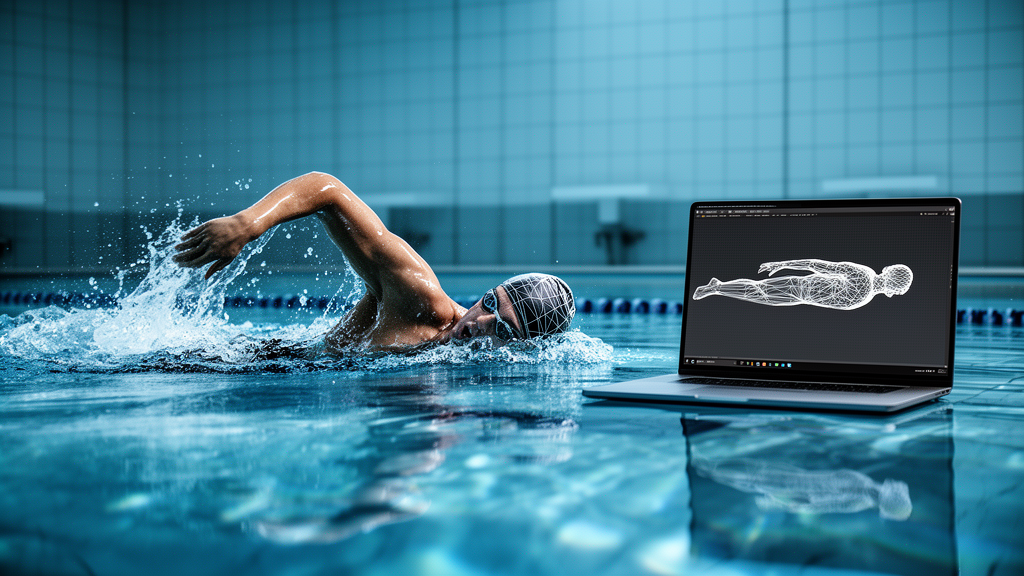
The distinction between what a model can recover about a signal’s shape and what it can recover about a signal’s magnitude sits at the heart of this study’s findings, and it deserves careful unpacking. When the researchers report per-window correlations of 0.85 and 0.84 for resultant hand force, they are describing agreement within the stream of overlapping time windows that make up a single stroke’s underwater phase. Because force rises and falls predictably during every pull, a model that simply learned the canonical rise-and-fall pattern would achieve respectable window-level agreement even without knowing anything specific about the swimmer producing the force. This is precisely why the phase-conditioned mean-waveform template, which encodes nothing but the average force curve across the cohort, proved so difficult to beat. The template achieved lower root-mean-square error than the neural network on the left hand, and the confidence interval on that difference excluded zero, meaning the more complex model was statistically worse, not merely equivalent, on that side.
The subject-wise six-fold cross-validation design is what makes this comparison meaningful. In many biomechanics applications of machine learning, data from a single athlete appear in both training and testing sets, allowing the model to memorise individual quirks such as stroke timing, hand size, and force magnitude. Here, each held-out fold consisted entirely of swimmers the model had never seen, so any generalisation had to come from shared structure in the kinematics-to-force relationship rather than from person-specific memorisation. The nested structure, in which architecture, regularisation, and smoothing choices were made inside each training fold, further protects against the subtle leakage that occurs when hyperparameters are tuned against the test data. Participant-cluster bootstrapping then quantified how sensitive the reported errors were to the particular composition of the twenty-four swimmers, an important safeguard given that a sample of this size, drawn from national and regional sprinters, cannot represent the full spread of competitive swimming.
The failure of between-swimmer correlations, which ranged from −0.36 to 0.27 for peak force, impulse, and mean force, illustrates a phenomenon well known in gait analysis but rarely quantified this explicitly in swimming. A model can track the temporal pattern of a waveform almost perfectly while producing outputs that are essentially the same for everyone, shifted and scaled only slightly. In such a case, the correlation between measured and estimated summary values across individuals hovers near zero, because the estimates lack the variance needed to rank athletes correctly. For a coach deciding which of two swimmers generates more impulse per stroke, this is the failure mode that matters most, and it is invisible in a pooled coefficient of determination. The study’s multi-level evaluation framework, examining the waveform, discrete descriptors, between-swimmer differences, and inter-limb differences separately, offers a template that future wearable-estimation studies in cyclic sports would do well to adopt.
The inter-limb findings are particularly instructive because asymmetry is a genuine clinical and performance concern in swimming. Swimmers often breathe to one side, develop side-dominant strokes, and carry asymmetric loads into the shoulder girdle, so an instrument that could flag meaningful left-right differences without hand-worn hardware would have real value. The estimated symmetry index, however, correlated negatively with the measured one, and the model identified the dominant limb no more often than chance would roughly allow, matching the measured dominant side in only 50 to 58 percent of swimmers. A negative correlation is arguably worse than a zero one, since it suggests the estimates could actively mislead a practitioner about which arm produces more force. Combined with the systematic 32.6-newton underestimation of left-hand peak force, this points to a lateral asymmetry in the model’s learning, possibly related to marker placement conventions, breathing-related trunk rotation, or an imbalance in the effective training examples available for each hand.
The comparison between analysis window definitions reveals how easily evaluation choices can flatter a model. When both hands were modelled in every window, including each hand’s recovery and entry periods, apparent accuracy rose, with left-hand root-mean-square error dropping to 21.6 newtons and correlation climbing to 0.89. But during recovery and entry, the hand is largely out of the propulsive flow, and its force output is low and stereotyped, so including those windows pads the evaluation with easy predictions. The stricter definition, restricting analysis to fingertip entry through exit, is the one that matches how the underwater phase is conventionally defined in swimming biomechanics, and it is the one under which the honest performance figures were obtained. This is a methodological lesson with broad relevance: the apparent accuracy of a kinematics-to-kinetics estimator depends not only on the model but on where in the movement cycle the evaluation is conducted.
The choice of a multilayer perceptron over more fashionable architectures reflects a deliberate emphasis on validation rather than novelty. The network consumed 197 features expressed in a trunk-fixed reference frame, a choice that removes the confounding effect of whole-body orientation and translation, so that the model receives limb posture relative to the torso rather than absolute coordinates in the pool. Comparisons against gradient boosting and coordinate-only variants showed that the multilayer perceptron was broadly comparable to other learned approaches, meaning the ceiling was set by the information content of the kinematics rather than by the choice of learning algorithm. This is an important negative result. When several model families converge on similar error against a simple template baseline, the bottleneck lies in the input data, and further architectural refinement offers diminishing returns until richer inputs, such as hand orientation, hand surface area estimates, or wrist-level inertial signals, are supplied.
The physics of the problem explains why the kinematics-to-force mapping is fundamentally harder in water than on land. Ground reaction force during walking and running emerges from a rigid contact whose mechanics are tightly constrained by whole-body motion, which is why convolutional networks can estimate it from joint angles with normalised errors below roughly thirteen percent in healthy adults. Hand propulsion in front crawl, by contrast, arises from unsteady hydrodynamics: the force depends on hand velocity relative to the water, hand orientation, the effective propelling area, and the behaviour of vortices and shed flow structures, some of which leave only weak traces in marker trajectories. Two swimmers with nearly identical arm kinematics could, in principle, produce different forces if their hand shapes, finger spread, or the flow history around the hand differ. The kinematic variables therefore carry substantial but incomplete information about force, and the residual gap is exactly what the template baseline was able to capture without any individual-specific learning.
The device-on protocol also deserves scrutiny when interpreting the error magnitudes. Because the swimmers wore the eo SwimBETTER handsets while the motion capture was recorded, the kinematics available to the model included any alterations in hand posture or stroke pattern caused by the handsets themselves. This design choice ensures that the force reference and the kinematics come from the same physical execution of the stroke, avoiding synchronisation and condition-mismatch errors, but it also means the validated model is conditioned on instrumented swimming. A model trained this way might perform differently on swimmers not wearing handsets, whose hands and wrists move slightly differently. Conversely, the device-on approach guarantees that the reference force measurements are genuine in-pool recordings rather than laboratory simulations, which strengthens the ecological validity of the force targets even as it narrows the deployment scenario in which the model has been tested.
The participant characteristics frame the generalisation boundary of the current results. The cohort consisted of twenty-four male sprinters with a mean 50-metre season best of about 24 seconds, roughly nine and a half years of training experience, and weekly training volumes around 42 kilometres. Female swimmers, distance specialists, developing age-group athletes, and recreational swimmers all differ in stroke mechanics, hand size, and force magnitude, and none are represented here. Because the model failed to discriminate between swimmers even within this relatively homogeneous group, there is little reason to expect better between-individual performance in a more diverse population without substantial additional data. The sample size, set by the availability of eligible sprinters rather than by a formal power calculation, nonetheless exceeds the ten swimmers used in the original device validation, and the bootstrap uncertainty estimates give a sense of how stable the reported errors are across resampled cohorts.
Looking forward, the study clarifies what kinematics-driven estimation could realistically offer in the near term and what remains out of reach. Recovering the group-typical force-time pattern from marker data alone is now demonstrated under rigorous subject-wise validation, which means kinematic archives could be used to study population-level stroke dynamics, compare conditions within a swimmer, or examine how force patterns change across a race or a training block, provided the questions concern temporal structure rather than individual magnitude. For individual assessment, ranking athletes, quantifying asymmetry, or tracking force production longitudinally in a single athlete, direct measurement with hand-worn devices remains necessary. The most promising extensions would supply the model with information closer to the hydrodynamic determinants of force, such as hand orientation and estimated effective area, or would combine sparse direct force measurements with dense kinematic records so that the model learns to personalise its outputs from a small amount of instrumented data per athlete. Until such hybrid approaches are validated with the same multi-level, subject-wise rigour applied here, hand force in swimming remains a quantity that must be measured, not merely inferred.
Subject of Research: Estimating bilateral hand kinetics from upper-limb kinematics in sprint front crawl: a subject-wise validation of an artificial neural network
Article Title: Estimating bilateral hand kinetics from upper-limb kinematics in sprint front crawl: a subject-wise validation of an artificial neural network
Article References: Gao, T., Qi, S., Li, J., Huang, D., Zheng, K., Li, H., & Gao, J. (2026). Estimating bilateral hand kinetics from upper-limb kinematics in sprint front crawl: a subject-wise validation of an artificial neural network. Frontiers in Bioengineering and Biotechnology, 14, Article 1978998. https://doi.org/10.3389/fbioe.2026.1978998
Image Credits: AI Generated
DOI: 10.3389/fbioe.2026.1978998
Keywords: Estimating, bilateral, hand, kinetics, upper-limb, kinematics, sprint, front, crawl, subject-wise, validation, artificial
Cite Scienmag News
Cassandra Pierce. (October 17, 2026). AI Can Sketch a Swimmer’s Stroke, But Not the Force Behind It. Scienmag. https://scienmag.com/ai-can-sketch-a-swimmers-stroke-but-not-the-force-behind-it/
Cassandra Pierce. "AI Can Sketch a Swimmer’s Stroke, But Not the Force Behind It." Scienmag, 17 October 2026, https://scienmag.com/ai-can-sketch-a-swimmers-stroke-but-not-the-force-behind-it/. Accessed 17 October 2026.
Cassandra Pierce. "AI Can Sketch a Swimmer’s Stroke, But Not the Force Behind It." Scienmag. October 17, 2026. https://scienmag.com/ai-can-sketch-a-swimmers-stroke-but-not-the-force-behind-it/


