


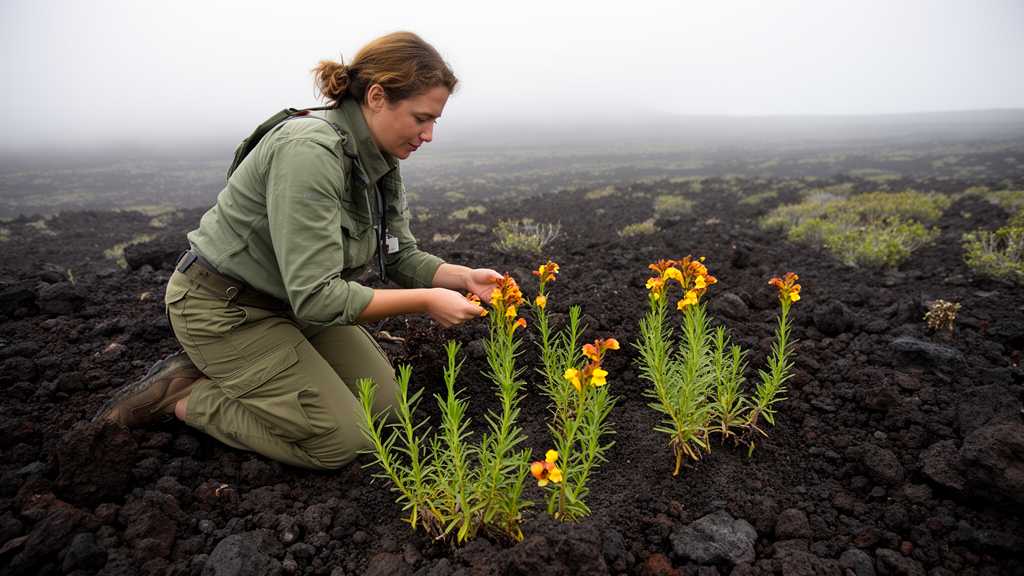
On the northern slopes of Isabela Island in the Galápagos archipelago, a small shrub with waxy-white tubular flowers came within a single catastrophe of vanishing forever. By 2007, Galvezia leucantha subsp. leucantha, the Galápagos snapdragon, had been reduced to just six known adult individuals in the wild, the last survivors of a population shredded by decades of grazing from introduced goats and the slow degradation of its arid coastal habitat. A new long-term study published in the journal Nature Conservation documents how a dedicated restoration program has now more than tripled that wild population and re-established a second colony at a site where the species had not been seen for more than sixty years.
The work was carried out by the Charles Darwin Foundation through its Galápagos Verde 2050 Program, in partnership with the Galápagos National Park. Since 2016, the team has combined laboratory propagation with field reintroduction, treating the plant’s recovery as a single integrated pipeline: seeds collected from the wild are germinated and grown under controlled conditions, then transplanted back into protected plots on Isabela. Between 2017 and 2024, ninety-four nursery-grown plants were outplanted at Playa Tortuga Negra on the lower slopes of Darwin Volcano, and in 2024 a further sixty-seven individuals were returned to Caleta Tagus along the Bolívar Channel, reviving a population recorded only in historical herbarium collections. By 2021, the wild adult population had climbed from six to twenty individuals, with natural seedling recruitment confirmed at both sites.
The scale of the challenge becomes clear when the plant’s ecology is considered. Galvezia leucantha is a pioneer species adapted to colonize eroded scoria cliffs and bare basaltic lava, substrates with almost no nutrients and little capacity to hold water. That xerophytic toughness allows it to stabilize newly exposed volcanic ground and pave the way for other plants, but it also means the species depends on a narrow set of harsh habitats. On Isabela, unlike neighboring Santiago and Rábida where goat eradication helped stabilize related populations, feral cats and black rats remain, eating the plants and disrupting the ecological interactions needed for regeneration. Limited seed dispersal and low genetic diversity compound the vulnerability of a species already teetering on demographic collapse.
A central achievement of the new study is the first standardized, high-resolution visual record of the subspecies’ floral anatomy. Using a Lankester Composite Dissection Plate assembled from ten cultivated adults at the Charles Darwin Research Station, the researchers documented slender, bent pedicels, a calyx of five ovate sepals, bilabiate waxy-white corollas ten to twelve millimeters long clothed in nonglandular hairs, light brown capsules, and dark brown seeds armed with cristate-echinate ridges. The white corollas clearly distinguish this subspecies from the purple-flowered relatives on Santiago and Rábida, and the plates, now curated in the CDS Herbarium, support taxonomic clarification of a genus that phylogenetic work places among Antirrhineae, with the Galápagos endemic having shifted from bird to insect pollination, served today by the native bee Xylocopa darwinii and other insects.
Seed biology proved to be the make-or-break variable. Across eight years of trials, the team tested hundreds of seeds using the tetrazolium staining method, which reveals living embryos by turning them pink to red. The results traced a striking pattern: seeds collected in 2016 from the tiny remnant population were almost entirely non-viable, with mature viability rates between zero and five percent, while seeds harvested in 2023 and soaked in distilled water reached 52.9 percent viability, the highest value ever recorded for the species. The researchers attribute this improvement not to any laboratory trick but to the restoration itself. As more transplanted individuals flowered, pollinator activity and cross-pollination increased, producing physiologically better seeds. In other words, the act of restoring the population improved the raw material for the next generation of restoration.
Germination experiments with 1,800 seeds from four mother plants revealed two decisive factors: pretreatment and substrate. Soaking seeds in a three percent sodium hypochlorite solution for one minute raised germination from 0.7 percent to 9 percent, a highly significant effect likely reflecting the chemical’s dual role as a disinfectant against fungi and a mild scarifying agent that weakens the seed coat. Substrate mattered just as much. Filter paper produced the highest germination rates at around 10 percent, but most seedlings on paper died before they could be transplanted, apparently for lack of anchorage and nutrients, a problem familiar from orchid propagation with tiny, reserve-poor seeds. A germination mix blended with sand offered a better compromise, and the authors recommend a two-step protocol: germinate on paper or in vitro media for monitoring, then transfer quickly to a supportive substrate for growth.
Seedlings displayed a biphasic growth pattern, investing first in roots and structural anchorage before accelerating stem elongation after about four weeks, a strategy typical of stress-tolerant pioneers. By the May 2024 transplant date, remaining nursery plants averaged roughly 70 centimeters in cumulative stem length. That size turned out to be the critical number for survival in the field. When the team analyzed early post-transplant survival at Caleta Tagus after two and a half months, both initial height and treatment were significant predictors. Plants outplanted at 60 centimeters or taller had a greater than 60 percent chance of surviving, giving restoration managers a concrete, evidence-based threshold for deciding when a seedling is ready to face the wild.
The water-saving technologies tested in fenced exclusion plots produced dramatic differences. Individuals planted with waterboxx devices, which harvest and slowly release moisture around the root zone, achieved 100 percent early survival, while hydrogel-treated plants reached 44 percent, untreated controls 28 percent, and biochar-amended plants only about 17 percent. The authors caution that the monitoring window was short and that results after the major dry season are needed before firm recommendations, but the pattern already suggests that in the parched lowlands of northern Isabela, keeping water at the roots during establishment is the single most controllable lever for success. Phenological monitoring across seven years added another practical tool: flowering peaks reliably from October to January, giving managers a precise calendar for seed collection and planting.
Perhaps the most encouraging signal is that the restored population now functions on its own terms. Natural seedling recruitment has been recorded at both Playa Tortuga Negra and Caleta Tagus, meaning the reintroduced plants are flowering, being pollinated, and producing offspring without human intervention. Plants reached reproductive maturity at just five months old, flowering shortly after repatriation, which likely increases their detectability to pollinators and accelerates the rebuilding of a self-sustaining reproductive cycle. Seed viability, in turn, has risen with population size, creating a positive feedback loop in which each successful restoration step improves the biological odds of the next.
The implications reach well beyond one shrub on one volcano. Roughly 60 percent of the 168 evaluated endemic plant species in the Galápagos are classified as threatened, and island floras worldwide face the same lethal combination of invasive herbivores, habitat degradation, and climate variability. The Galápagos snapdragon’s recovery offers a replicable template: document the species’ morphology rigorously, solve its propagation biology in the laboratory, identify measurable thresholds such as minimum outplanting size, match planting to the natural phenological calendar, and use adaptive trials of water-saving technologies to squeeze survival out of marginal habitat. From six individuals clinging to a lava slope to twenty adults and a second, newly founded population, the Galápagos snapdragon demonstrates that even species at the very edge of extinction can be pulled back, provided the science is patient, integrated, and willing to learn from every seed.
Subject of Research: Ecological restoration and ex situ propagation of the critically endangered Galápagos endemic plant Galvezia leucantha subsp. leucantha
Article Title: Advances in the recovery of Galvezia leucantha subsp. leucantha ( Plantaginaceae ): restoring a critically endangered species on northern Isabela Island, Galápagos
Article References: Jaramillo Díaz, P., Charette, C., Calle-Loor, A., Espinosa-Ortega, N., Mayorga, P., Zambrano, D., Chango, R., & Velasco, N. (2026). Advances in the recovery of Galvezia leucantha subsp. leucantha (Plantaginaceae): restoring a critically endangered species on northern Isabela Island, Galápagos. Nature Conservation, 64, 111-133. https://doi.org/10.3897/natureconservation.64.177895
Image Credits: AI Generated
DOI: 10.3897/natureconservation.64.177895
Keywords: Galápagos, Galvezia leucantha, critically endangered species, plant restoration, ex situ propagation, seed viability, germination, Isabela Island, invasive species, phenology, reintroduction, Charles Darwin Foundation
Cite Scienmag News
Margaret Porter. (October 17, 2026). Back From Six Plants: Scientists Rescue the Galápagos Snapdragon From the Brink. Scienmag. https://scienmag.com/back-from-six-plants-scientists-rescue-the-galapagos-snapdragon-from-the-brink/
Margaret Porter. "Back From Six Plants: Scientists Rescue the Galápagos Snapdragon From the Brink." Scienmag, 17 October 2026, https://scienmag.com/back-from-six-plants-scientists-rescue-the-galapagos-snapdragon-from-the-brink/. Accessed 17 October 2026.
Margaret Porter. "Back From Six Plants: Scientists Rescue the Galápagos Snapdragon From the Brink." Scienmag. October 17, 2026. https://scienmag.com/back-from-six-plants-scientists-rescue-the-galapagos-snapdragon-from-the-brink/


