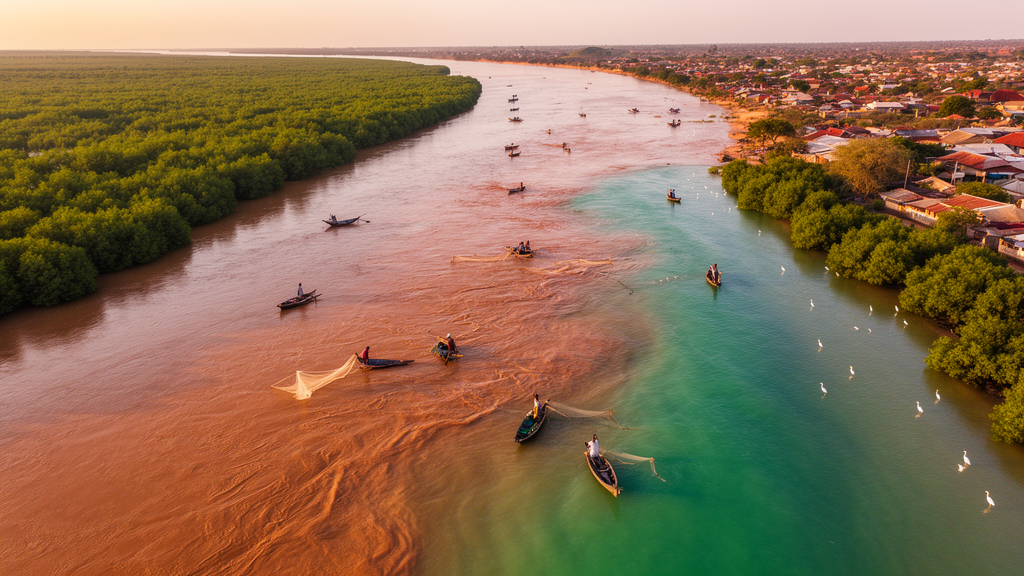
Where rivers meet the sea, some of the planet’s most productive ecosystems come to life. A new expert review published in Estuarine Management and Technologies argues that African estuaries, long understudied relative to their counterparts in Europe and North America, are indispensable engines of biodiversity, economic activity, and climate resilience whose fate will shape the sustainability of the continent and, increasingly, the world. The synthesis draws together hydrological measurements, population data, and economic valuations to build the most comprehensive picture yet of what these transitional waters are worth and how close they are to the brink.
The numbers underpinning the review are striking. African rivers discharge an estimated 3,271.4 cubic kilometres of freshwater into the surrounding seas every year, roughly 8.7 percent of the global river flow into the oceans. The continent counts more than 150 rivers, but seven dominate: the Nile, Congo, Niger, Zambezi, Orange, Limpopo, and the Ubangi, a major Congo tributary. The Congo alone ranks as the world’s second-largest river after the Amazon, with an average annual discharge of approximately 1,293 cubic kilometres, contributing about 3.4 percent of all freshwater reaching the global ocean. Notably, about 71 percent of Africa’s total estuarine discharge originates from West African rivers, a fact that concentrates both ecological productivity and human pressure along that coastline.
People cluster where the water is. In 2017, an estimated 62 million people lived on African deltas and estuaries, representing about 19 percent of the total global population residing in delta environments. The Nile and Niger deltas host the overwhelming majority of these residents, with the Nile delta alone home to roughly 58 million people. Megacities including Lagos, Alexandria, Durban, Dakar, Abidjan, Mombasa, and Maputo sit on or near estuarine systems, and the review estimates that harbour operations in these seven ports alone generate between 22 and 37 billion US dollars annually, spanning cargo handling, storage, pilotage, and the broader logistics economies that depend on navigable estuarine waterways.
Ecologically, the review frames African estuaries as multifunctional systems performing at least six critical services: biodiversity support, nursery provision, water quality regulation, carbon sequestration, coastal protection, and nutrient cycling. The mixing of fresh and saltwater creates conditions that sustain mangrove forests, salt marshes, seagrass beds, and dense communities of invertebrates and fish. African estuaries and deltas contain approximately 3.36 million hectares of mangrove forest, about 19 to 20 percent of the global mangrove cover, with West Africa holding the largest share and the Niger Delta standing out as one of the most extensive mangrove ecosystems on Earth. East African mangroves are particularly species-rich, hosting a significant proportion of the world’s mangrove diversity.
The carbon mathematics of these systems deserves particular attention. Coastal wetlands are among the most effective carbon sinks on the planet, and the review cites estimates that West African mangroves store around 854 million metric tons of carbon across roughly 1.97 million hectares, with an average ecosystem carbon density of approximately 799 megagrams of carbon per hectare in the West-Central Africa region. Because mangroves bury carbon in waterlogged sediments where decomposition is slow, protecting them offers a rare double dividend: emissions avoided through conservation and carbon locked away in soils that can persist for centuries.
The economic ledger extends well beyond ports. South African estuaries alone are estimated to generate 4.2 billion rand, roughly 250 to 300 million US dollars, in economic value each year. In Tanzania’s Rufiji Delta, the provisioning services of the mangrove sanctuary were valued at nearly 16,000 US dollars per household per year in 2025. Perhaps most remarkable is the West African shellfish economy: estuarine and mangrove-based shellfisheries yield more than 300,000 metric tons annually, worth an estimated 336 million US dollars, and women constitute 79 percent of the harvesters, supporting roughly 571,935 households across 11 countries. Estuaries also function as nurseries for commercially important fish and shellfish, meaning their health directly determines the productivity of the coastal fisheries that feed millions.
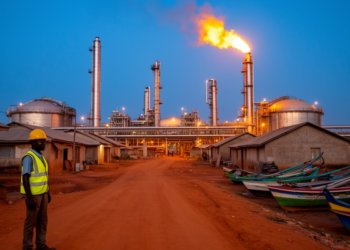
Yet the review is unflinching about the threats. Pollution data from South Africa’s Knysna Estuary reveal chromium concentrations in sediments reaching nearly 1,590 milligrams per kilogram, while historical analysis of persistent organic pollutants in the Buffalo River recorded polychlorinated biphenyl levels of up to 2,329 nanograms per litre, far exceeding health advisory thresholds. In Ghana’s Pra and Ankobra estuaries, microplastic fragments and fibres permeate the sediments. Habitat degradation compounds the chemical assault: dredging, land reclamation, and dam construction disrupt the sediment and freshwater flows on which estuarine function depends, and oil exploration has severely damaged the Niger Delta’s mangroves. Globally, mangroves lost 5,245 square kilometres between 1996 and 2020, and African deforestation rates range from 0.2 to 0.5 percent annually on average, with Ghana’s historical losses reaching as high as 2 percent per year.
Overfishing is hollowing out estuarine food webs from within. Studies in Ghanaian and Nigerian estuaries report declines of 30 to over 70 percent in catches of certain commercially important species over recent decades, and fish landings in parts of the Niger Delta have fallen by as much as half since the 1980s. The pattern, familiar to ecologists worldwide, is one of fishing down the food web: large, valuable predators disappear and are replaced by smaller, faster-reproducing species of lower market value. Climate change stacks a further layer of stress, with sea-level rise threatening to inundate low-lying habitats, saltwater intrusion contaminating freshwater supplies, and shifting rainfall regimes destabilising the salinity balance that estuarine life depends on. West African coastlines are identified as especially vulnerable to rising seas.
The review’s authors argue that piecemeal responses will not suffice and call instead for integrated coastal zone management that treats catchments, estuaries, and the nearshore ocean as a single connected system. Their recommendations include strict regulation of industrial and agricultural discharges, large-scale restoration of mangroves and salt marshes, sustainable fishing regimes built on community co-management, and climate adaptation planning that explicitly accounts for sea-level rise and storm intensification. They also stress the need for sustained research and monitoring, noting that many African estuaries remain poorly instrumented compared with systems elsewhere, and for capacity building that empowers local communities as stewards rather than bystanders.
What emerges from the synthesis is a stark equation. Estuaries that shelter 62 million people, filter the continent’s runoff, nurse its fisheries, and anchor tens of billions of dollars in trade are being degraded at precisely the moment their buffering services are most needed. The review’s central message is that African estuaries are not peripheral conservation concerns but strategic infrastructure, as vital to regional and global sustainability as any engineered system, and that the window for protecting them affordably is narrowing with every polluted discharge and every hectare of mangrove cleared.
Subject of Research: The ecological, economic, and climatic importance of African estuaries and the threats facing them
Article Title: Why African estuaries matter? An expert perspective on regional and global sustainability
Article References: Hoguane, A. M., & Hoguane, C. A. M. (2026). Why African estuaries matter? An expert perspective on regional and global sustainability. Estuarine Management and Technologies, 3, 23-40. https://doi.org/10.3897/emt.3.183511
Image Credits: AI Generated
DOI: 10.3897/emt.3.183511
Keywords: African estuaries, mangroves, blue carbon, river discharge, Niger Delta, coastal fisheries, sea-level rise, pollution, integrated coastal zone management, biodiversity, ecosystem services, climate change
Cite Scienmag News
Sloane Callahan. (October 16, 2026). Africa’s Estuaries Deliver Billions in Value but Face Mounting Threats. Scienmag. https://scienmag.com/africas-estuaries-deliver-billions-in-value-but-face-mounting-threats/
Sloane Callahan. "Africa’s Estuaries Deliver Billions in Value but Face Mounting Threats." Scienmag, 16 October 2026, https://scienmag.com/africas-estuaries-deliver-billions-in-value-but-face-mounting-threats/. Accessed 16 October 2026.
Sloane Callahan. "Africa’s Estuaries Deliver Billions in Value but Face Mounting Threats." Scienmag. October 16, 2026. https://scienmag.com/africas-estuaries-deliver-billions-in-value-but-face-mounting-threats/