


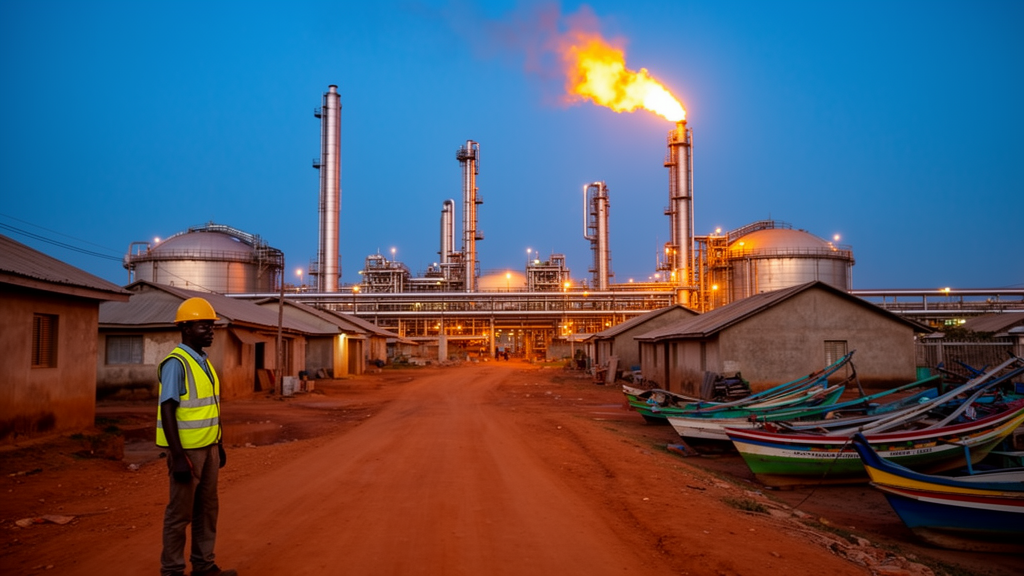
Deep in Ghana’s Western Region, the Ellembelle District processes the natural gas that powers much of the nation’s economy. Its Atuabo facility, operated by Ghana National Gas Company, handles offshore gas from the Jubilee, Tweneboa-Enyenra-Ntomme, and Sankofa fields, while multinational operators ENI and Quantum Power run concessions and a 200-megawatt gas-to-power plant within the district’s 1,700 square kilometers. Yet a striking paradox defines daily life here: only 12 percent of households can afford liquefied petroleum gas for cooking, despite the district hosting the very infrastructure that processes it. A 14.5-kilogram LPG cylinder costs roughly GH 180, about US$15, more than many families earn in a week, forcing the majority to rely on firewood and charcoal with well-documented health consequences from smoke inhalation.
This contradiction sits at the heart of new research examining how Ghana’s ambitious just energy transition is experienced by the communities that physically host its fossil fuel infrastructure. Published in Frontiers in Environmental Economics, the study engaged 127 participants between February and April 2025 through six focus group discussions, 15 key informant interviews, 18 expert consultations with Ghana Gas personnel, and three community town hall meetings across Esiama, Atuabo, and Sanzule. Applying an energy justice framework, the researchers interrogated three dimensions: distributional justice, concerning who bears costs and receives benefits; procedural justice, concerning who participates in decisions; and recognition justice, concerning whose identities and knowledge systems are respected in governance.
The findings reveal a coherent structural pattern rather than isolated policy failures. Despite hosting major national energy infrastructure, residents report near-total exclusion from skilled and permanent employment. Recruitment processes are centralized in Accra, approximately 250 kilometers away, effectively excluding residents who lack the financial resources and social networks to navigate capital-city hiring. A youth participant from Nkroful captured the spatial injustice directly: all recruitments are done in Accra, requiring expensive and risky travel to submit applications and attend interviews for jobs located in Ellembelle itself. Community members learn of new hires only when external workers arrive searching for accommodation.
This occupational segregation follows a familiar extractive pattern: residents fill temporary, low-skill roles primarily as cleaners and security personnel, while professional and technical positions are occupied by workers recruited externally. National local content regulations under LI 2204, introduced in 2013 to maximize domestic employment and procurement, remain poorly enforced at the district level. The Ellembelle District Assembly lacks authority to monitor compliance or impose penalties; enforcement authority is vested in the Petroleum Commission in Accra, creating a fundamental accountability gap between where monitoring happens and where implementation occurs. Expert consultations with Ghana Gas engineers partially diverged from community narratives, attributing exclusion to skills gaps rather than systemic institutional failures, a framing the researchers identify as shifting responsibility from corporate and regulatory actors to community members themselves.
Skills development barriers compound the problem. The district contains no technical or vocational training institutions; the nearest facilities are in Takoradi, roughly 90 kilometers away. A senior high school graduate from Nkroful explained that pursuing technical training is impossible because his family cannot afford accommodation in Takoradi or daily transport costs. Ghana Gas engineers confirmed that renewable energy transition skills, including solar installation, wind maintenance, battery storage management, and energy-efficiency auditing, differ substantially from existing fossil fuel competencies, and current training infrastructure cannot bridge this gap. The researchers warn of a double exclusion: residents are excluded from skilled fossil fuel employment now and risk exclusion from renewable energy employment in the future due to the same structural barriers. Gender dimensions amplify these barriers, as women with childcare responsibilities face additional obstacles accessing training offered in distant urban centers.
Procedural justice deficits pervade corporate social responsibility project selection, environmental management, and transition planning. A community leader in Atuabo described how Ghana Gas constructed a six-unit classroom block in Aiyinasi even though communities had specifically requested a health post, because medical emergencies require traveling 18 kilometers to Esiama. The misalignment between company-determined projects and genuine community priorities erodes rather than builds trust, a pattern well documented across African extractive industry contexts. Traditional authorities are marginalized despite holding legitimate customary governance roles in land administration and dispute resolution. A sub-chief in Sanzule described being treated as a ceremonial figure invited for ribbon-cutting but excluded from substantive discussions about environmental impacts or employment, despite customary law granting authority to speak for communities.
Environmental burdens compound these distributional and procedural injustices. Community members across multiple data sources reported health impacts including skin rashes and stomach ulcers attributed to oil and gas operations, with residents of Bakanta and Sanzule experiencing excessive heat from gas processing. Fishing communities described ecological changes: seaweed now covers areas where they previously fished, and catch volumes have reduced dramatically, with some attributing changes to wastewater from the gas plant. The company denies these claims, but the absence of accessible, independent environmental monitoring leaves communities without the technical capacity to substantiate or refute company denials. Local ecological knowledge is discounted in favor of formal assessment protocols that communities cannot access, constituting a recognition failure with procedural consequences.
The energy access paradox emerged as the most analytically striking finding, drawing unprompted comment across all community locations. A female participant from Esiama encapsulated the contradiction: Ghana Gas processes gas in Atuabo that goes to the whole country, yet Ellembelle residents cannot afford LPG and continue using firewood and charcoal despite health problems from smoke inhalation and time spent collecting fuelwood. The District Budget Officer confirmed that LPG pricing is determined nationally, with district assemblies having no authority to provide subsidies or negotiate preferential pricing despite the unique circumstances of hosting gas-processing infrastructure. This policy inflexibility represents a structural distributional injustice directly contradicting the energy justice principles that Ghana’s National Energy Transition Framework nominally endorses.
These findings situate Ellembelle within a broader sub-Saharan African pattern: the concentration of extractive burdens alongside exclusion from transition benefits. The researchers draw parallels to Nigeria’s Niger Delta, where oil company recruitment in Lagos and Port Harcourt excludes rural communities hosting offshore platforms, and to Mozambique’s Tete coal mining region, where nationals occupy unskilled roles while technical positions are filled by expatriates despite local content frameworks. The mechanisms documented in Ellembelle, including spatial exclusion from recruitment, enforcement authority disconnected from implementation sites, CSR governance without community participation, and energy access paradoxes in infrastructure-hosting communities, appear across diverse African contexts, suggesting structural features of extractive industry governance rather than idiosyncratic local failures.
The implications for Ghana’s energy transition are significant. With peak oil production projected for 2029 and the National Energy Transition Framework targeting 70 percent renewable electricity by 2030 and net-zero emissions by 2070, the governance failures documented here risk reproduction in the renewable energy sector absent deliberate corrective interventions. The researchers recommend devolving local content monitoring authority to district assemblies, establishing localized skills training infrastructure within Ellembelle, instituting genuine participatory governance mechanisms that bring together traditional leaders, youth representatives, and women’s groups, and developing community benefit programs including subsidized LPG distribution for communities within a defined radius of processing facilities. They also urge initiating long-term transition planning now, while fossil fuel revenues are still flowing, rather than waiting for operational decline to create urgency. Achieving socially just outcomes, the study concludes, requires prioritizing distributional equity, procedural inclusion, and recognition of local governance systems, ensuring that communities like Ellembelle are not merely passive recipients of transition impacts but active agents in shaping how energy systems evolve.
Subject of Research: Energy Justice
Article Title: Just energy transition in Ghana: community experiences from the fossil-fuel hub in the Ellembelle District
Article References: Akudugu, J. A., Addaney, M., Amankona, L. O., Dumenu, Y. C., & Aniah, E. (2026). Just energy transition in Ghana: community experiences from the fossil-fuel hub in the Ellembelle District. Frontiers in Environmental Economics, 5, Article 1835455. https://doi.org/10.3389/frevc.2026.1835455
Image Credits: AI Generated
DOI: 10.3389/frevc.2026.1835455
Keywords: just energy transition, energy justice, Ghana, fossil fuels, local content, community participation, renewable energy, sub-Saharan Africa, Just, energy, transition, community
Cite Scienmag News
Violet Maxwell. (October 16, 2026). Ghana’s Gas Heartland Reveals the Cracks in the Global Just Energy Transition. Scienmag. https://scienmag.com/ghanas-gas-heartland-reveals-the-cracks-in-the-global-just-energy-transition/
Violet Maxwell. "Ghana’s Gas Heartland Reveals the Cracks in the Global Just Energy Transition." Scienmag, 16 October 2026, https://scienmag.com/ghanas-gas-heartland-reveals-the-cracks-in-the-global-just-energy-transition/. Accessed 16 October 2026.
Violet Maxwell. "Ghana’s Gas Heartland Reveals the Cracks in the Global Just Energy Transition." Scienmag. October 16, 2026. https://scienmag.com/ghanas-gas-heartland-reveals-the-cracks-in-the-global-just-energy-transition/


