


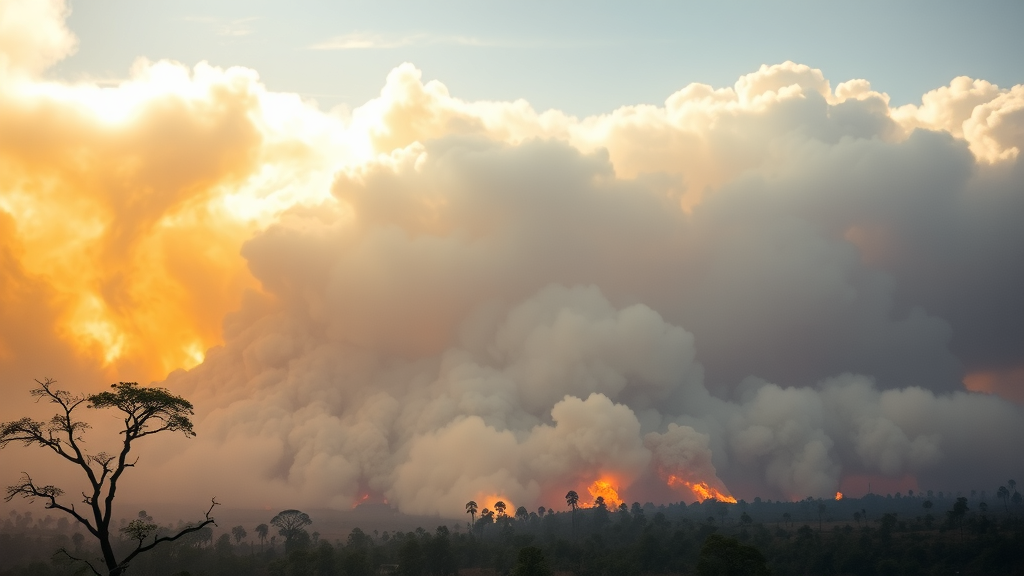
Every dry season, agricultural fires sweep across Angola and neighboring parts of southern Africa, releasing plumes of smoke that drift far out over the southeast Atlantic Ocean. Scientists have long known that this smoke brightens the region’s vast marine cloud decks by seeding them with extra particles on which cloud droplets can form. A new study from the University of Miami Rosenstiel School of Marine, Atmospheric and Earth Science now reveals a complicating twist: the very weather pattern responsible for carrying the smoke offshore also thins the cloud layer and reduces its coverage, canceling out much of the cooling that the brightened clouds would otherwise deliver. The findings, published in the journal Communications Earth & Environment, carry significant weight for anyone hoping to read future climate trends in this heavily studied region.
The research, led by Tyler Tatro, a doctoral student in the Department of Atmospheric Sciences at the Rosenstiel School, and coauthored by Paquita Zuidema, professor and chair of the same department, combined aircraft and shipboard observations with two decades of satellite and reanalysis data to untangle the competing influences of smoke aerosols and atmospheric circulation. Their central conclusion is that cloud responses to smoke cannot be evaluated in isolation from the weather systems that transport it. The same shallow, dry convection over Angola that lofted smoke into offshore airflows also worked to suppress and thin the stratocumulus deck below, meaning the observed cloud changes reflect a tug-of-war between aerosol brightening and meteorological suppression.
Agricultural burning in Angola generates a substantial share of southern Africa’s contribution to global biomass-burning emissions, and from June through August the resulting smoke is funneled out over the southeast Atlantic in a recurring seasonal pattern. Once over the ocean, the smoke interacts with one of the most extensive marine stratocumulus cloud decks on the planet. Smoke particles modify the atmosphere as they travel, altering cloud droplet concentrations, the amount of sunlight reflected back to space, surface and atmospheric temperatures, and in some cases rainfall patterns. These interactions make the region a natural laboratory for studying how aerosols influence clouds and climate.
To dissect these interactions, the research team drew on two major field campaigns: the Department of Energy’s Layered Atlantic Smoke Interactions with Clouds, or LASIC, campaign based on Ascension Island, and NASA’s Observations of Aerosols above Clouds and their Interactions, known as ORACLES, which deployed research aircraft into the smoke layers. By merging these in situ observations with weather and aerosol datasets, and then extending the analysis with satellite observations and twenty years of reanalysis data spanning 2003 through 2023, the researchers were able to trace how seasonal weather patterns over Angola shape both the transport of smoke and its downstream effects on the marine cloud deck.
The study’s findings arrive at a moment of growing interest in geoengineering strategies that attempt to cool the climate by manipulating clouds. Chief among these is marine cloud brightening, a proposed intervention that would deliberately add tiny particles to low-lying oceanic clouds to increase their reflectivity and redirect more sunlight back into space. Proponents point out that the physics is essentially the same as what pollution and smoke already do to clouds inadvertently. The southeast Atlantic, with its seasonally smoke-laden stratocumulus deck, has become one of the regions most frequently studied as a candidate testbed for such an approach, precisely because nature already runs a large-scale version of the experiment every fire season.
But the Miami team’s results caution that the apparent effectiveness of cloud brightening in this region may be distorted by the underlying meteorology. The researchers found that the same weather pattern that carries smoke offshore also thins and reduces cloud cover, offsetting the cooling effect that aerosol-induced brightening would otherwise produce. In other words, an observer correlating brighter clouds with more smoke might mistakenly attribute the cooling to aerosols when in fact the atmospheric circulation is simultaneously working in the opposite direction. Any serious evaluation of marine cloud brightening, the study suggests, must disentangle these covarying effects rather than treating aerosol loading as the sole driver of cloud reflectivity.
The study also flags a subtle detection problem with implications for how cloud brightening is measured from real-world data. Ship exhaust trails, the long, bright streaks of cloud that form in the wake of vessels emitting sulfur-rich exhaust, are among the clearest natural demonstrations that added particles can brighten marine clouds. Yet the researchers found that these trails are easier to detect when ambient smoke levels are low. In the smoke-covered southeast Atlantic, the background haze can effectively mask ship trails, while in cleaner conditions the trails stand out more clearly. This overlap raises the possibility that shipping-related cloud brightening could appear more effective in observational studies than it truly is, simply because it is more visible against a clean backdrop. The authors emphasize that assessments of climate-cooling interventions must therefore account for background aerosol levels and prevailing atmospheric conditions, not just the visible brightening signal.
The stakes of getting this right extend well beyond geoengineering. As Zuidema notes, low clouds over the ocean represent the largest source of uncertainty in projections of future global warming. The southeast Atlantic stratocumulus deck is one of four major, semi-permanent subtropical low-cloud regions on Earth, and it is the most seasonally polluted of the four, blanketed each year by biomass-burning smoke. Understanding how smoke interacts with these clouds is essential for interpreting observed climate trends and for predicting how cloud cover may evolve as carbon dioxide levels continue to rise, fire seasons shift in timing and intensity, and geoengineering strategies are weighed as possible supplements to emissions reductions.
The human dimension of the research is also close to home for the authors. Tatro points out that millions of people live with wildfire smoke as a seasonal fact of life, including residents of Miami, and that the study demonstrates smoke’s effects on clouds depend fundamentally on the weather carrying it. The same fire, he notes, can brighten or diminish clouds depending on the atmospheric conditions through which its smoke travels. That insight reframes smoke not as a one-way climate coolant but as a participant in a coupled aerosol-weather system whose net outcome varies from season to season and region to region.
The study, titled ‘Weak, shallow dry convection over Angola increases offshore stratocumulus cloud droplet number concentrations,’ was published on August 29, 2026, in Communications Earth & Environment, with Tatro and Zuidema as the sole authors. The work was supported by grants from NASA and the Department of Energy’s Atmospheric System Research program. By showing that the seasonal weather pattern over Angola simultaneously brightens clouds through smoke transport and suppresses them through circulation-driven thinning, the research delivers a clear message to climate scientists and geoengineering planners alike: in the atmosphere, the medium is part of the message, and no assessment of aerosol effects on clouds can afford to ignore the meteorology that shapes them.
Subject of Research: How African biomass-burning smoke and transporting weather patterns jointly affect southeast Atlantic stratocumulus clouds and their climate cooling effect
Article Title: African smoke brightens clouds, but weather patterns offset its cooling effect, new study finds
Article References: African smoke brightens clouds, but weather patterns offset its cooling effect, new study finds. (n.d.). Original publication
Image Credits: AI Generated
DOI: Not provided
Keywords: African smoke, marine cloud brightening, stratocumulus clouds, aerosols, geoengineering, southeast Atlantic, biomass burning, climate cooling, Angola, cloud droplet number, ORACLES, LASIC
Cite Scienmag News
Russell Cooper. (September 23, 2026). African wildfire smoke brightens clouds, yet weather patterns cancel its cooling. Scienmag. https://scienmag.com/african-wildfire-smoke-brightens-clouds-yet-weather-patterns-cancel-its-cooling/
Russell Cooper. "African wildfire smoke brightens clouds, yet weather patterns cancel its cooling." Scienmag, 23 September 2026, https://scienmag.com/african-wildfire-smoke-brightens-clouds-yet-weather-patterns-cancel-its-cooling/. Accessed 4 October 2026.
Russell Cooper. "African wildfire smoke brightens clouds, yet weather patterns cancel its cooling." Scienmag. September 23, 2026. https://scienmag.com/african-wildfire-smoke-brightens-clouds-yet-weather-patterns-cancel-its-cooling/


