


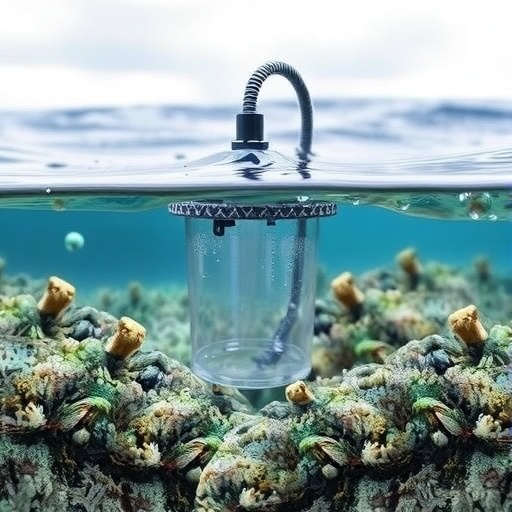
In the ongoing battle against environmental pollution, microplastics have emerged as one of the most insidious and challenging contaminants to monitor and mitigate. These minute plastic particles, often measuring less than five millimeters in diameter, infiltrate ecosystems worldwide, from pristine mountaintops to the deepest reaches of the oceans. Among the hardest to study are microplastics embedded within deep-sea sediments, where their detection and separation pose significant scientific hurdles. A groundbreaking study published in 2024 by Shaw, Sandquist, Fairclough, and colleagues introduces a novel, accessible method designed to revolutionize how researchers isolate microplastics from these remote sedimentary environments.
Traditionally, extracting microplastics from deep-sea sediments has been a resource-intensive process relying on expensive, complex laboratory apparatuses. These methods often involve centrifugation, sophisticated density gradient setups, or chemical treatments that can be time-consuming, hazardous, or generate secondary waste. Shaw and the team set out to create an affordable alternative that could be widely adopted by laboratories globally, including those in resource-limited settings, without sacrificing precision and accuracy. Their innovation: a simple-to-use density separation device that leverages fundamental principles of buoyancy and material density differences.
Density separation exploits the inherent physical characteristics of microplastics, which typically have lower densities than the mineral particles composing sediments. By immersing sediment samples in fluids of carefully calibrated densities, microplastics can be made to float or remain suspended while heavier sediment grains sink. The challenge lies in optimizing this process such that a broad range of plastic polymer types—each with slightly varying densities—can be efficiently separated without contamination from sediment particles or the loss of fragile microplastic fragments.
The device developed by the researchers employs readily available components that can be assembled at a fraction of the cost of commercial alternatives. Its core design facilitates repeated density separation cycles using non-toxic, environmentally benign solutions that are easy to dispose of or recycle. The apparatus also incorporates features that minimize sample disturbance and allow direct visual inspection during separation, reducing the need for extensive post-processing analysis. This pragmatic design ethos promises to democratize access to microplastic research tools for oceanographers, environmental scientists, and citizen science initiatives alike.
In their experiments, Shaw’s team validated the device by processing sediment samples from various deep-sea sites known for substantial microplastic contamination. Analytical techniques such as Fourier-transform infrared spectroscopy (FTIR) and Raman microscopy confirmed the identity and purity of separated microplastic fractions, highlighting the method’s robustness. Notably, the separation efficacy was consistent across different particle size ranges and polymer types, underscoring the device’s versatility for heterogeneous environmental samples.
The significance of this advancement extends beyond methodological convenience. Microplastics residing in deep-sea sediments represent a largely underexplored reservoir of plastic pollution, with potential implications for deep ocean ecology, biogeochemical cycles, and human health via seafood contamination. Accurate quantification and characterization of these sediments are vital for assessing the true scale of plastic influx into marine systems and informing mitigation policies. Tools that lower barriers to such investigations can catalyze broader, higher-resolution spatial and temporal assessments worldwide.
Moreover, by facilitating rapid and cost-effective microplastic extraction, the device accelerates experimental workflows and enables higher throughput processing of sediment samples. This scalability is critical, given the exponential increase in oceanic microplastic contamination reported over recent decades. Researchers can leverage this technology to conduct extensive longitudinal studies or cross-comparative regional surveys that were previously impractical due to resource constraints.
The device also embodies a commitment to sustainability and ethical research practice. Utilizing benign chemicals reduces laboratory hazards and environmental impact, aligning with green chemistry principles increasingly emphasized in environmental science. This feature makes it attractive not only for field laboratories but educational settings where safety and simplicity are paramount.
Importantly, the team’s publication delineates comprehensive protocols for device assembly, sample preparation, and operation, fostering reproducibility and enabling modification or customization by other researchers. This open-access approach promotes innovation and continuous improvement within the scientific community, potentially inspiring derivative technologies tailored to specific research questions or sediment types.
Future applications of this density separation method include coupling with automated microplastic identification systems powered by machine learning, integrating sediment core sampling for paleoenvironmental reconstructions of plastic pollution, and facilitating biomonitoring studies assessing microplastic uptake by benthic organisms. Its adaptability across interdisciplinary contexts positions it as a foundational tool in the evolving field of microplastic research.
While challenges remain—such as refining separation for nanoplastic particles below the microscale and differentiating polymer types with overlapping densities—the device represents a decisive step forward. By striking a balance between affordability, usability, and scientific rigor, Shaw and colleagues open new horizons for understanding and ultimately mitigating the deep-sea microplastic dilemma.
In conclusion, the deep ocean’s sediment layers, once inaccessible or disregarded in plastic pollution studies, may soon yield their hidden secrets thanks to this innovative density separation device. Such technologies empower scientists to map the extent of anthropogenic impact on Earth’s largest ecosystem more precisely than ever before. As plastic contamination continues to threaten marine biodiversity and ecosystem services, tools like these are indispensable allies in the quest for effective conservation strategies.
Shaw et al.’s work exemplifies how clever engineering married to environmental science can transform complex analytical challenges into manageable, scalable solutions. Their contribution not only advances microplastic research methodologically but embodies a broader paradigm shift towards inclusive, sustainable environmental monitoring methodologies essential for the planetary stewardship demanded by our times.
Cite Scienmag News
Violet Maxwell. (August 6, 2025). Affordable Density Device Separates Microplastics from Sediment. Scienmag. https://scienmag.com/affordable-density-device-separates-microplastics-from-sediment/
Violet Maxwell. "Affordable Density Device Separates Microplastics from Sediment." Scienmag, 6 August 2025, https://scienmag.com/affordable-density-device-separates-microplastics-from-sediment/. Accessed 3 September 2026.
Violet Maxwell. "Affordable Density Device Separates Microplastics from Sediment." Scienmag. August 6, 2025. https://scienmag.com/affordable-density-device-separates-microplastics-from-sediment/


