


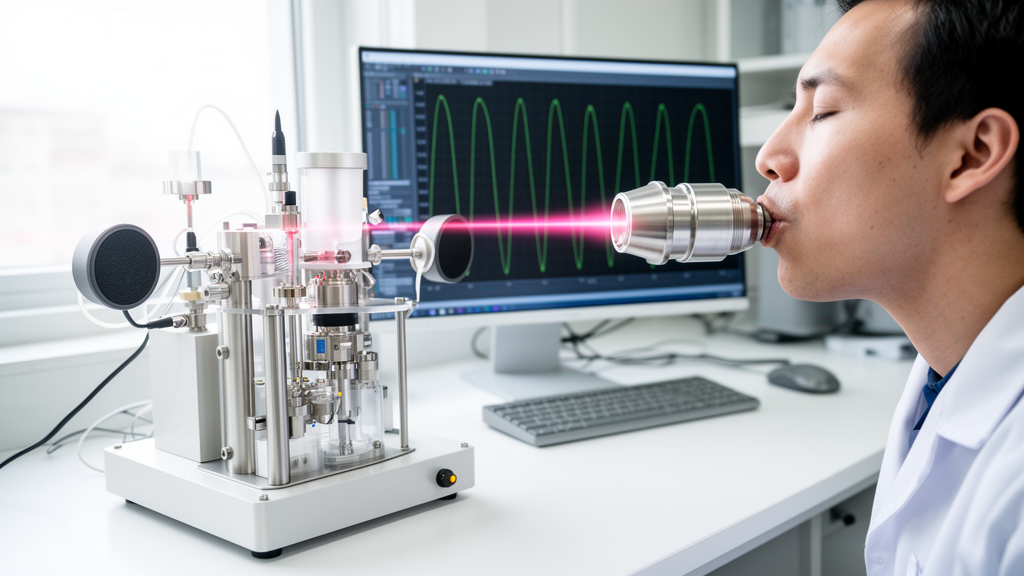
Photoacoustic spectroscopy has advanced from laboratory detection of gases in controlled mixtures to measurements in human breath, including targeted detection of carbon monoxide, methane, ammonia, acetone, isoprene and propofol, as well as composite volatile organic compound fingerprints associated with asthma and chronic obstructive pulmonary disease. A 2026 mini review concludes that the technique is technically capable of sensitive breath analysis, but its usefulness depends as much on standardized sampling, humidity correction, gas-transport control and clinical validation as on the sensitivity of the detector. The authors find that the evidence is still uneven across the field, with independent multicenter validation still needed before photoacoustic breath tests can support broad clinical conclusions.
Human exhaled breath contains water vapor, carbon dioxide, oxygen, nitrogen, inorganic trace gases and volatile organic compounds that can occur from parts per million to parts per billion or lower concentrations. Its appeal for health assessment lies in non-invasive collection, repeatability and the possibility of real-time or longitudinal monitoring. Exhaled carbon monoxide, for example, is influenced by smoking and may also relate to heme metabolism, oxidative stress and inflammation, while methane is mainly associated with intestinal methanogenic activity. Patterns of breath compounds have also been investigated in respiratory disease, including asthma and chronic obstructive pulmonary disease. These associations do not by themselves establish that any single compound can diagnose a condition, and the chemical complexity of breath creates a demanding analytical environment.
Photoacoustic spectroscopy converts absorbed optical energy into acoustic signals. When modulated light is absorbed by a gas, non-radiative molecular relaxation produces periodic heating, pressure and temperature oscillations that can be detected with a microphone, quartz tuning fork, cantilever or optical acoustic sensor. Unlike direct absorption spectroscopy, which may require long optical paths and stable correction of baseline drift and interference fringes, photoacoustic spectroscopy can combine high sensitivity with compact, low-volume gas cells. Its signal nevertheless depends on incident optical power, molecular number density, absorption cross-section, non-radiative heat-conversion efficiency, cell geometry, acoustic mode and thermodynamic properties. In human breath, water vapor and carbon dioxide can also alter relaxation rates, the speed of sound, resonance frequency, acoustic loss and the quality factor of the detector, complicating the relationship between concentration and measured signal.
Targeted photoacoustic detection has produced encouraging results across several analytes. An all-optical system using a 1650.96 nm distributed-feedback laser and a fiber Fabry–Pérot acoustic sensor reported a methane limit of detection of 64 parts per billion at a 30-second averaging time. An off-axis quartz-enhanced system with a 4.7 micrometer quantum cascade laser measured breath carbon monoxide in smokers, nonsmokers and healthy participants, but its reliability depended strongly on the sampling protocol. A buffer-gas-flow quartz-enhanced system measured ammonia at parts-per-billion levels in breath from eight healthy volunteers, while also showing that adsorption and desorption could affect the result. These demonstrations establish feasibility in real breath, but their low detection limits do not remove the need for traceable calibration and consistent sampling.
Timing is particularly important for online use. A resonant photoacoustic system achieved acquisitions at 230-millisecond intervals, yet the full gas path added a transport delay of about 10 seconds, showing why acquisition rate should not be confused with total system response. In a comparison with proton-transfer-reaction time-of-flight mass spectrometry, photoacoustic measurements of breath acetone and isoprene agreed better for static alveolar samples than during dynamic exercise, warning that static performance does not guarantee breath-by-breath accuracy. A differential dual-wavelength method also compensated for acetone interference when monitoring propofol in anesthetized patients and agreed with ion–molecule-reaction mass spectrometry over 18 hours. That study involved a small, single-center patient cohort, so it provides exploratory clinical evidence rather than independent diagnostic validation.
Multicomponent analysis addresses a harder problem: separating several signals in a gas whose constituents span many orders of magnitude in concentration. One carbon-dioxide-laser system found that ethylene and ammonia interfered with acetone measurement and addressed the overlap through a multicomponent calibration and concentration-retrieval procedure. A tunable quantum-cascade laser with spectral fitting separated overlapping acetone and ethanol features in synthetic breath containing water and carbon dioxide, with sub-parts-per-billion-volume analytical sensitivity. Another system measured trace methane and abundant carbon dioxide in the same cell by using fundamental and overtone absorption bands, reporting limits of 320 parts per billion for methane and 450 parts per million for carbon dioxide with a one-second response. A compact differential system subsequently monitored end-tidal carbon dioxide and oxygen with a 2.6-milliliter sampling volume, sub-second response, and reported limits of 12.6 and 18.4 parts per million, respectively.
Sample enrichment can extend photoacoustic sensitivity, but it introduces a different measurement cycle. A multisource, multiresonance system paired with a Cu-ZSM-5 preconcentrator increased nitric oxide sensitivity by approximately 16.6-fold and reached a reported limit of 465 parts per trillion in simulated breath. The enrichment-and-measurement cycle lasted about 110 seconds, and the experiment involved no human or patient validation. These results show that photoacoustic instruments can measure trace and high-abundance gases together, but the practical accuracy of measurements during breathing still depends on gas flow, identification of the end-tidal phase, cell exchange, sampling volume and comparison with established respiratory-gas analyzers. The added value of simultaneous multi-gas measurements for diagnosis or physiology also remains to be demonstrated in well-characterized human cohorts.
Composite breath fingerprinting takes a different approach. Rather than quantifying a single marker, it uses multivariate analysis of the overall photoacoustic response to a mixture of volatile compounds, potentially providing screening information when no individual biomarker is sufficiently specific. In one study, 266 nm ultraviolet photoacoustic spectroscopy and principal component analysis distinguished breath samples from 15 patients with asthma and 20 healthy participants, with reported sensitivity of 89%, specificity of 93% and an area under the receiver operating characteristic curve of about 0.94. A later analysis combined photoacoustic and laser-induced fluorescence measurements and compared responses at 213, 266, 355 and 532 nm. In a dataset comprising 24 asthma patients, 20 patients with chronic obstructive pulmonary disease and 25 healthy participants, the reported sensitivity and specificity were 88% and 89%, with model area-under-curve values above 0.9. These are exploratory findings from small, single-center cohorts without independent external validation, so the reported classification performance cannot yet be treated as a general diagnostic performance.
Those fingerprinting results are promising but remain vulnerable to overoptimistic estimates. Repeated measurements from one participant must remain within the same data partition, or participant-specific characteristics can leak into model evaluation. Preprocessing, feature selection, algorithm tuning and threshold optimization should be confined to training data, ideally with participant-level nested cross-validation. Class imbalance, repeated-measure aggregation, probability calibration and uncertainty intervals also need explicit treatment. Internal validation cannot replace testing of a locked model in an independent prospective cohort, especially because sampling procedures, instruments, humidity, smoking, medication, diet, age and comorbidities can all shape breath signals. Paired measurements with gas chromatography–mass spectrometry or proton-transfer-reaction mass spectrometry would further clarify which chemicals produce the composite photoacoustic differences, rather than leaving the classifier without chemical interpretation. The review also emphasizes that future studies should report confidence intervals and, where relevant, probability-calibration measures alongside sensitivity, specificity and area under the curve.
The review organizes the literature in a descriptive five-level framework rather than a formal clinical grading system: standard-gas characterization; testing in simulated breath; feasibility in real human breath; exploratory patient-cohort evaluation; and independent external or multicenter validation. The table of representative studies includes targeted biomarker detection, multicomponent analysis and composite fingerprinting across different evidence levels, with reference-method comparison treated as an additional validation attribute rather than as a separate level. Translation now depends on low-dead-volume gas paths, carbon-dioxide-guided end-tidal segmentation, simultaneous humidity and carbon-dioxide monitoring, low-adsorption materials, resonance-frequency tracking and stable calibration. Miniaturized cells, faster demodulation and tunable mid-infrared sources may improve response, but each design choice involves trade-offs: smaller cells can accelerate gas exchange, higher optical power can increase wall and window backgrounds, and preconcentration improves sensitivity at the expense of cycle time. With standardized protocols, reliable matrix correction, transparent reporting and prospective multicenter testing, photoacoustic spectroscopy could develop into a practical platform for human breath analysis, but the current evidence does not yet justify treating it as a clinically validated diagnostic test.
Subject of Research: Advances and validation needs in photoacoustic spectroscopy for human exhaled-breath analysis
Article Title: Advances in photoacoustic spectroscopy for human breath analysis
Article References: Jiang, B., Geng, X., Zhao, T., & Yin, X. (2026). Advances in photoacoustic spectroscopy for human breath analysis. Frontiers in Physics, 14, Article 1973953. https://doi.org/10.3389/fphy.2026.1973953
Image Credits: AI Generated
DOI: 10.3389/fphy.2026.1973953
Keywords: photoacoustic spectroscopy, human breath, exhaled biomarkers, trace gas detection, multicomponent sensing, breath fingerprinting, quartz-enhanced spectroscopy, volatile organic compounds, clinical validation, humidity interference, Advances, photoacoustic
Cite Scienmag News
Ophelia Keating. (October 22, 2026). Advances in photoacoustic spectroscopy for human breath analysis. Scienmag. https://scienmag.com/advances-in-photoacoustic-spectroscopy-for-human-breath-analysis/
Ophelia Keating. "Advances in photoacoustic spectroscopy for human breath analysis." Scienmag, 22 October 2026, https://scienmag.com/advances-in-photoacoustic-spectroscopy-for-human-breath-analysis/. Accessed 22 October 2026.
Ophelia Keating. "Advances in photoacoustic spectroscopy for human breath analysis." Scienmag. October 22, 2026. https://scienmag.com/advances-in-photoacoustic-spectroscopy-for-human-breath-analysis/


