


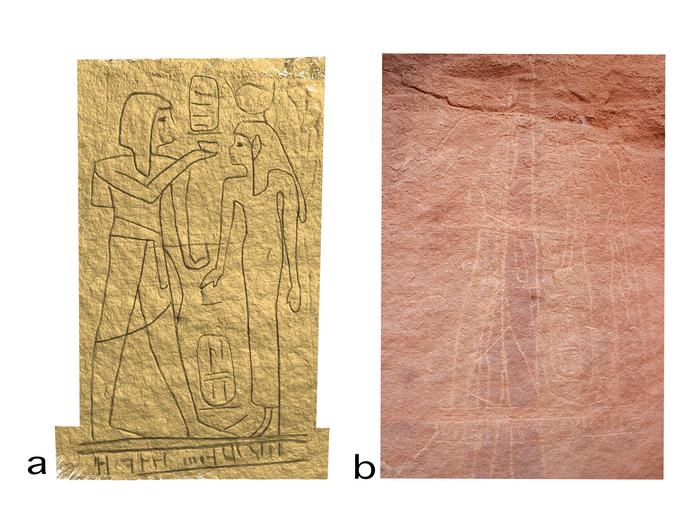
Researchers have developed a new method using ArchCUT3-D software to study rock engravings, integrating technological and visual analysis to reveal intricate details of ancient techniques. This new approach bridges the gap between production processes and visual outcomes, offering comprehensive insights into the cultural significance of engravings in Timna Park, southern Israel.

Credit: Liron Narunsky
Researchers have developed a new method using ArchCUT3-D software to study rock engravings, integrating technological and visual analysis to reveal intricate details of ancient techniques. This new approach bridges the gap between production processes and visual outcomes, offering comprehensive insights into the cultural significance of engravings in Timna Park, southern Israel.
PhD student Lena Dubinsky and Prof. Leore Grosman from the Computational Archaeology Laboratory at the Hebrew University’s Institute of Archaeology have pioneered a new method to study rock engravings, merging technological and visual analysis to uncover the intricate details behind ancient techniques. Utilizing the in-house developed ArchCUT3-D software, which allows a computational analysis of the three dimensional traits of rock engravings, the research showcases an innovative approach that provides new insights into the production processes and cultural significance of engravings found in Timna Park, southern Israel.
Historically, rock engravings have been examined primarily through their visual characteristics using comparative and interpretative methodologies. While recent works have focused on identifying production processes, these studies often neglected the visual outcomes. Dubinsky and Prof. Grosman’s research bridges this gap by using computational analysis to integrate both technological and visual aspects, offering a comprehensive understanding of ancient engraving practices.
“We employed ArchCUT3-D software to conduct a detailed analysis of 3-D data from various rock engravings. This method allowed us to extract micro-morphological evidence from engraved lines, decoding technical trends and variabilities in the execution of these ancient artworks. By examining a specific group of engraved figures, we established a link between the techniques used and the visual considerations guiding them,” explains Lena Dubinsky.
Based on their findings, the researchers propose the term “Techné” to describe the choice of technique that goes beyond mere practicality, encompassing the intentional design and cultural concepts embedded in the engravings. This integrative approach challenges the traditional dichotomy between visual and technological research, presenting a unified framework for understanding ancient production acts.
The study highlights how social structures and individual actions influence production methods, suggesting that the decisions related to technique selection are reflective of broader sociocultural contexts. This perspective offers a richer narrative of ancient engravers’ cognitive and material interactions, providing deeper insights into their cultural and technological environment.
The research underscores the potential of digital tools in archaeological studies. Their methodology not only advances the study of rock engravings but also sets a precedent for exploring other archaeological artifacts. By identifying “techno-visual codes” and the “fingerprints” of engraved complexes, this approach enhances our ability to understand the cultural and technological nuances of ancient societies.
“This study marks a significant step forward in archaeological research, combining advanced computational analysis with a nuanced understanding of ancient techniques and visual styles. It opens new avenues for exploring the interplay between technology and visuality in historical contexts, promising to deepen our knowledge of the past,” says Prof. Grosman.
Journal
Journal of Archaeological Method and Theory
Method of Research
Computational simulation/modeling
Subject of Research
Not applicable
Article Title
Techné of Rock Engravings—the Timna Case Study
Article Publication Date
3-Jul-2024
Cite Scienmag News
Courtney Benton. (July 11, 2024). Advanced method for rock engraving analysis: computational answers to riddles on stone. Scienmag. https://scienmag.com/advanced-method-for-rock-engraving-analysis-computational-answers-to-riddles-on-stone/
Courtney Benton. "Advanced method for rock engraving analysis: computational answers to riddles on stone." Scienmag, 11 July 2024, https://scienmag.com/advanced-method-for-rock-engraving-analysis-computational-answers-to-riddles-on-stone/. Accessed 4 September 2026.
Courtney Benton. "Advanced method for rock engraving analysis: computational answers to riddles on stone." Scienmag. July 11, 2024. https://scienmag.com/advanced-method-for-rock-engraving-analysis-computational-answers-to-riddles-on-stone/

