

Thursday, September 3, 2026
Science
No Result
View All Result
  • Login
  • HOME
  • SCIENCE NEWS
  • CONTACT US
  • HOME
  • SCIENCE NEWS
  • CONTACT US
No Result
View All Result
Scienmag
No Result
View All Result
Home Science News Agriculture

Adaptive Grid-Scale Irrigation System Enhances Rice Yields Amid Climate Swings

July 26, 2026
in Agriculture
Alan Morgan
By Alan Morgan Scienmag Editorial Profile - Precision Agriculture
Reading Time: 2 mins read
0
Adaptive Grid-Scale Irrigation System Enhances Rice Yields Amid Climate Swings

Adaptive Grid-Scale Irrigation System Enhances Rice Yields Amid Climate Swings

65
SHARES
587
VIEWS
Share on FacebookShare on Twitter
ADVERTISEMENT

A new study is turning climate uncertainty into a controllable variable for rice farming by using grid-scale, high-efficiency precision irrigation. The research, published in 2026, addresses a problem familiar to farmers worldwide: rainfall patterns and evapotranspiration demands are shifting, while water supply and distribution infrastructure must still deliver stable yields. Instead of relying on fixed irrigation schedules, the authors propose a dynamic regulation framework that adapts irrigation decisions in near real time as climate conditions change.

At the core of the approach is the idea that irrigation should respond to both weather variability and field-level water needs. The method integrates climate-driven signals with crop water requirements, enabling the system to adjust delivery rates across a network rather than treating fields as isolated units. This “dynamic” control aims to reduce the gap between what crops need and what irrigation provides, especially during volatile periods when temperature, radiation, and atmospheric demand fluctuate.

The study’s design is particularly relevant for rice, a crop that is both water-intensive and highly sensitive to timing. Over-irrigation can waste water and exacerbate nutrient losses, while under-irrigation can stress plants and suppress growth. By continuously recalibrating irrigation based on climate variability, the framework targets more accurate water delivery aligned with crop growth stages.

Importantly, the work focuses on grid-scale systems—meaning irrigation management is coordinated at the scale of water distribution infrastructure. This shifts the challenge from optimizing a single plot to optimizing performance across a larger service area. In practice, such coordination can help prevent bottlenecks, reduce operational inefficiencies, and improve overall reliability when weather shocks disrupt typical water planning.

The authors also emphasize high-efficiency precision irrigation, which typically relies on targeted delivery rather than uniform flooding. Under dynamic regulation, the system can fine-tune irrigation intensity, improving the match between water applied and water used. This capability is crucial when climate variability creates sudden changes in demand, such as heat waves or unusual dry spells.

From a technical perspective, the study leverages modeling and control logic to interpret climate inputs and translate them into irrigation commands. The researchers frame the system as a closed-loop decision process: observe variability, estimate crop water need, regulate irrigation accordingly, and maintain performance targets. Such control-oriented approaches are increasingly seen as a bridge between agricultural science and operational engineering.

Beyond water savings, the proposed strategy has implications for sustainability and resilience. More efficient irrigation can lower pressure on freshwater resources and help buffer farms against extremes. For rice-growing regions facing more erratic climates, adaptive irrigation may become a key component of future climate-smart agriculture.

As irrigation networks modernize, dynamic regulation could become a scalable template for other crops and regions. This research suggests that “precision” is not only about equipment accuracy, but also about decision-making that evolves with the atmosphere above the field. If validated broadly, the framework may help turn climate variability from a threat into a signal the irrigation system can respond to.

Subject of Research: Dynamic regulation of grid-scale high-efficiency precision irrigation for rice under climate variability

Article Title: Dynamic regulation of grid-scale high-efficiency precision irrigation for rice under climate variability

Article References: Dong, W., Xu, Y., Zhangzhong, L., Xu, X., Wei, S., Sun, Z., Chen, Y., Zhang, P., & Li, M. (2026). Dynamic regulation of grid-scale high-efficiency precision irrigation for rice under climate variability. npj Sustainable Agriculture, 4(1), Article 61. https://doi.org/10.1038/s44264-026-00172-7

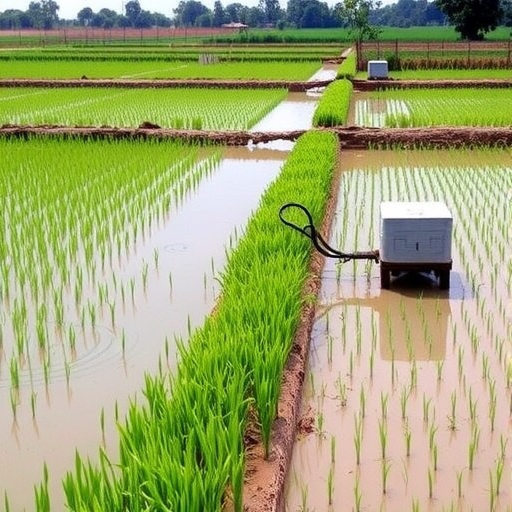
Image Credits: AI Generated

DOI: 10.1038/s44264-026-00172-7

Keywords: adaptive water management, climate variability, climate-smart agriculture, dynamic irrigation scheduling, evapotranspiration-based irrigation, high-efficiency irrigation systems, impact of climate swings on rice yields, infrastructure for grid-scale irrigation, precision irrigation for rice, real-time irrigation control, sustainable water management practices, water use optimization in rice farming

Cite Scienmag News

Alan Morgan. (July 26, 2026). Adaptive Grid-Scale Irrigation System Enhances Rice Yields Amid Climate Swings. Scienmag. https://scienmag.com/adaptive-grid-scale-irrigation-system-enhances-rice-yields-amid-climate-swings/


Alan Morgan. "Adaptive Grid-Scale Irrigation System Enhances Rice Yields Amid Climate Swings." Scienmag, 26 July 2026, https://scienmag.com/adaptive-grid-scale-irrigation-system-enhances-rice-yields-amid-climate-swings/. Accessed 3 September 2026.

Alan Morgan. "Adaptive Grid-Scale Irrigation System Enhances Rice Yields Amid Climate Swings." Scienmag. July 26, 2026. https://scienmag.com/adaptive-grid-scale-irrigation-system-enhances-rice-yields-amid-climate-swings/

Tags: adaptive water managementclimate variabilityclimate-smart agriculturedynamic irrigation schedulingevapotranspiration-based irrigationhigh-efficiency irrigation systemsimpact of climate swings on rice yieldsinfrastructure for grid-scale irrigationprecision irrigation for ricereal-time irrigation controlsustainable water management practiceswater use optimization in rice farming
Share26Tweet16
Previous Post

Genome-wide screen finds host-targeted drugs and SARS-CoV-2 pro-viral pathways

Next Post

Spatial planning boosts sustainability by restructuring land use, new study finds

Related Posts

Amodal completion enables 3D wheat reconstruction from a single image
Agriculture

Amodal completion enables 3D wheat reconstruction from a single image

September 3, 2026
Scientists reveal sugar transporter gene regulation in peony by ABA signals
Agriculture

Scientists reveal sugar transporter gene regulation in peony by ABA signals

September 3, 2026
Sweet Potato Weevil Pheromones Offer a Chemical Route to Cleaner Pest Control
Agriculture

Sweet Potato Weevil Pheromones Offer a Chemical Route to Cleaner Pest Control

September 3, 2026
Industrial Waste and Designer Biochar Join Forces to Rescue the World’s Dying Soils
Agriculture

Industrial Waste and Designer Biochar Join Forces to Rescue the World’s Dying Soils

September 3, 2026
Transfer learning enables a generalizable model for counting crop stands
Agriculture

Transfer learning enables a generalizable model for counting crop stands

September 3, 2026
Tropical Maize Germplasm Shows Genetic Variation in Silage Nutritional Quality Across Environments
Agriculture

Tropical Maize Germplasm Shows Genetic Variation in Silage Nutritional Quality Across Environments

August 31, 2026
Next Post
Spatial planning boosts sustainability by restructuring land use, new study finds

Spatial planning boosts sustainability by restructuring land use, new study finds

  • Mothers who receive childcare support from maternal grandparents show more optimized

    Mothers who receive childcare support from maternal grandparents show more parental warmth, finds NTU Singapore study

    27656 shares
    Share 11059 Tweet 6912
  • University of Seville Breaks 120-Year-Old Mystery, Revises a Key Einstein Concept

    1061 shares
    Share 424 Tweet 265
  • Bee body mass, pathogens and local climate influence heat tolerance

    682 shares
    Share 273 Tweet 171
  • Researchers record first-ever images and data of a shark experiencing a boat strike

    546 shares
    Share 218 Tweet 137
  • Groundbreaking Clinical Trial Reveals Lubiprostone Enhances Kidney Function

    531 shares
    Share 212 Tweet 133
Science

Embark on a thrilling journey of discovery with Scienmag.com—your ultimate source for cutting-edge breakthroughs. Immerse yourself in a world where curiosity knows no limits and tomorrow’s possibilities become today’s reality!

RECENT NEWS

  • DNA Methylation Emerges as a Possible, Still Unproven, Player in Delirium
  • New tool Dory analyzes differences in image-based chromatin tracing data
  • Efficacy of venous coupler versus hand-sewn venous anastomosis in free-flap reconstruction: a single-centre randomized controlled trial
  • Gene family evolution and salivary gene expression track diet shifts in hemipterans

Categories

  • Agriculture
  • Anthropology
  • Archaeology
  • Athmospheric
  • Biology
  • Biotechnology
  • Blog
  • Bussines
  • Cancer
  • Chemistry
  • Climate
  • Earth Science
  • Editorial Policy
  • Marine
  • Mathematics
  • Medicine
  • Pediatry
  • Policy
  • Psychology & Psychiatry
  • Science Education
  • Social Science
  • Space
  • Technology and Engineering

Subscribe to Blog via Email

Enter your email address to subscribe to this blog and receive notifications of new posts by email.

Join 5,151 other subscribers

© 2025 Scienmag - Science Magazine

Welcome Back!

Login to your account below

Forgotten Password?

Retrieve your password

Please enter your username or email address to reset your password.

Log In
No Result
View All Result
  • HOME
  • SCIENCE NEWS
  • CONTACT US

© 2025 Scienmag - Science Magazine

Discover more from Science

Subscribe now to keep reading and get access to the full archive.

Continue reading