


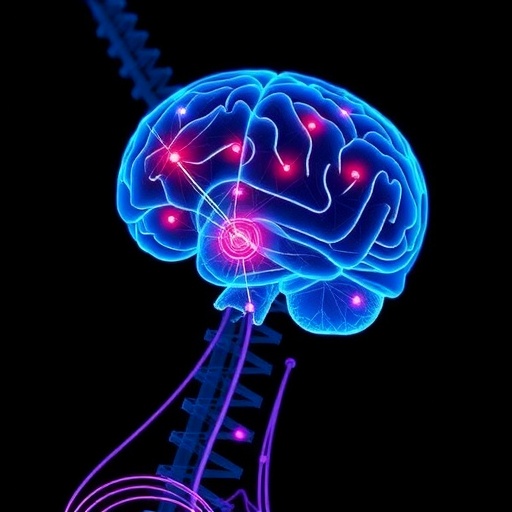
Researchers at the University of California, San Francisco (UCSF) have pioneered a groundbreaking approach to deep brain stimulation (DBS) that dynamically adapts to a person’s walking behavior in real time, marking a monumental advancement in the treatment of Parkinson’s disease. Traditional DBS therapies, while effective at alleviating tremor, rigidity, and bradykinesia, often fall short in addressing gait disorders, which are among the most debilitating and life-altering symptoms faced by patients. This innovative system utilizes neural signals intrinsically linked to each step, enabling an implanted neurostimulator to modulate stimulation instantaneously and thus enhance gait stability and reduce the incidence of falls.
In a study published in Nature Medicine, UCSF neuroscientists describe a personalized adaptive deep brain stimulation (aDBS) system designed to detect the subtle, rapidly fluctuating neural activity associated with left and right leg movements during ambulation. Unlike conventional DBS devices delivering a continuous, fixed stimulation pattern, this system is engineered to respond fluidly to real-time behavioral cues. The technology achieves this by embedding signal processing algorithms directly into the implanted device, eliminating dependence on external computational hardware and ensuring seamless therapeutic adjustments within fractions of a second as patients walk.
“Walking is a highly complex motor behavior, demanding precise bilateral coordination and temporal accuracy,” said Dr. Doris D. Wang, the study’s senior author. “By decoding neural signals specific to each phase of gait, our aDBS system is able to provide on-demand stimulation that synchronizes with the natural rhythm of walking, offering a more intelligent and effective treatment solution for those with Parkinson’s.”
Parkinson’s disease affects over 10 million individuals globally, and gait impairments such as freezing of gait, instability, and frequent falls severely restrict mobility and independence. Previous efforts to improve locomotor function through DBS have been hampered by the static nature of stimulation, which fails to accommodate the dynamic changes inherent in natural walking patterns. The UCSF researchers circumvented this limitation by focusing on the characteristic oscillatory brain signals that align with the initiation and progression of each step, enabling real-time modulation that enhances gait symmetry and reduces variability—two critical markers of stable and efficient movement.
The study enrolled five individuals who had already undergone surgical implantation of standard DBS leads targeting deep brain structures implicated in motor control. In addition, research electrodes were temporarily placed over cortical regions related to leg movement, allowing for comprehensive neural recording during walking tasks. This combined setup facilitated the identification of individualized neural signatures tied to gait phases, which were then programmed into the implanted stimulator’s onboard computer to direct adaptive stimulation without latency.
Laboratory testing revealed that the aDBS system significantly improved gait parameters, reinforcing the premise that responsive therapy tailored to brain and body rhythms can surpass the efficacy of continuous stimulation. Beyond controlled settings, participants engaged in a blinded, multi-day crossover trial within their natural environments, where activation of the adaptive system led to fewer falls and maintained overall Parkinsonian symptom control. Participants reported that the rapid modulation of stimulation was well tolerated and did not produce adverse neurological effects, highlighting the safety profile of this intelligent therapeutic approach.
This innovative research heralds a paradigmatic shift from treating neurological disorders based purely on static biomarkers or disease states toward a new frontier of personalized, behavior-responsive neuromodulation. Existing adaptive DBS technologies primarily respond to slow-changing indicators such as fluctuations in symptom severity or brain wave frequency bands. In contrast, the UCSF system’s capacity to decode instantaneous motor commands and phase-specific brain signals represents a significant leap in precision medicine.
“We envision an era in which brain stimulators do not simply deliver constant pulses but instead continuously monitor neural activity and adjust therapy in a nuanced, context-dependent manner,” Dr. Wang elaborated. This concept opens exciting possibilities not only for movement disorders but for a broad spectrum of conditions where brain activity fluctuates dynamically and unpredictably, including speech disorders, mood dysregulation, cognitive impairment, and psychiatric illnesses.
The technological underpinnings of this aDBS system draw inspiration from cardiac pacemakers, which revolutionized heart disease treatment by synchronizing electrical therapy with cardiac rhythms. By analogy, these novel neurostimulators “listen” to the brain’s motor control networks and tailor their output with unparalleled temporal accuracy, essentially partnering with the patient’s own neural processes. As research advances, this platform could be adapted for various brain functions, expanding the horizons of deep brain stimulation well beyond its current applications.
Importantly, the study was supported by robust funding from the Michael J. Fox Foundation, the National Institute of Neurological Disorders and Stroke, and UCSF’s Burroughs Wellcome Fund Career Award for Medical Scientists. While the initial trial involved a small cohort, the promising outcomes have set the stage for larger-scale clinical evaluations that will further confirm safety and efficacy, refine the technology, and ultimately translate this adaptive stimulation paradigm into widespread clinical practice.
The research team included prominent experts in neurosurgery, neurology, and biomedical engineering, underscoring the multidisciplinary nature required to tackle such a complex therapeutic challenge. Ethical considerations and conflict of interest disclosures were carefully managed; for example, Dr. Wang’s consultancy roles and research support from medical device manufacturers were transparently reported, ensuring integrity and objectivity in the study’s execution and dissemination.
In summary, the UCSF research represents a transformative advance in the use of brain-computer interface technologies for the dynamic control of Parkinson’s disease symptoms. By harnessing the brain’s own signals associated with motor activity, the adaptive DBS system offers a prototype for next-generation neuromodulatory devices that are intelligent, personalized, and finely tuned to the needs of individual patients in real time. This approach has the potential to dramatically improve quality of life for those affected by gait disturbances and sets a precedent for innovation in neurotherapeutics.
News Publication Date: 15-Jun-2026
Web References:
https://www.nature.com/articles/s41591-026-04434-2
References:
UCSF study published in Nature Medicine, June 15, 2026
Cite Scienmag News
Cassandra Pierce. (June 15, 2026). Adaptive Brain Stimulation Tailored to Every Step of Parkinson’s Patients. Scienmag. https://scienmag.com/adaptive-brain-stimulation-tailored-to-every-step-of-parkinsons-patients/
Cassandra Pierce. "Adaptive Brain Stimulation Tailored to Every Step of Parkinson’s Patients." Scienmag, 15 June 2026, https://scienmag.com/adaptive-brain-stimulation-tailored-to-every-step-of-parkinsons-patients/. Accessed 3 September 2026.
Cassandra Pierce. "Adaptive Brain Stimulation Tailored to Every Step of Parkinson’s Patients." Scienmag. June 15, 2026. https://scienmag.com/adaptive-brain-stimulation-tailored-to-every-step-of-parkinsons-patients/


