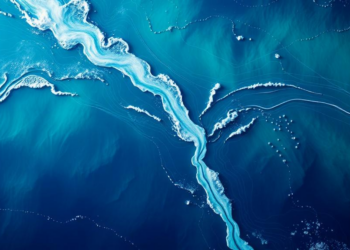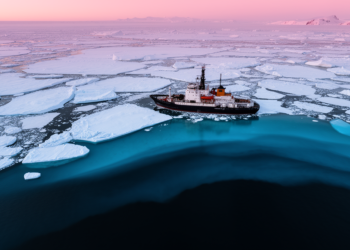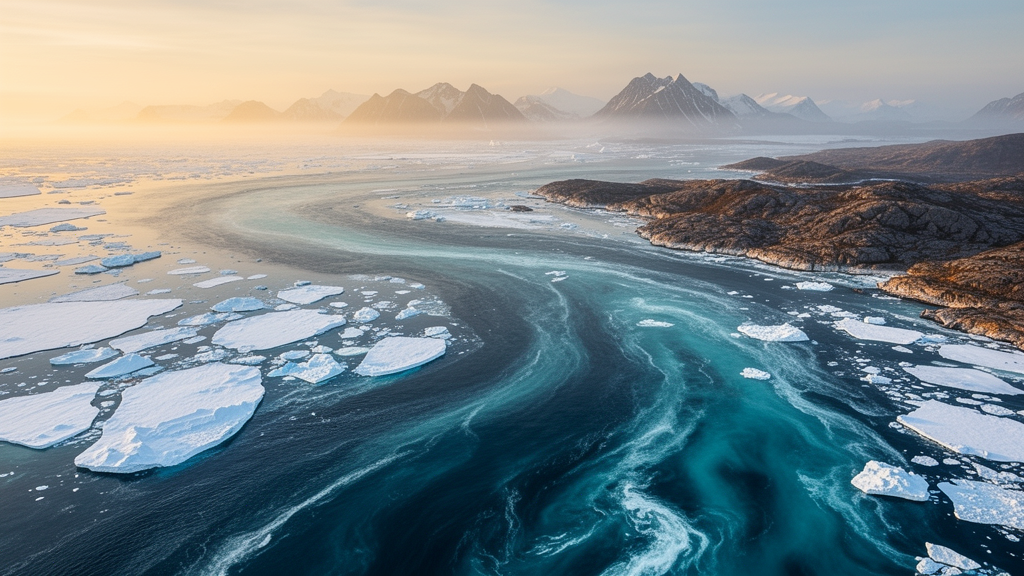
The Arctic Mediterranean Sea is changing rapidly, and a new review argues that statements about that change often omit the essential context: changing from what, and towards what. The paper, published in the journal Ocean Science, develops a unified perspective on how the interacting components of this ocean system evolve in space and time, and on the processes that determine their evolution.
The review’s central concern is the role of the Arctic Mediterranean in the global climate system, particularly with respect to the Atlantic Meridional Overturning Circulations, which the author notes remains poorly constrained. By following the pathways of the principal water masses, the paper describes the inflows into the region, the circulations between its basins, the transformations that water masses undergo, and the outflows of heat and salt that reach the bordering subpolar gyre and the global ocean.
To set the stage, the review provides a succinct overview of the geographic setting of the Arctic Mediterranean and of its early explorations, before turning to the modern oceanography of the system.
A key thread of the narrative is the fundamental connection to the global ocean: the Atlantic water. The paper traces this water mass along its route into and through the Arctic Mediterranean, showing how its properties are reshaped along the way.
Those transformations are driven by cooling and by the freezing and melting of sea ice. According to the review, they lead to the creation of both denser and less dense waters, which form and maintain the water column structures within the Arctic Mediterranean, a configuration the paper describes as the so-called double estuary.
A second advective component also supplies the Arctic: the low salinity water carried by the Pacific inflow. The review explains that this input is concentrated into the Amerasian Basin, where it acts to further isolate the denser waters derived from the Atlantic inflow.
The consequences extend beyond the Arctic itself. The review states that the waters return to the North Atlantic either as dense overflows or as buoyant outflows, linking the internal workings of the Arctic Mediterranean directly to the exchanges with the world ocean east and west of Greenland.
The paper also emphasizes that the water masses within diverse regions of the Arctic Mediterranean have changed over the past few decades, and that this change influences their exchanges with the world ocean on both sides of Greenland.
Finally, the review highlights a structural feature of the system: the water mass transformations in the Arctic Mediterranean take place beyond a ridge system. That geography allows for the build-up of significant density differences which, through entrainment, can increase the impact of the Arctic Mediterranean on the global overturning circulation.
Subject of Research: Ocean circulation and water mass transformations in the Arctic Mediterranean Sea
Article Title: The circulation and water mass (trans)formations in the Arctic Mediterranean Sea and their implications for the deep ocean circulation: a narrative
Article References: Rudels, B., & Carmack, E. (2026). The circulation and water mass (trans)formations in the Arctic Mediterranean Sea and their implications for the deep ocean circulation: a narrative. Ocean Science, 22(5), 3287-3346. https://doi.org/10.5194/os-22-3287-2026
Image Credits: AI Generated
Keywords: Arctic Mediterranean, ocean circulation, water masses, AMOC, Atlantic water, sea ice, Pacific inflow, overflows, double estuary, review, circulation, water
Cite Scienmag News
Violet Maxwell. (October 28, 2026). A unified narrative traces how Arctic Mediterranean waters feed the global overturning circulation. Scienmag. https://scienmag.com/a-unified-narrative-traces-how-arctic-mediterranean-waters-feed-the-global-overturning-circulation/
Violet Maxwell. "A unified narrative traces how Arctic Mediterranean waters feed the global overturning circulation." Scienmag, 28 October 2026, https://scienmag.com/a-unified-narrative-traces-how-arctic-mediterranean-waters-feed-the-global-overturning-circulation/. Accessed 28 October 2026.
Violet Maxwell. "A unified narrative traces how Arctic Mediterranean waters feed the global overturning circulation." Scienmag. October 28, 2026. https://scienmag.com/a-unified-narrative-traces-how-arctic-mediterranean-waters-feed-the-global-overturning-circulation/