Snakehead murrel (Channa striata) is one of Asia’s most prized freshwater fish, valued both as food and as a traditional convalescent remedy, yet a new review argues that the most talked-about ideas for farming it sustainably rest on very different levels of evidence. Published in Aquaculture Science and Management, the review systematically separates what has actually been demonstrated in C. striata from what has merely been borrowed from other fish species and from laboratory fermentation systems. Its central conclusion is blunt: probiotics and alternative feeds have solid species-specific support, but a proposed system combining monosodium glutamate (MSG), GABA-producing probiotics and biofloc technology should be treated as a testable framework, not an established production technology.
The authors, L. Lourdu Lincy, S. Saranya and P. Chellapandi, searched PubMed and Google Scholar from January 2000 to August 2026, using Scopus and Web of Science for cross-verification, and screened 2,405 aggregate search hits down to 100 included studies. Crucially, they graded every piece of evidence into four tiers: direct in vivo C. striata studies, species-specific laboratory and compositional work, studies of other Channa species, and finally research in unrelated teleosts or microbial systems. Species-specific conclusions were drawn only from the top two tiers, with everything else explicitly labelled as indirect support. This grading discipline is what allows the review to make unusually careful claims about what murrel farmers can and cannot rely on.
Where the direct evidence is strong, it concerns nutrition. A 10-week trial with 225 C. striata juveniles showed that two-spotted cricket meal could completely replace fishmeal protein without compromising growth, while increasing protein and phosphorus retention and reducing nitrogen and phosphorus waste. Fish condensate replacing 500 g per kg of fishmeal protein proved near-optimal over six months with an economic advantage. A protein hydrolysate made from catfish filleting waste improved growth performance by 8.03 percent, protein efficiency ratio by 25.66 percent and feed efficiency by 23.41 percent at up to 45 percent inclusion. In a 70-day factorial trial with 405 juveniles, the combination of 20 percent starch and 0.1 percent exogenous alpha-amylase improved growth and nutrient digestibility while lowering serum liver-enzyme markers.
Early life nutrition also has species-specific answers. Direct measurements of digestive enzyme ontogeny showed that trypsin, chymotrypsin, leucine aminopeptidase and lipase activities peaked at 18 days post-hatching, with alkaline phosphatase peaking at 21 days, identifying 18 days as the right moment to begin gradual pellet weaning. In a subsequent 60-day trial, taurine at 10 to 15 g per kg of feed supported 90 percent survival, with an estimated post-weaning requirement of 16.31 to 16.40 g per kg. The review also notes that C. striata possesses functional Fads2 and Elovl5 enzymes for long-chain polyunsaturated fatty acid biosynthesis, and that a 12-week trial using stearidonic-acid-rich Echium oil increased hepatic fads2 and elovl5 expression and muscle EPA and DHA relative to linseed oil without changing growth or feed conversion.
Probiotics and synbiotics form the second pillar of direct evidence. In feeding trials comparing beta-glucan, galacto-oligosaccharides, mannan-oligosaccharides, live Saccharomyces cerevisiae and Lactobacillus acidophilus, the L. acidophilus treatment produced the strongest growth and feed utilization responses, improved red and white blood cell counts, hemoglobin, serum protein and lysozyme activity, and gave the greatest resistance to Aeromonas hydrophila challenge. A 60-day trial in 450 juveniles confirmed that 0.02 percent L. acidophilus produced the highest growth, nutrient utilization, digestive enzyme activity and immune gene expression. In a separate synbiotic trial, Bacillus amyloliquefaciens H23 combined with beta-glucan delivered the best growth, immune and antioxidant outcomes, lowered cortisol, and improved survival after A. hydrophila challenge by 27.7 percent.
The gut microbiome itself has now been profiled directly in C. striata. High-throughput 16S rRNA gene V3-V4 profiling during the spawning season showed that habitat and sex altered gut community structure and muscle fatty acid profiles: pond-simulated females had higher palmitic and linoleic acid contents, tank-reared females higher oleic acid, and taxa such as Pseudoalteromonas and Salmonella enterica were enriched in tank fish. Chitosan supplementation increased gut richness to a Chao1 index of 531.62 and enriched Lactobacillus, Bacteroides, Alloprevotella and Muribaculaceae. The authors are careful, however, to state that these are associations and functional predictions, not evidence of metabolite transfer to the host, and that no causal gut-brain-immune pathway has been demonstrated in the species.
It is the MSG story where the review draws its sharpest line. Glutamate and glutamine are central metabolic substrates in teleosts, and lactic acid bacteria can convert glutamate or MSG to gamma-aminobutyric acid (GABA) via glutamate decarboxylase in fermentation systems. Biological effects of GABA have been reported in grass carp, Jian carp, turbot, zebrafish and pufferfish, providing mechanistic support. But the review found no controlled long-term dose-response study establishing an optimal or maximum safe dietary MSG concentration for C. striata, and no in vivo trial that simultaneously quantified dietary MSG disappearance, microbial GABA production, circulating or intestinal GABA, behavioral stress endpoints and growth. The growth and feed conversion responses sometimes attributed to dietary MSG came from rainbow trout and grass carp studies, not from murrel. Routine MSG supplementation therefore cannot be recommended.
The review also flags a stoichiometric safety issue: MSG monohydrate is approximately 12.3 percent sodium by mass, so 10 g of MSG per kg of feed would contribute roughly 1.23 g of sodium per kg of feed before any basal dietary sodium. Direct C. striata physiology shows that exposure to salinity of 10 per mille or above elevates cortisol and glucose, causes muscle dehydration, and activates branchial Na+/K+-ATPase, making osmoregulatory endpoints essential in any MSG safety study. The 30 mg per kg body weight benchmark cited in the literature is a human dietary risk-assessment value, not an approved aquafeed inclusion limit, and any commercial recommendation would require species-specific dose-response and chronic studies covering growth, osmoregulation, renal and hepatic biomarkers, oxidative stress, behavior and tissue sodium, glutamate and GABA levels.
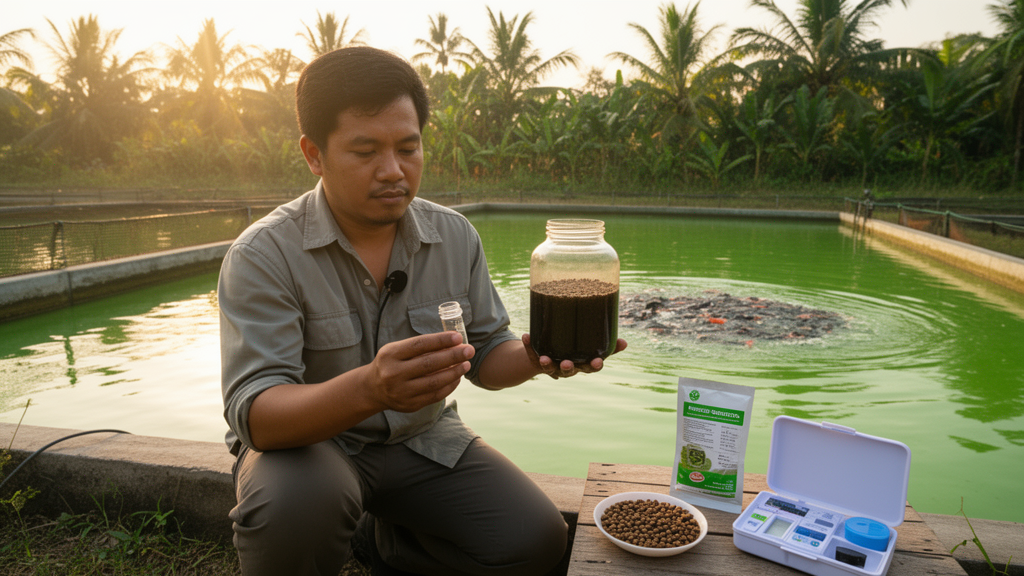
Biofloc technology, the third component of the proposed triad, carries its own operational realities. The system couples heterotrophic nitrogen assimilation with microbial biomass production while reducing water exchange, but reported improvements in feed conversion, growth and water quality come from heterogeneous studies across different species, carbon sources and management regimes. In practice, biofloc imposes continuous oxygen and mixing demands because fish and microbes both consume oxygen, so blower failure can rapidly degrade performance. Carbon dosing must be matched to feed nitrogen and measured total ammonia nitrogen, and alkalinity, pH, settleable solids, suspended solids, nitrite, nitrate and floc volume all require routine monitoring. Excess solids can impair gill function and destabilize microbial composition, and nitrite exposure can markedly disturb sodium, chloride, bicarbonate and osmolality even in this comparatively tolerant air-breathing species. Economic feasibility is site-specific, with continuous aeration, emergency power, carbon sources and skilled labor among the major cost drivers.
The proposed MSG-probiotic-biofloc framework, the review stresses, is a conceptual model rather than an experimentally established pathway. No controlled factorial trial of the complete three-component system exists in C. striata. The authors propose a validation design using replicated tanks that independently tests MSG dose, a genomically characterized GABA-producing probiotic and biofloc conditions, measuring feed intake, growth, survival, digestibility, plasma and intestinal glutamate and GABA, residual feed MSG, sodium balance, cortisol, immune markers, microbiome profiles and challenge survival, alongside biofloc water-quality and energy variables. Only statistically supported interaction effects, rather than parallel improvements reported in separate studies, would justify the word synergy. The staged pathway runs from controlled dose-response studies through replicated factorial validation, multi-omics mechanism work, pilot-scale economic assessment and finally multi-farm trials across seasons and water sources. Until that evidence exists, the review concludes, routine recommendations should follow, not precede, species-specific proof of efficacy, safety, economic feasibility and consumer acceptability.
Subject of Research: Evidence grading of microbial biotechnology, functional nutrition and biofloc technology for snakehead murrel aquaculture
Article Title: Integrating microbial biotechnology, functional nutrition, and biofloc technology for sustainable snakehead murrel (Channa striata) aquaculture
Article References: Lincy, L. L., Saranya, S., & Chellapandi, P. (2026). Integrating microbial biotechnology, functional nutrition, and biofloc technology for sustainable snakehead murrel (Channa striata) aquaculture. Aquaculture Science and Management, 3(1), Article 15. https://doi.org/10.1186/s44365-026-00043-9
Image Credits: AI Generated
DOI: 10.1186/s44365-026-00043-9
Keywords: snakehead murrel, Channa striata, aquaculture, probiotics, biofloc technology, functional nutrition, GABA, monosodium glutamate, gut microbiome, sustainable feed, fish nutrition, review
Cite Scienmag News
Morgan Morrow. (October 28, 2026). Probiotics, biofloc and MSG: a testable framework for snakehead murrel farming. Scienmag. https://scienmag.com/probiotics-biofloc-and-msg-a-testable-framework-for-snakehead-murrel-farming/
Morgan Morrow. "Probiotics, biofloc and MSG: a testable framework for snakehead murrel farming." Scienmag, 28 October 2026, https://scienmag.com/probiotics-biofloc-and-msg-a-testable-framework-for-snakehead-murrel-farming/. Accessed 29 October 2026.
Morgan Morrow. "Probiotics, biofloc and MSG: a testable framework for snakehead murrel farming." Scienmag. October 28, 2026. https://scienmag.com/probiotics-biofloc-and-msg-a-testable-framework-for-snakehead-murrel-farming/