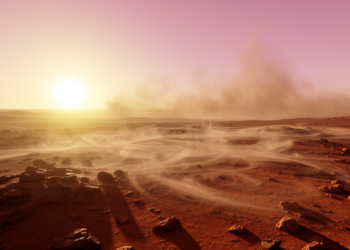
Water ice clouds drift through the thin Martian atmosphere in patterns that repeat year after year, yet the way they swell and shrink over the course of a single Martian day has remained one of the most poorly measured aspects of the planet’s water cycle. By retrieving water ice aerosol optical depth in the 3.3 micrometer spectral band, the researchers assembled a climatology spanning approximately eight Martian years, from MY27 to MY34, and used the spacecraft’s unusual orbit to watch the same regions of Mars at different local times of day.
The results confirm the three great seasonal patterns of Martian water ice that earlier instruments had sketched out. The aphelion cloud belt, or ACB, a band of clouds straddling the equator and low latitudes between roughly 10 degrees south and 30 degrees north, dominates the aphelion season when Mars is farthest from the Sun. The north polar hood forms during northern autumn, winter and early spring, while the south polar hood appears during southern autumn and winter. During the perihelion season, when the atmosphere warms and dust activity intensifies, water ice becomes scarce across most low latitudes. The PFS/SWC data reproduce this familiar rhythm consistently across all eight Martian years, giving the pattern a firm multi-annual foundation.
What sets the new analysis apart is its treatment of local time. Because of the geometry of the Mars Express orbit, PFS can observe the same location at different hours of the Martian day, something most instruments cannot do. Binning observations of the aphelion cloud belt by one-hour local-time intervals revealed a clear diurnal cycle: water ice optical depth is highest around sunrise at about 6 a.m. local time, declines steadily through the morning, reaches its minimum between roughly 10 a.m. and 2 p.m., and then climbs again after 2 p.m. Independent support came from the THEMIS instrument on Mars Odyssey, whose observations, confined to late afternoon hours between about 3 p.m. and 8 p.m., show optical depth rising with local time in the same way the PFS data do over their overlapping window.
The researchers attribute this daily rhythm to Martian atmospheric thermal tides. As daytime temperatures rise, ice sublimates back into vapor and cloud mass thins; as the surface cools toward evening, condensation resumes. The amplitude of the effect is strongest during the aphelion season and in tropical latitudes. Notably, the spatial pattern of the diurnal cycle argues against a sampling artifact: high optical depths appear over Tharsis Montes, Valles Marineris and Arabia Terra in the morning hours, fade to a longitudinally uniform haze by midday, and reappear over the same regions, joined by Elysium Mons, in the evening. If the variation were merely a quirk of when and where the spacecraft happened to observe, the geography would not pulse in this coordinated way.
The spatial climatology itself carries important clues. Within the aphelion cloud belt, peak optical depths of roughly 0.225 to 0.250 cluster near 60 to 120 degrees west and 90 to 150 degrees east, corresponding to the Tharsis bulge and Elysium Mons. These maxima sit in anticorrelation with surface thermal inertia, meaning the thickest clouds form over dusty, insulating terrain. A distinct cloud feature also appears over the Hellas basin. General circulation model simulations have long predicted that these topographic highs act as funnels for water vapor, which is lifted by atmospheric circulation and condenses in the colder mid-to-lower atmosphere, and the new observations bear that picture out.
Interannual differences in the cloud belt proved revealing as well. The maximum aphelion-season optical depth reached about 0.22 in MY27, 0.20 in MY31 and 0.23 in MY33, but only about 0.18 in MY32. The explanation is not a change in the Martian climate but a change in viewing schedule: during MY32 the aphelion observations happened to fall around 10 a.m. to noon local time, precisely when clouds are near their daily minimum. The finding is a caution for any single-time-of-day survey of Martian clouds, and it underscores how much apparent year-to-year variability can be an artifact of local-time sampling.
Comparisons with other datasets sharpened the picture further. The PFS/SWC retrievals agree well with THEMIS, which measures water ice in the 12 micrometer band, on the seasonal evolution of the cloud belt. CRISM, on the Mars Reconnaissance Orbiter, retrieves ice in a spectral range similar to PFS but observes around 3 p.m. local time, and its aphelion cloud belt optical depths come out systematically lower. Even when the comparison was restricted to overlapping local-time windows, PFS values in the cloud belt remained higher than CRISM’s, a difference the authors attribute partly to spatial resolution: PFS’s field of view spans several tens of kilometers and may blur cloud-free patches into the average, biasing binned values upward, whereas merged CRISM observations resolve patches of roughly 2 by 2 kilometers.
The study also paired the ice measurements with water vapor column abundances retrieved from the same instrument, exposing a coupled seasonal exchange. In the equatorial band, vapor initially declines as the cold aphelion season promotes condensation into ice; after about Ls 50 degrees, both rise together as the retreating north polar cap sublimates, sending vapor southward, where topographic lifting converts it back into cloud. After Ls 150 degrees the two quantities decouple, with ice falling to low levels while vapor holds near its annual maximum, signaling a shift in the dominant atmospheric processes.
Against the Mars Climate Database, a general-circulation-model-based reference, the observations diverge in ways that matter for modelers. The simulated vapor peak in the north polar region is roughly twice the observed value, and the modeled low-latitude water vapor rises steadily through northern spring instead of first dipping as observed. Most strikingly, the model predicts that aphelion-season cloud optical depth should swing by a factor of 8 to 10 over the Martian day, while the PFS retrievals show a more modest variation of about 25 percent of the daily maximum. The authors note that sampling biases may contribute to the small observed amplitude, but the result is also consistent with a real Martian water cycle that proceeds more slowly than current simulations predict, and they call for coordinated future observations to settle the question.
The team acknowledges limitations: the retrieval fixes the ice particle effective radius at 2 micrometers, and assuming 1.5 or 3.0 micrometers shifts absolute optical depths by roughly 20 to 30 percent, while nadir geometry provides only column-integrated information with no vertical resolution. Uncertainties from dust reach about 3 percent in quiet conditions but can climb to 50 percent during global dust storms, which suppress ice formation anyway. Even so, the eight-year dataset stands as a benchmark for validating global climate models, and the authors recommend that future Mars missions carry spectrometers covering at least two water ice absorption bands, such as 3.3 and 12 micrometers, to break the degeneracy between cloud opacity and particle size and extend a multi-decade climatological record.
Subject of Research: Diurnal and spatial variability of Martian atmospheric water ice clouds observed by Mars Express PFS/SWC over eight Martian years
Article Title: Diurnal variability and spatial distributions of martian atmospheric water ice from mars express PFS/SWC observations
Article References: Chai, Y., Jin, S., & Wang, Y. (2026). Diurnal variability and spatial distributions of martian atmospheric water ice from mars express PFS/SWC observations. Frontiers in Astronomy and Space Sciences, 13, 1957213. https://doi.org/10.3389/fspas.2026.1957213
Image Credits: AI Generated
DOI: 10.3389/fspas.2026.1957213
Keywords: Mars, water ice clouds, Mars Express, PFS/SWC, aphelion cloud belt, diurnal variability, water cycle, Mars Climate Database, THEMIS, CRISM, Tharsis, global climate models
Cite Scienmag News
Russell Cooper. (October 28, 2026). Mars Express Reveals Morning-Heavy Water Ice Clouds Across Eight Martian Years. Scienmag. https://scienmag.com/mars-express-reveals-morning-heavy-water-ice-clouds-across-eight-martian-years/
Russell Cooper. "Mars Express Reveals Morning-Heavy Water Ice Clouds Across Eight Martian Years." Scienmag, 28 October 2026, https://scienmag.com/mars-express-reveals-morning-heavy-water-ice-clouds-across-eight-martian-years/. Accessed 28 October 2026.
Russell Cooper. "Mars Express Reveals Morning-Heavy Water Ice Clouds Across Eight Martian Years." Scienmag. October 28, 2026. https://scienmag.com/mars-express-reveals-morning-heavy-water-ice-clouds-across-eight-martian-years/