


For the first time, scientists have managed to create sheets of gold only a single atom layer thick. The material has been termed goldene. According to researchers from Linköping University, Sweden, this has given the gold new properties that can make it suitable for use in applications such as carbon dioxide conversion, hydrogen production, and production of value-added chemicals. Their findings are published in the journal Nature Synthesis.

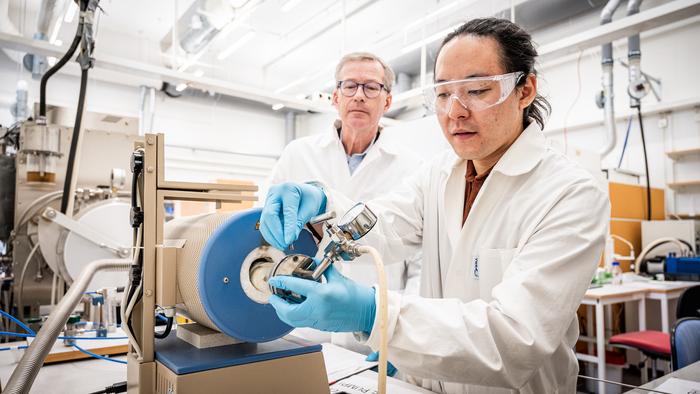
Credit: Olov Planthaber
For the first time, scientists have managed to create sheets of gold only a single atom layer thick. The material has been termed goldene. According to researchers from Linköping University, Sweden, this has given the gold new properties that can make it suitable for use in applications such as carbon dioxide conversion, hydrogen production, and production of value-added chemicals. Their findings are published in the journal Nature Synthesis.
Scientists have long tried to make single-atom-thick sheets of gold but failed because the metal’s tendency to lump together. But researchers from Linköping University have now succeeded thanks to a hundred-year-old method used by Japanese smiths.
“If you make a material extremely thin, something extraordinary happens – as with graphene. The same thing happens with gold. As you know, gold is usually a metal, but if single-atom-layer thick, the gold can become a semiconductor instead,” says Shun Kashiwaya, researcher at the Materials Design Division at Linköping University.
To create goldene, the researchers used a three-dimensional base material where gold is embedded between layers of titanium and carbon. But coming up with goldene proved to be a challenge. According to Lars Hultman, professor of thin film physics at Linköping University, part of the progress is due to serendipidy.
“We had created the base material with completely different applications in mind. We started with an electrically conductive ceramics called titanium silicon carbide, where silicon is in thin layers. Then the idea was to coat the material with gold to make a contact. But when we exposed the component to high temperature, the silicon layer was replaced by gold inside the base material,” says Lars Hultman.
This phenomenon is called intercalation and what the researchers had discovered was titanium gold carbide. For several years, the researchers have had titanium gold carbide without knowing how the gold can be exfoliated or panned out, so to speak.
By chance, Lars Hultman found a method that has been used in Japanese forging art for over a hundred years. It is called Murakami’s reagent, which etches away carbon residue and changes the colour of steel in knife making, for example. But it was not possible to use the exact same recipe as the smiths did. Shun Kashiwaya had to look at modifications:
“I tried different concentrations of Murakami’s reagent and different time spans for etching. One day, one week, one month, several months. What we noticed was that the lower the concentration and the longer the etching process, the better. But it still wasn’t enough,” he says.
The etching must also be carried out in the dark as cyanide develops in the reaction when it is struck by light, and it dissolves gold. The last step was to get the gold sheets stable. To prevent the exposed two-dimensional sheets from curling up, a surfactant was added. In this case, a long molecule that separates and stabilises the sheets, i.e. a tenside.
“The goldene sheets are in a solution, a bit like cornflakes in milk. Using a type of “sieve”, we can collect the gold and examine it using an electron microscope to confirm that we have succeeded. Which we have,” says Shun Kashiwaya.
The new properties of goldene are due to the fact that the gold has two free bonds when two-dimensional. Thanks to this, future applications could include carbon dioxide conversion, hydrogen-generating catalysis, selective production of value-added chemicals, hydrogen production, water purification, communication, and much more. Moreover, the amount of gold used in applications today can be much reduced.
The next step for the LiU researchers is to investigate whether it is possible to do the same with other noble metals and identify additional future applications.
Journal
Nature Synthesis
Article Title
Synthesis of goldene comprising single-atom layer gold
Article Publication Date
16-Apr-2024
Cite Scienmag News
Bethany Barker. (April 16, 2024). A single atom layer of gold – LiU researchers create goldene. Scienmag. https://scienmag.com/a-single-atom-layer-of-gold-liu-researchers-create-goldene/
Bethany Barker. "A single atom layer of gold – LiU researchers create goldene." Scienmag, 16 April 2024, https://scienmag.com/a-single-atom-layer-of-gold-liu-researchers-create-goldene/. Accessed 3 September 2026.
Bethany Barker. "A single atom layer of gold – LiU researchers create goldene." Scienmag. April 16, 2024. https://scienmag.com/a-single-atom-layer-of-gold-liu-researchers-create-goldene/

