


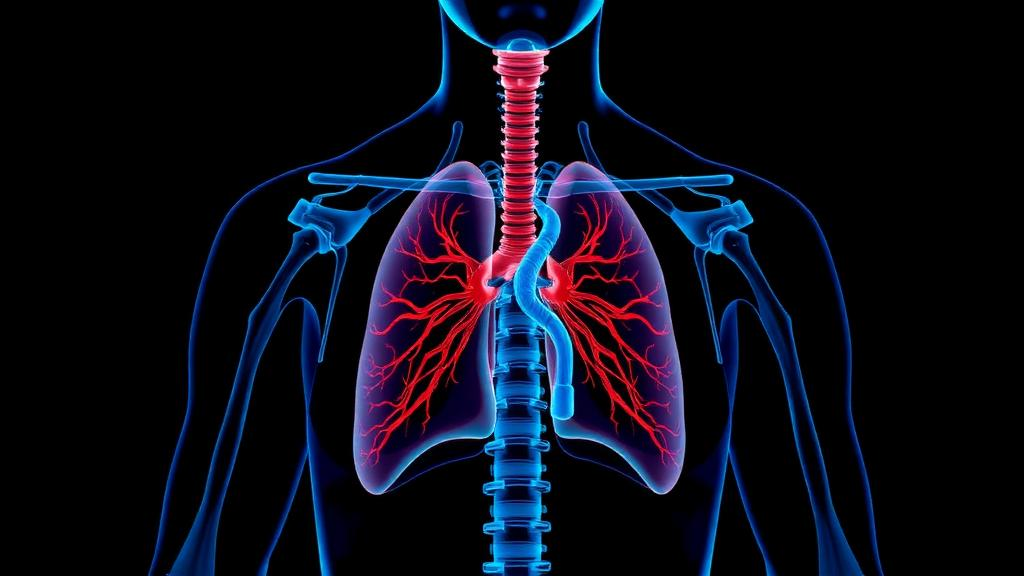
For people living with amyotrophic lateral sclerosis, one of the most consequential clinical decisions is when to start non-invasive ventilation, the mask-based breathing support that extends survival and improves quality of life. That decision has long rested on tests that require the patient’s active cooperation, most notably forced vital capacity, the maximal volume of air a person can exhale after a deep breath. But ALS progressively erodes the bulbar muscles of speech and swallowing and, in many patients, cognition itself, making a forceful, well-sealed exhale increasingly difficult to perform reliably. A new study published in the Journal of Neurology offers a striking alternative: a routine electrical test of the phrenic nerve, the wire that drives the diaphragm, appears to predict the timing of ventilatory failure without asking anything of the patient at all.
The research, led by José Castro and Mamede de Carvalho at the Hospital de Santa Maria and the Universidade de Lisboa, drew on one of the largest single-centre ALS cohorts ever assembled for this purpose: 1,486 patients contributing 2,968 serial phrenic nerve conduction studies. In this test, a small electrical stimulus is applied over the nerve in the neck, and electrodes record the compound muscle action potential, the summed electrical response of the diaphragm. Because the diaphragm cannot voluntarily influence the evoked signal, the amplitude is, by design, effort-independent. The investigators expressed each amplitude as a percentage of an age- and sex-predicted normative value and asked a deceptively simple question: does this number forecast when a patient will need breathing support, above and beyond the established clinical measures?
The answer, delivered through a pre-registered analysis plan lodged publicly on the Open Science Framework, was emphatic. Using cause-specific Cox proportional hazards models with death treated as a competing risk, the team found that each 10 percent decrease in predicted phrenic amplitude was associated with a 22 percent higher hazard of starting non-invasive ventilation, with an adjusted hazard ratio of 1.22 and a 95 percent confidence interval of 1.16 to 1.27. The statistical weight of the association was extraordinary: a likelihood-ratio chi-square of 77.6, corresponding to a p-value of roughly ten to the minus eighteenth. In a field where biomarker candidates routinely collapse on replication, a signal of this magnitude in nearly three thousand serial measurements commands attention.
Perhaps the most clinically useful finding is the temporal structure of the prediction. The association was concentrated in the near term: within the first year of follow-up, the hazard ratio climbed to 1.31 per 10 percent decrement, before attenuating in later intervals. This makes physiological sense. The phrenic compound muscle action potential reflects the number and integrity of functioning motor units in the diaphragm, so a low or rapidly falling amplitude signals that the respiratory motor pool is approaching a functional threshold. Once that threshold is crossed, ventilatory decline accelerates. For clinicians, the message is that the nerve test is not a distant oracle but a near-term alarm, precisely the window in which the timing of ventilation matters most for survival and quality of life.
The quantitative gains over existing practice were substantial. Adding phrenic amplitude to a clinical model built on forced vital capacity and the revised ALS Functional Rating Scale, the standard severity instrument that incorporates respiratory items, improved discrimination by an optimism-corrected increment of 0.055, with a bootstrap-validated confidence interval of 0.034 to 0.073. That may sound modest, but in prognostic modelling, where incremental improvements of this size are considered meaningful, it represents a genuine advance. More striking is the absolute risk translation: patients whose phrenic amplitude fell below the age- and sex-adjusted normal threshold had approximately double the twelve-month risk of requiring ventilation, 62 percent versus 29 percent. A single bedside-adjacent measurement effectively stratifies patients into two very different futures.
To capture the dynamic nature of the disease, the team also deployed a Bayesian joint longitudinal-survival model, a sophisticated statistical architecture that links repeated measurements over time to the hazard of the clinical event. This analysis separated two distinct prognostic signals: the current amplitude itself, carrying a hazard ratio of 1.57 per 10 percent decrement, and the rate of decline of that amplitude, carrying an independent hazard ratio of 1.30. In other words, both where the diaphragm’s electrical output stands today and how fast it is eroding contribute independent information. This dual signal mirrors the logic clinicians apply intuitively to forced vital capacity, but here it operates on a measurement that no amount of weakness elsewhere in the body can distort.
The problem the study solves is well documented in the ALS literature. Forced vital capacity depends on bulbar competence to seal the mouthpiece, on respiratory muscle strength to generate flow, and on cognitive capacity to follow instructions. Slow vital capacity has been proposed as a gentler alternative, and supine measurements add sensitivity to diaphragmatic weakness, but all remain effort-dependent to some degree. Recent work from the same Lisbon group showed that cognitive dysfunction is associated with an underestimation of respiratory function on these tests, meaning the very patients whose breathing is deteriorating may appear deceptively stable. Guidelines from the European Academy of Neurology and its predecessors have long acknowledged the difficulty of timing ventilation, and the randomised trial by Bourke and colleagues that established the survival benefit of non-invasive ventilation relied on thresholds that cooperative patients can demonstrate but severely affected ones cannot.
The phrenic nerve conduction study itself is not new. It has been studied as a prognostic marker in ALS since at least 2009, when Pinto, Turkman and colleagues showed its value in predicting respiratory insufficiency, and the Lisbon group has since published normative data establishing age- and sex-referenced amplitude thresholds. What distinguishes the new work is scale, rigour and statistical ambition. The pre-registered plan, the competing-risk framework, the bootstrap validation, the time-dependent discrimination analyses and the joint modelling collectively meet the standards set by the TRIPOD reporting guidelines for clinical prediction models. The authors also positioned the measurement as a candidate outcome for clinical trials, where an objective, effort-independent readout of respiratory motor unit loss could serve as a sensitive endpoint for drugs targeting motor neuron degeneration.
Important caveats remain, and the authors state them plainly. The cohort is single-centre, and although it is large, the amplitude values were expressed against normative data derived from the same investigative tradition, raising the possibility of centre-specific calibration. External validation in independent cohorts, ideally spanning different health systems and ethnicities, is required before the marker can be embedded in guidelines, and the models will need recalibration to local populations. The association also attenuates beyond the first year, so the marker complements rather than replaces longitudinal clinical assessment. And while the test involves a mild electrical stimulus that most patients tolerate well, it is still an invasive neurophysiological procedure compared with a spirometry manoeuvre, which shapes how it might be deployed in routine monitoring.
Even with those qualifications, the implications are considerable. Respiratory failure remains the dominant cause of death in ALS, and the window for initiating ventilation comfortably, with time for adjustment, education and psychological preparation, is narrow and easy to miss when the usual yardsticks falter. An effort-independent electrical signature of the diaphragm’s remaining motor units, measured in a clinic room in minutes, that roughly doubles the predicted twelve-month risk when abnormal, offers a way to keep that window open for the patients who need it most, including those who can no longer perform the breathing manoeuvres their own care depends on. As disease-modifying therapies multiply and trials search for responsive endpoints, the humble phrenic nerve, stimulated and recorded for decades in neurophysiology labs, may be poised to become one of the most consequential numbers on the ALS chart.
Subject of Research: Phrenic nerve conduction studies as prognostic biomarkers of respiratory failure in amyotrophic lateral sclerosis
Article Title: Phrenic nerve amplitude as an effort-independent prognostic biomarker of respiratory failure in amyotrophic lateral sclerosis
Article References: Castro, J., Sá, V., Lopes, D., Alves, I., Oliveira Santos, M., & de Carvalho, M. (2026). Phrenic nerve amplitude as an effort-independent prognostic biomarker of respiratory failure in amyotrophic lateral sclerosis. Journal of Neurology, 273(10), Article 574. https://doi.org/10.1007/s00415-026-14125-0
Image Credits: AI Generated
DOI: 10.1007/s00415-026-14125-0
Keywords: amyotrophic lateral sclerosis, phrenic nerve, nerve conduction studies, non-invasive ventilation, respiratory failure, prognosis, biomarkers, forced vital capacity, diaphragm, neurophysiology, motor neuron disease, ALSFRS-R
Cite Scienmag News
Ophelia Keating. (October 7, 2026). A Simple Nerve Test Could Predict When ALS Patients Will Need Breathing Support. Scienmag. https://scienmag.com/a-simple-nerve-test-could-predict-when-als-patients-will-need-breathing-support/
Ophelia Keating. "A Simple Nerve Test Could Predict When ALS Patients Will Need Breathing Support." Scienmag, 7 October 2026, https://scienmag.com/a-simple-nerve-test-could-predict-when-als-patients-will-need-breathing-support/. Accessed 7 October 2026.
Ophelia Keating. "A Simple Nerve Test Could Predict When ALS Patients Will Need Breathing Support." Scienmag. October 7, 2026. https://scienmag.com/a-simple-nerve-test-could-predict-when-als-patients-will-need-breathing-support/


