


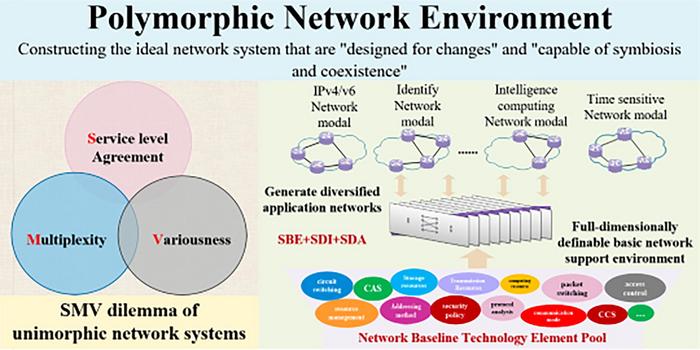
In a new study published in Engineering, Academician Wu Jiangxing’s research team unveils a theoretical framework that could revolutionize the landscape of network systems and architectures. The paper titled “Theoretical Framework for a Polymorphic Network Environment,” addresses a fundamental challenge in network design—achieving global scalability while accommodating the diverse needs of evolving services.

Credit: Jiangxing Wu, Junfei Li, Penghao Sun, Yuxiang Hu, Ziyong
In a new study published in Engineering, Academician Wu Jiangxing’s research team unveils a theoretical framework that could revolutionize the landscape of network systems and architectures. The paper titled “Theoretical Framework for a Polymorphic Network Environment,” addresses a fundamental challenge in network design—achieving global scalability while accommodating the diverse needs of evolving services.
For decades, the quest for an ideal network capable of seamlessly scaling across various dimensions has remained elusive. The team, however, has identified a critical barrier known as the “impossible service-level agreement (S), multiplexity (M), and variousness (V) triangle” dilemma, which highlights the inherent limitations of traditional unimorphic network systems. These systems struggle to adapt to the growing complexity of services and application scenarios while maintaining global scalability throughout the network’s life cycle.
To overcome this challenge, the researchers propose a paradigm shift in network development—an approach they term the polymorphic network environment (PNE). At the core of this framework lies the separation of application network systems from the underlying infrastructure environment. By leveraging core technologies such as network elementization and dynamic resource aggregation, the PNE enables the creation of a versatile “network of networks” capable of accommodating diverse service requirements.
Through extensive theoretical analysis and environment testing, the team demonstrates the viability of the PNE model. Results indicate that the framework not only supports multiple application network modalities simultaneously but also aligns with technical and economic constraints, thus paving the way for scalable and adaptable network architectures.
This study challenges the conventional wisdom surrounding network design and offers a promising path towards achieving the elusive goal of an ideal network system. The PNE not only addresses the limitations of current approaches but also lays the foundation for a more flexible and resilient network infrastructure.
Looking ahead, the team aims to further refine the PNE framework and explore key techniques such as elemental extraction and flexible resource scheduling. By doing so, they seek to unlock the full potential of polymorphic network systems and usher in a new era of connectivity and innovation.
The publication of this paper marks a significant milestone in the field of network engineering, with implications that extend far beyond academia. As society becomes increasingly reliant on interconnected systems, the development of scalable and adaptable networks is more crucial than ever. With the PNE, researchers are one step closer to realizing this vision.
The paper “Theoretical Framework for a Polymorphic Network Environment,” authored by Jiangxing Wu, Junfei Li, Penghao Sun, Yuxiang Hu, Ziyong Li. Full text of the open access paper: For more information about the Engineering, follow us on Twitter (https://twitter.com/EngineeringJrnl) & like us on Facebook (https://www.facebook.com/EngineeringJrnl).
Journal
Engineering
Article Title
Theoretical Framework for a Polymorphic Network Environment
Article Publication Date
28-Feb-2024
Cite Scienmag News
Denise Maddox. (April 26, 2024). Researchers propose groundbreaking framework for future network systems. Scienmag. https://scienmag.com/researchers-propose-groundbreaking-framework-for-future-network-systems/
Denise Maddox. "Researchers propose groundbreaking framework for future network systems." Scienmag, 26 April 2024, https://scienmag.com/researchers-propose-groundbreaking-framework-for-future-network-systems/. Accessed 4 September 2026.
Denise Maddox. "Researchers propose groundbreaking framework for future network systems." Scienmag. April 26, 2024. https://scienmag.com/researchers-propose-groundbreaking-framework-for-future-network-systems/

