


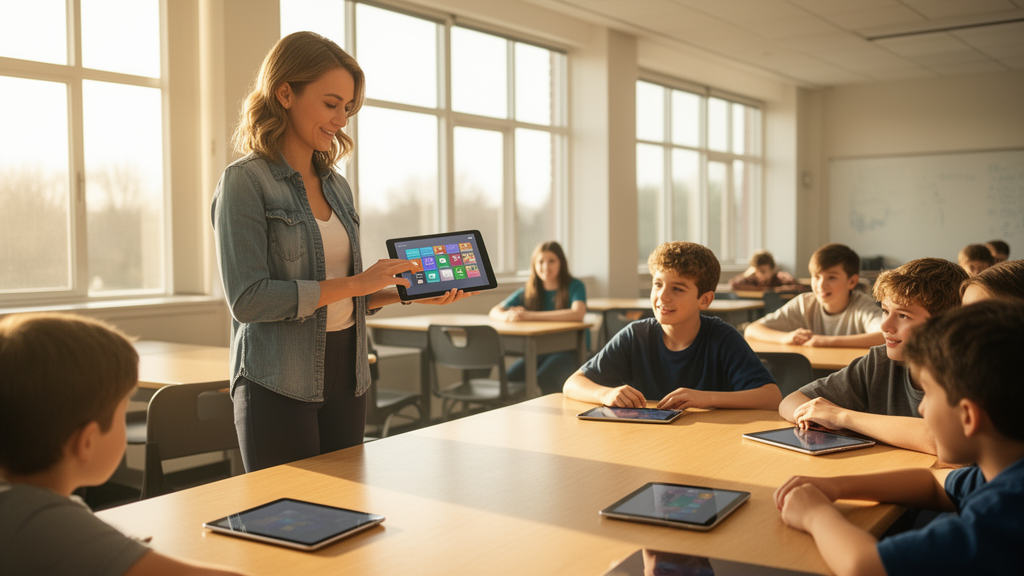
A study investigating how educators approach integrated digital learning initiatives has found that teachers’ perceived ability and self-confidence are the primary factors driving their behavioral intentions to carry out student device programs. Instead, perceived practical ability emerged as the most critical factor shaping whether instructors intend to execute programs combining Bring Your Own Device and Take-Home Student Device initiatives.
To evaluate these dynamics, the study applied the Cognitive–Affective–Behavior framework to examine how cognitive perceptions and affective responses jointly influence K-12 teachers’ behavioral intentions toward technology integration.
The investigation was conducted through an empirical survey of 176 K-12 teachers in Taiwan who assessed their readiness and views regarding BYOD and THSD programs. To thoroughly evaluate the survey responses, the authors utilized a dual-stage analytical strategy incorporating Partial Least Squares Structural Equation Modeling alongside Artificial Neural Network analysis. The researchers additionally conducted an Importance-Performance Map Analysis to contrast the practical influence of each psychological construct against its existing level of performance among surveyed educators.
The structural analysis established that understanding, ability, and self-confidence were all positively associated with teachers’ behavioral intention to implement the digital learning programs. Furthermore, the modeling confirmed that self-confidence served as a key mediating factor connecting the two cognitive dimensions—understanding and ability—with behavioral intention. In the complementary Importance-Performance Map Analysis, ability demonstrated the highest overall importance value, followed closely by self-confidence. Conversely, while teachers’ understanding exhibited the highest performance score among the examined factors, it demonstrated the lowest importance value for predicting implementation intentions.
The authors concluded that teacher readiness to implement BYOD and THSD initiatives depends not merely on an understanding of program guidelines, but fundamentally on teachers’ perceived ability and confidence to manage practical implementation demands. The study expands Cognitive–Affective–Behavior research within educational technology implementation and underscores critical considerations for institutional decision-makers.
Subject of Research: Predictors of K-12 teachers' behavioral intentions to implement BYOD and THSD programs
Article Title: Predicting teachers’ intentions to implement bring your own device and take-home student device programs: a cognitive-affective-behavior framework with sem-ann analysis
Article References: Liu, M.-C., Kao, T.-C., Bali, S., Yen, A.-C., & Chen, T.-C. (2026). Predicting teachers’ intentions to implement bring your own device and take-home student device programs: a cognitive-affective-behavior framework with sem-ann analysis. BMC Psychology. https://doi.org/10.1186/s40359-026-05905-4
Image Credits: AI Generated
DOI: 10.1186/s40359-026-05905-4
Keywords: Bring Your Own Device, Take-Home Student Device, BYOD, THSD, Cognitive-Affective-Behavior framework, behavioral intention, K-12 teachers, educational technology implementation, Partial Least Squares Structural Equation Modeling, PLS-SEM, Artificial Neural Network, ANN analysis, Importance-Performance Map Analysis, IPMA, self-confidence, perceived ability, teacher readiness, digital education policy, teacher preparation
Cite Scienmag News
Glenn Wilkins. (November 10, 2026). Perceived Ability Outweighs Understanding in Teachers’ Intentions to Implement Device Programs. Scienmag. https://scienmag.com/perceived-ability-outweighs-understanding-in-teachers-intentions-to-implement-device-programs/
Glenn Wilkins. "Perceived Ability Outweighs Understanding in Teachers’ Intentions to Implement Device Programs." Scienmag, 10 November 2026, https://scienmag.com/perceived-ability-outweighs-understanding-in-teachers-intentions-to-implement-device-programs/. Accessed 14 November 2026.
Glenn Wilkins. "Perceived Ability Outweighs Understanding in Teachers’ Intentions to Implement Device Programs." Scienmag. November 10, 2026. https://scienmag.com/perceived-ability-outweighs-understanding-in-teachers-intentions-to-implement-device-programs/




